

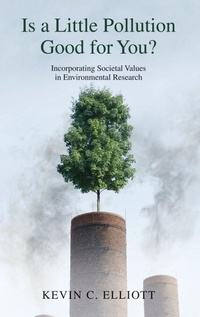
Is a Little Pollution Good for You?
Incorporating Societal Values in Environmental Research
1st Edition
Published on 10. March 2011
Book
Hardback
264 pages
978-0-19-975562-2 (ISBN)
Description
Could low-level exposure to polluting chemicals be analogous to exercise-a beneficial source of stress that strengthens the body? Some scientists studying the phenomenon of hormesis (beneficial or stimulatory effects caused by low-dose exposure to toxic substances) claim that that this may be the case. Is A Little Pollution Good For You? critically examines the current evidence for hormesis. In the process, it highlights the range of methodological and interpretive judgments involved in environmental research: choices about what questions to ask and how to study them, decisions about how to categorize and describe new information, judgments about how to interpret and evaluate ambiguous evidence, and questions about how to formulate public policy in response to debated scientific findings. The book also uncovers the ways that interest groups with deep pockets attempt to influence these scientific judgments for their benefit. Several chapters suggest ways to counter these influences and incorporate a broader array of societal values in environmental research: (1) moving beyond conflict-of-interest policies to develop new ways of safeguarding academic research from potential biases; (2) creating deliberative forums in which multiple stakeholders can discuss the judgments involved in policy-relevant research; and (3) developing ethical guidelines that can assist scientific experts in disseminating debated and controversial phenomena to the public. Kevin C. Elliott illustrates these strategies in the hormesis case, as well as in two additional case studies involving contemporary environmental research: endocrine disruption and multiple chemical sensitivity. This book should be of interest to a wide variety of readers, including scientists, philosophers, policy makers, environmental ethicists and activists, research ethicists, industry leaders, and concerned citizens.
"This is a timely, well-researched and compelling book .Elliott admirably combines insights and strategies from philosophy of science with those of applied ethics to carefully analyze contemporary science and science policy around pollutants and human health. There is a growing interest in the philosophy of science community in bringing the work of philosophers to bear on contemporary social issues. This book stands out as a model for how to do just that." - Sandra D. Mitchell, Philosophy, University of Pittsburgh
Is A Little Pollution Good For You? is a wonderfully clear and insightful book dealing with the interplay between social values and economic and political interests in scientific research. He articulates an account of how societal values should and should not enter into science and illustrates his views with an extended discussion of research on hormesis-the hypothesis that chemicals that are toxic at high doses may be benign or even beneficial at low doses. The chemical industry has a strong financial interest in promoting scientific acceptance of hormesis, as this could convince regulatory agencies to loosen up restrictions on allowable exposures to pesticides and other chemicals. Elliott argues that because scientists have an obligation to minimize the harmful effects of their research, they must be mindful of the social context of their work and how it may be interpreted and applied by private companies or interest groups, to the potential detriment of public and environmental health. Elliott's book is a must read for researchers, scholars, and students who are interested in the relationship between science, industry, and society." - David B. Resnik, National Institute of Environmental Health Sciences, National Institutes of Health, author of Playing Politics With Science: Balancing Scientific Independence And Government
"This is a timely, well-researched and compelling book .Elliott admirably combines insights and strategies from philosophy of science with those of applied ethics to carefully analyze contemporary science and science policy around pollutants and human health. There is a growing interest in the philosophy of science community in bringing the work of philosophers to bear on contemporary social issues. This book stands out as a model for how to do just that." - Sandra D. Mitchell, Philosophy, University of Pittsburgh
Is A Little Pollution Good For You? is a wonderfully clear and insightful book dealing with the interplay between social values and economic and political interests in scientific research. He articulates an account of how societal values should and should not enter into science and illustrates his views with an extended discussion of research on hormesis-the hypothesis that chemicals that are toxic at high doses may be benign or even beneficial at low doses. The chemical industry has a strong financial interest in promoting scientific acceptance of hormesis, as this could convince regulatory agencies to loosen up restrictions on allowable exposures to pesticides and other chemicals. Elliott argues that because scientists have an obligation to minimize the harmful effects of their research, they must be mindful of the social context of their work and how it may be interpreted and applied by private companies or interest groups, to the potential detriment of public and environmental health. Elliott's book is a must read for researchers, scholars, and students who are interested in the relationship between science, industry, and society." - David B. Resnik, National Institute of Environmental Health Sciences, National Institutes of Health, author of Playing Politics With Science: Balancing Scientific Independence And Government
Reviews / Votes
Kevin C. Elliot provides an excellent synopsis of the challenges facing research scientists today. * Environmental Ethics * One of the few (if only?) books that attempts to work across debates concerning values in science and social epistemology, to develop insights not just about science in policy but also policy for science. This kind of finely textured analysis of the specific social institutions around scientific practice is desperately needed. Elliott's book opens this terrain up for examination, debate, and hopefully, eventual improvement. * Heather Douglas, Philosophy of Science * Kevin Elliott has taken on a particularly controversial scientific view, namely hormesis, and utilized it to clearly identify various places non-epistemic social values can and should be incorporated into core scientific activities that bear on public policy issues. This comprehensive, thoughtful, and careful discussion should now be part of the dialogue about social values in science-policy discussions. * Notre Dame Philosophical Reviews * This is a timely, well-researched and compelling book. Elliott admirably combines insights and strategies from philosophy of science with those of applied ethics to carefully analyze contemporary science and science policy around pollutants and human health. There is a growing interest in the philosophy of science community in bringing the work of philosophers to bear on contemporary social issues. This book stands out as a model for how to do just that. * Sandra D. Mitchell, University of Pittsburgh * Is A Little Pollution Good For You? by Kevin Elliott, is a wonderfully clear and insightful book dealing with the interplay between social values and economic and political interests in scientific research. Elliott's book is a must read for researchers, scholars, and students who are interested in the relationship between science, industry, and society. * David B. Resnik, National Institute of Environmental Health Sciences, National Institutes of Health, author of Playing Politics with Science *More details
Series
Language
English
Place of publication
New York
United States
Target group
College/higher education
The primary audience is philosophers of science, and secondarily historians and sociologists of science. Some of the other crucial audiences are: (1) toxicologists; (2) research ethicists; (3) science policy makers; (4) environmental ethicists; and (5) environmental organizations and activists. General readers who are concerned about environmental issues, especially pollution, could very well be interested in the book.
Dimensions
Height: 240 mm
Width: 161 mm
Thickness: 19 mm
Weight
558 gr
ISBN-13
978-0-19-975562-2 (9780199755622)
Copyright in bibliographic data and cover images is held by Nielsen Book Services Limited or by the publishers or by their respective licensors: all rights reserved.
Schweitzer Classification
Other editions
Additional editions
Kevin C. Elliott
Is a Little Pollution Good for You?
Incorporating Societal Values in Environmental Research
E-Book
03/2011
1st Edition
OUP eBook
€19.99
Available for download
Kevin C. Elliott
Is a Little Pollution Good for You?
Incorporating Societal Values in Environmental Research
E-Book
01/2011
1st Edition
OUP eBook
€22.99
Available for download
Person
Kevin Elliott is Assistant Professor of Philosophy, University of South Carolina
Content
TABLE OF CONTENTS; OVERVIEW OF THE BOOK; CHAPTER SUMMARIES; CONCLUSION; SETTING THE STAGE; BRIEF HISTORY OF HORMESIS RESEARCH; CHOOSING AND DESIGNING STUDIES; DEVELOPING SCIENTIFIC LANGUAGE; EVALUATING AND INTERPRETING STUDIES; APPLYING RESEARCH; CONCLUSION; BACKGROUND ON VALUES IN SCIENCE; THE EASY CASES; VALUES IN THE DEVELOPMENT OF SCIENTIFIC LANGUAGE; VALUES IN THE EVALUATION AND INTERPRETATION OF STUDIES; CONCLUSION; SPECIAL-INTEREST SCIENCE; UNIVERSITY CONFLICT-OF-INTEREST POLICIES; ADDITIONAL RESPONSES; CONCLUSION; REVIEW; ONGOING QUESTIONS; CONCLUSION