

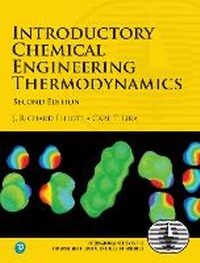
Introductory Chemical Engineering Thermodynamics
2nd Edition
Published on 8. June 2012
Book
Hardback
912 pages
978-0-13-606854-9 (ISBN)
Description
A Practical, Up-to-Date Introduction to Applied Thermodynamics, Including Coverage of Process Simulation Models and an Introduction to Biological Systems
Introductory Chemical Engineering Thermodynamics, Second Edition, helps readers master the fundamentals of applied thermodynamics as practiced today: with extensive development of molecular perspectives that enables adaptation to fields including biological systems, environmental applications, and nanotechnology. This text is distinctive in making molecular perspectives accessible at the introductory level and connecting properties with practical implications.
Features of the second edition include
Hierarchical instruction with increasing levels of detail: Content requiring deeper levels of theory is clearly delineated in separate sections and chapters
Early introduction to the overall perspective of composite systems like distillation columns, reactive processes, and biological systems
Learning objectives, problem-solving strategies for energy balances and phase equilibria, chapter summaries, and "important equations" for every chapter
Extensive practical examples, especially coverage of non-ideal mixtures, which include water contamination via hydrocarbons, polymer blending/recycling, oxygenated fuels, hydrogen bonding, osmotic pressure, electrolyte solutions, zwitterions and biological molecules, and other contemporary issues
Supporting software in formats for both MATLAB (R) and spreadsheets
Online supplemental sections and resources including instructor slides, ConcepTests, coursecast videos, and other useful resources
Introductory Chemical Engineering Thermodynamics, Second Edition, helps readers master the fundamentals of applied thermodynamics as practiced today: with extensive development of molecular perspectives that enables adaptation to fields including biological systems, environmental applications, and nanotechnology. This text is distinctive in making molecular perspectives accessible at the introductory level and connecting properties with practical implications.
Features of the second edition include
Hierarchical instruction with increasing levels of detail: Content requiring deeper levels of theory is clearly delineated in separate sections and chapters
Early introduction to the overall perspective of composite systems like distillation columns, reactive processes, and biological systems
Learning objectives, problem-solving strategies for energy balances and phase equilibria, chapter summaries, and "important equations" for every chapter
Extensive practical examples, especially coverage of non-ideal mixtures, which include water contamination via hydrocarbons, polymer blending/recycling, oxygenated fuels, hydrogen bonding, osmotic pressure, electrolyte solutions, zwitterions and biological molecules, and other contemporary issues
Supporting software in formats for both MATLAB (R) and spreadsheets
Online supplemental sections and resources including instructor slides, ConcepTests, coursecast videos, and other useful resources
More details
Other editions
Additional editions
J. Elliott | Carl Lira
Introductory Chemical Engineering Thermodynamics
E-Book
03/2012
2nd Edition
Pearson
from
€84.00
Available for download
J. Elliott | Carl Lira
Introductory Chemical Engineering Thermodynamics
E-Book
02/2012
2nd Edition
Pearson
€128.99
Available for download
Persons
J. Richard Elliott is Professor of Chemical Engineering at the University of Akron in Ohio. He has taught courses ranging from freshman tools to senior process design as well as thermodynamics at every level. He has worked with the NIST lab in Boulder and ChemStations in Houston. He holds a Ph.D. from Pennsylvania State University.
Carl T. Lira is Associate Professor in the Department of Chemical Engineering and Materials Science at Michigan State University. He teaches thermodynamics at all levels, chemical kinetics, and material and energy balances. He has been recognized with the Amoco Excellence in Teaching Award and multiple presentations of the MSU Withrow Teaching Excellence Award. He holds a Ph.D. from the University of Illinois.
Carl T. Lira is Associate Professor in the Department of Chemical Engineering and Materials Science at Michigan State University. He teaches thermodynamics at all levels, chemical kinetics, and material and energy balances. He has been recognized with the Amoco Excellence in Teaching Award and multiple presentations of the MSU Withrow Teaching Excellence Award. He holds a Ph.D. from the University of Illinois.
Content
Unit I: First and Second Laws
Chapter 1: Basic Concepts
Chapter 2: The Energy Balance
Chapter 3: Energy Balances for Composite Systems
Chapter 4: Entropy 1
Chapter 5: Thermodynamics Of Processes
Unit II: Generalized Analysis of Fluid Properties
Chapter 6: Classical Thermodynamics - Generalizations For Any Fluid
Chapter 7: Engineering Equations of State for PVT Properties
Chapter 8: Departure Functions
Chapter 9: Phase Equilibrium in a Pure Fluid
Unit III: Fluid Phase Equilibria in Mixtures
Chapter 10: Introduction to Multicomponent Systems
Chapter 11: An Introduction To Activity Models
Chapter 12: van der Waals Activity Models
Chapter 13: Local Composition Activity Models
Chapter 14: Liquid-Liquid and Solid-Liquid Phase Equilibria
Chapter 15: Phase Equilibria in Mixtures by an Equation of State
Chapter 16: Advanced Phase Diagrams
Unit IV: Reaction Equilibria
Chapter 17: Reaction Equilibria
Chapter 18: Electrolyte Solutions
Chapter 19: Molecular Association and Solvation
Appendix A: Summary of Computer Programs
Appendix B: Mathematics
Appendix C: Strategies for Solving VLE Problems
Appendix D: Models for Process Simulators
Appendix E: Themodynamic Properties
Index
Chapter 1: Basic Concepts
Chapter 2: The Energy Balance
Chapter 3: Energy Balances for Composite Systems
Chapter 4: Entropy 1
Chapter 5: Thermodynamics Of Processes
Unit II: Generalized Analysis of Fluid Properties
Chapter 6: Classical Thermodynamics - Generalizations For Any Fluid
Chapter 7: Engineering Equations of State for PVT Properties
Chapter 8: Departure Functions
Chapter 9: Phase Equilibrium in a Pure Fluid
Unit III: Fluid Phase Equilibria in Mixtures
Chapter 10: Introduction to Multicomponent Systems
Chapter 11: An Introduction To Activity Models
Chapter 12: van der Waals Activity Models
Chapter 13: Local Composition Activity Models
Chapter 14: Liquid-Liquid and Solid-Liquid Phase Equilibria
Chapter 15: Phase Equilibria in Mixtures by an Equation of State
Chapter 16: Advanced Phase Diagrams
Unit IV: Reaction Equilibria
Chapter 17: Reaction Equilibria
Chapter 18: Electrolyte Solutions
Chapter 19: Molecular Association and Solvation
Appendix A: Summary of Computer Programs
Appendix B: Mathematics
Appendix C: Strategies for Solving VLE Problems
Appendix D: Models for Process Simulators
Appendix E: Themodynamic Properties
Index