

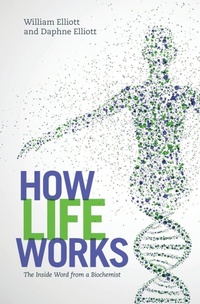
How Life Works
The Inside Word from a Biochemist
Published on 1. September 2015
Book
Paperback/Softback
176 pages
978-1-4863-0047-1 (ISBN)
Description
Complete with colour illustrations and written in a conversational style, biochemist William Elliott unravels the mystery of life while revealing its majesty. How do chemical reactions occur? How do genes hold information? Why do our bodies age? What happens when someone gets cancer? How Life Works provides the inside word for those who are curious about the workings of the microscopic world inside us.
Biochemistry not only explains what DNA is and how it forms the blueprint for who you are, it also explains how the food you eat is broken down, supplying the energy to run a marathon. It shows the intricate structures of proteins and describes their amazing functions. With millions of interactions and reactions all taking place in accord, biochemistry is the science of how life works.
More details
Language
English
Place of publication
Melbourne
Australia
Target group
College/higher education
Illustrations
Illustrations
Dimensions
Height: 203 mm
Width: 133 mm
Thickness: 10 mm
Weight
203 gr
ISBN-13
978-1-4863-0047-1 (9781486300471)
Copyright in bibliographic data and cover images is held by Nielsen Book Services Limited or by the publishers or by their respective licensors: all rights reserved.
Schweitzer Classification
Persons
William (Bill) Elliott was a Fellow of the Australian Academy of Sciences and Head of Biochemistry at The University of Adelaide for 23 years. In 1982 his department was awarded the Australian Government's first Centre of Excellence, for research devoted to gene technology. In 2001, he was awarded the Centenary Medal for service to Australian society and science in molecular biosciences. At The University of Adelaide, his legacy and achievements are celebrated annually by the W.H. Elliott lecture and a research fellowship in his name. Bill passed away in 2012, and the book was subsequently prepared for publication by his wife Daphne.