

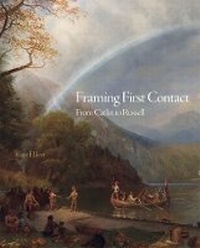
Framing First Contact
From Catlin to Russell
Published on 30. October 2020
Book
Hardback
174 pages
978-0-8061-6711-4 (ISBN)
Description
Representations of first contact - the first meetings of European explorers and Native Americans - have always had a central place in our nation's historical and visual record. They have also had a key role in shaping and interpreting that record. In Framing First Contact author Kate Elliott looks at paintings by artists from George Catlin to Charles M. Russell and explores what first contact images tell us about the process of constructing national myths - and how those myths acquired different meanings at different points in our nation's history.
First contact images, with their focus on beginnings rather than conclusive action or determined outcomes, might depict historical events in a variety of ways. Elliott argues that nineteenth century artists, responding to the ambiguity and indeterminacy of the subject, used the visualized space between cultures meeting for the first time to address critical contemporary questions and anxieties. Taking works from the 1840s through the 1910s as case studies - paintings by Robert W. Weir, Thomas Moran, and Albert Bierstadt, along with Catlin and Russell - Elliott shows how many first contact representations, especially those commissioned and conceived as official history, speak blatantly of conquest, racial superiority, and imperialism. And yet, others communicate more nuanced messages that might surprise contemporary viewers.
Elliott suggests it was the very openness of the subject of first contact that allowed artists, consciously or not, to speak of contemporary issues beyond imperialism and conquest. Uncovering those issues, Framing First Contact forces us to think about why we tell the stories we do, and why those stories matter.
First contact images, with their focus on beginnings rather than conclusive action or determined outcomes, might depict historical events in a variety of ways. Elliott argues that nineteenth century artists, responding to the ambiguity and indeterminacy of the subject, used the visualized space between cultures meeting for the first time to address critical contemporary questions and anxieties. Taking works from the 1840s through the 1910s as case studies - paintings by Robert W. Weir, Thomas Moran, and Albert Bierstadt, along with Catlin and Russell - Elliott shows how many first contact representations, especially those commissioned and conceived as official history, speak blatantly of conquest, racial superiority, and imperialism. And yet, others communicate more nuanced messages that might surprise contemporary viewers.
Elliott suggests it was the very openness of the subject of first contact that allowed artists, consciously or not, to speak of contemporary issues beyond imperialism and conquest. Uncovering those issues, Framing First Contact forces us to think about why we tell the stories we do, and why those stories matter.
More details
Series
Language
English
Place of publication
Oklahoma
United States
Target group
Professional and scholarly
Illustrations
36 colour illustrations
Dimensions
Height: 241 mm
Width: 197 mm
Thickness: 15 mm
Weight
630 gr
ISBN-13
978-0-8061-6711-4 (9780806167114)
Copyright in bibliographic data and cover images is held by Nielsen Book Services Limited or by the publishers or by their respective licensors: all rights reserved.
Schweitzer Classification
Person
Kate Elliott is Associate Professor of Art History at Luther College in Decorah, Iowa, and the recipient of a Wyeth Foundation Predoctoral Fellowship, sponsored by the Smithsonian American Art Museum, and a United States Capitol Historical Society Fellowship.