

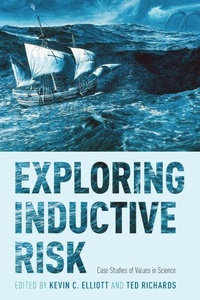
Exploring Inductive Risk
Case Studies of Values in Science
Published on 27. July 2017
Book
Paperback/Softback
310 pages
978-0-19-046772-2 (ISBN)
Description
Science is the most reliable means available for understanding the world around us and our place in it. But, since science draws conclusions based on limited empirical evidence, there is always a chance that a scientific inference will be incorrect. That chance, known as inductive risk, is endemic to science.
Though inductive risk has always been present in scientific practice, the role of values in responding to it has only recently gained extensive attention from philosophers, scientists, and policy-makers. Exploring Inductive Risk brings together a set of eleven concrete case studies with the goals of illustrating the pervasiveness of inductive risk, assisting scientists and policymakers in responding to it, and moving theoretical discussions of this phenomenon forward. The case studies range over a wide variety of scientific contexts, including the drug approval process, high energy particle physics, dual-use research, climate science, research on gender disparities in employment, clinical trials, and toxicology.
The book includes an introductory chapter that provides a conceptual introduction to the topic and a historical overview of the argument that values have an important role to play in responding to inductive risk, as well as a concluding chapter that synthesizes important themes from the book and maps out issues in need of further consideration.
Though inductive risk has always been present in scientific practice, the role of values in responding to it has only recently gained extensive attention from philosophers, scientists, and policy-makers. Exploring Inductive Risk brings together a set of eleven concrete case studies with the goals of illustrating the pervasiveness of inductive risk, assisting scientists and policymakers in responding to it, and moving theoretical discussions of this phenomenon forward. The case studies range over a wide variety of scientific contexts, including the drug approval process, high energy particle physics, dual-use research, climate science, research on gender disparities in employment, clinical trials, and toxicology.
The book includes an introductory chapter that provides a conceptual introduction to the topic and a historical overview of the argument that values have an important role to play in responding to inductive risk, as well as a concluding chapter that synthesizes important themes from the book and maps out issues in need of further consideration.
Reviews / Votes
provides an excellent snapshot of current thinking about inductive risk in philosophy of science. * Zina B. Ward, Journal of Moral Philosophy * this collection will provide a valuable point of departure for many future debates in the philosophy of cognitive science, and I would highly recommend it to anyone looking to get involved in these debates * Joe Dewhurst, University of Edinburgh, BJPS Review of books * During the last two decades, the various challenges of inductive risk have been addressed by a number of philosophers of science in diverse contexts. Thus, it is fortuitous that there is now a volume available providing an overview of the status of the discussion as well as addressing hitherto unanswered questions. It provides useful reading material to classroom teachers who address all sorts of topics on science and values. * Anna Leuschner and Anke Bueter, Science & Education * I think the individual chapters in this volume provide a set of interesting and important case studies of non-epistemic values in science. Scientists or philosophers looking for such case studies or for a general understanding of the roles that values can play in scientific practice can benefit from reading any of the chapters in this volume. Philosophers working specifically on inductive risk and the role of values in science, though, will benefit from considering the volume as a whole. What it implicitly shows, and what Biddle and Kukla explicitly argue, is that philosophers of science talking about inductive risk have not, to this point, had a clear idea of precisely what inductive risk is. This volume can, I think, help to start that conversation. * S. Andrew Schroeder, Metascience *More details
Language
English
Place of publication
New York
United States
Target group
Professional and scholarly
Dimensions
Height: 234 mm
Width: 156 mm
Thickness: 18 mm
Weight
530 gr
ISBN-13
978-0-19-046772-2 (9780190467722)
Copyright in bibliographic data and cover images is held by Nielsen Book Services Limited or by the publishers or by their respective licensors: all rights reserved.
Schweitzer Classification
Other editions
Additional editions
Book
07/2017
Oxford University Press Inc
€195.70
Shipment within 15-20 days
E-Book
06/2017
1st Edition
OUP eBook
€22.99
Available for download
E-Book
06/2017
1st Edition
OUP eBook
€30.49
Available for download
Persons
Kevin C. Elliott is an Associate Professor with joint appointments in Lyman Briggs College, the Department of Fisheries & Wildlife, and the Department of Philosophy at Michigan State University. His publications include Is a Little Pollution Good for You? Incorporating Societal Values in Environmental Research (Oxford University Press, 2011) and A Tapestry of Values: An Introduction to Values in Science (Oxford University Press, 2017).
Ted Richards is the editor of Soccer and Philosophy: Beautiful Thoughts on the Beautiful Game (Open Court, 2010). He teaches Philosophy at Michigan State University.
Ted Richards is the editor of Soccer and Philosophy: Beautiful Thoughts on the Beautiful Game (Open Court, 2010). He teaches Philosophy at Michigan State University.
Content
Foreword, Heather Douglas
Contributors
Introduction
Part I: Weighing Inductive Risk
Drug Regulation and the Inductive Risk Calculus Jacob Stegenga
Decisions, Decisions: Inductive Risk and the Higgs Boson Kent W. Staley
Part II: Evading Inductive Risk
Dual Use Research and Inductive Risk David B. Resnik
Making Uncertanties Explicit: The Jeffreyan Value-Free Ideal and Its Limits David M. Frank
Inductive Risk, Deferred Decisions, and Climate Science Advising Joyce C. Havstad and Matthew J. Brown
Part III: The Breadth of Inductive Risk
Measuring Inequality: The Roles of Values and Inductive Risk Robin Andreasen and Heather Doty
Safe or Sorry? Cancer Screening and Inductive Risk Anya Plutynski
Inductive Risk and Values in Composite Outcome Measures Roger Stanev
Inductive Risk and the Role of Values in Clinical Trials Robyn Bluhm
Part IV: Exploring the Limits of Inductive Risk
The Geography of Epistemic Risk Justin B. Biddle and Rebecca Kukla
The Inductive Risk of "Demasculinization" Jack Powers
Exploring Inductive Risk: Future Questions
Index
Contributors
Introduction
Part I: Weighing Inductive Risk
Drug Regulation and the Inductive Risk Calculus Jacob Stegenga
Decisions, Decisions: Inductive Risk and the Higgs Boson Kent W. Staley
Part II: Evading Inductive Risk
Dual Use Research and Inductive Risk David B. Resnik
Making Uncertanties Explicit: The Jeffreyan Value-Free Ideal and Its Limits David M. Frank
Inductive Risk, Deferred Decisions, and Climate Science Advising Joyce C. Havstad and Matthew J. Brown
Part III: The Breadth of Inductive Risk
Measuring Inequality: The Roles of Values and Inductive Risk Robin Andreasen and Heather Doty
Safe or Sorry? Cancer Screening and Inductive Risk Anya Plutynski
Inductive Risk and Values in Composite Outcome Measures Roger Stanev
Inductive Risk and the Role of Values in Clinical Trials Robyn Bluhm
Part IV: Exploring the Limits of Inductive Risk
The Geography of Epistemic Risk Justin B. Biddle and Rebecca Kukla
The Inductive Risk of "Demasculinization" Jack Powers
Exploring Inductive Risk: Future Questions
Index