

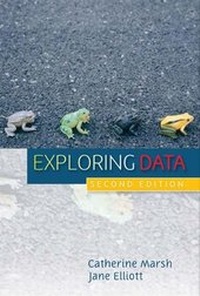
Exploring Data
An Introduction to Data Analysis for Social Scientists
2nd Edition
Will be published approx. on 14. November 2008
Book
Hardback
305 pages
978-0-7456-2282-8 (ISBN)
Description
The updated edition of this classic text introduces a range of techniques for exploring quantitative data. Beginning with an emphasis on descriptive statistics and graphical approaches, it moves on in later chapters to simple strategies for examining the associations between variables using inferential statistics such as chi squared. The book has been substantially revised to include the most recent approaches to data analysis, and includes step-by-step instructions on using SPSS. All these techniques are illustrated with intriguing real examples, drawn from important social research over the past three decades, designed to illuminate significant sociological and political debates.
The book shows how students can use quantitative data to answer various questions:
* Is it true that the rich are getting richer and the poor are getting poorer?
* Are crime rates really going down, and how can we tell?
* How much alcohol do men and women really drink in an average week?
* Which country in Europe has the highest average working hours?
Readers are encouraged to explore data for themselves, and are carefully guided through the opportunities and pitfalls of using statistical packages, as well as the numerous data sources readily available online.
Suitable for those with no previous experience of quantitative data analysis, the second edition of Exploring Data will be invaluable to students across the social sciences.
Reviews / Votes
"In 1988 Cathie Marsh's first edition of Exploring Data broke new ground and became an immediate success among non-statisticians. Jane Elliott does her memory proud, lifting the book into the 21st century whilst retaining all the immediacy of its appeal."Peter Elias, University of Warwick "This book will be widely used in the social sciences - by those who want to inject some 'real data' into their teaching and by those who want to use relevant examples to teach exploratory data analysis. The writing is interesting, clear and informative, and accessible to everyone, irrespective of whether they are good with numbers. Above all, this book is a good read."
Angela Dale, University of Manchester
"Cathie Marsh's original book, published 20 years ago, had a remarkable impact on students and researchers alike, liberating them to explore data - focussing on their meaning, not just the statistical significance. Jane Elliott has done an invaluable job in updating this book, taking account of developments in software and statistics."
Brendan Burchell, University of Cambridge
More details
Product info
gebunden
Edition
2. Auflage
Language
English
Place of publication
Oxford
United Kingdom
Publishing group
John Wiley and Sons Ltd
Target group
College/higher education
Professional and scholarly
Edition type
New edition
Product notice
sewn/stitched
Cloth over boards
Dimensions
Height: 250 mm
Width: 150 mm
Thickness: 15 mm
Weight
794 gr
ISBN-13
978-0-7456-2282-8 (9780745622828)
Schweitzer Classification
Other editions
Additional editions
E-Book
09/2025
2nd Edition
Polity Press
€18.99
Available for download
Book
11/2008
2nd Edition
Polity Press
€30.50
Article not available at the moment
Previous edition

Book
09/1988
Polity Press
€75.71
Article exhausted; check for reprint
Persons
Jane Elliott is Research Director, Centre for Longitudinal Studies at the Institute of Education.
Content
Detailed Table of Contents.
List of Figures.
Acknowledgements.
Introduction.
Part I: Single Variables.
1. Distribution Variables.
2. Numerical Summaries of Level and Spread.
3. Scaling and Standardising.
4. Inequality.
5. Smoothing Time Series.
Part II: Relationships between Two Variables.
6. Percentage Tables.
7. Analysing Contingency Tables.
8. Handling Several Batches.
9. Scatterplots and Resistant Lines.
10. Transformations.
Part III: Introducing a Third Variable.
11. Causal Explanations.
12. Three-Variable Contingency Tables and Beyond.
13. Longitudinal Data.
Footnotes.
References