

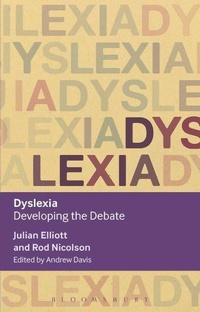
Dyslexia
Developing the Debate
Published on 19. May 2016
Book
Paperback/Softback
224 pages
978-1-4742-3375-0 (ISBN)
Description
Dyslexia is often presented as a clearly delineated condition that can be diagnosed on the basis of appropriate cognitive tests with corresponding forms on intervention. However, this approachable text explores the issues behind this assertion in bringing together leading figures in the field to debate dyslexia.
Julian Elliott shows that understandings and usage of the dyslexia label vary substantially with little consensus or agreement and in putting forward his critique draws upon research in several disciplinary fields to demonstrate the irrationality of these arguments. Roderick I. Nicolson demonstrates that current approaches to understanding, identification and support of dyslexia are catastrophically flawed in terms of their failure to consider the developmental nature of dyslexia. He develops two themes: first that the underlying cause of dyslexia is 'delayed neural commitment' for skills and neural circuits, and second that the cause of the reading disability is the introduction of formal instruction before the dyslexic child's neural circuits for executive function are sufficiently developed. He argues that a more effective and cost-effective approach to identification and support involves 'assessment for dyslexia' rather than 'of dyslexia'. Elliott and Nicolson respond to the points each other raise before Andrew Davis investigates how far the key claims of Elliott and Nicolson can withstand close conceptual investigation, and explores the inherent limitations of scientific research on this topic, given the value and conceptual issues concerned.
Julian Elliott shows that understandings and usage of the dyslexia label vary substantially with little consensus or agreement and in putting forward his critique draws upon research in several disciplinary fields to demonstrate the irrationality of these arguments. Roderick I. Nicolson demonstrates that current approaches to understanding, identification and support of dyslexia are catastrophically flawed in terms of their failure to consider the developmental nature of dyslexia. He develops two themes: first that the underlying cause of dyslexia is 'delayed neural commitment' for skills and neural circuits, and second that the cause of the reading disability is the introduction of formal instruction before the dyslexic child's neural circuits for executive function are sufficiently developed. He argues that a more effective and cost-effective approach to identification and support involves 'assessment for dyslexia' rather than 'of dyslexia'. Elliott and Nicolson respond to the points each other raise before Andrew Davis investigates how far the key claims of Elliott and Nicolson can withstand close conceptual investigation, and explores the inherent limitations of scientific research on this topic, given the value and conceptual issues concerned.
Reviews / Votes
The authors and editor of this book have impressive track records in terms of their research into aspects of dyslexia and they sit at the heart of the contentious issues that surround it as a recognizable learning difference ... An interesting read for those working in this field. * SEN Magazine * Ask almost any teacher and they will say that, without doubt, 'dyslexia' is one of the most contentious terms in contemporary education. Dyslexia attracts combatants who often polarize their position, sometimes to the detriment of children themselves. Elliott and Nicolson bring authoritative good sense to a contentious debate. Theirs are arguments that allow judgment and intellect to flourish, whilst diminishing the case of 'dyslexia partisans'. * Philip Garner, Professor of Education, University of Northampton, UK *More details
Series
Language
English
Place of publication
London
United Kingdom
Publishing group
Bloomsbury Publishing PLC
Target group
Professional and scholarly
Product notice
Paperback (trade)
Illustrations
6 bw illus
Dimensions
Height: 216 mm
Width: 140 mm
Thickness: 12 mm
Weight
259 gr
ISBN-13
978-1-4742-3375-0 (9781474233750)
Copyright in bibliographic data and cover images is held by Nielsen Book Services Limited or by the publishers or by their respective licensors: all rights reserved.
Schweitzer Classification
Other editions
Additional editions
E-Book
05/2016
1st Edition
Bloomsbury Academic
€31.99
Available for download
E-Book
05/2016
1st Edition
Bloomsbury Academic
€31.99
Available for download
Persons
Julian Elliott is Principal at Collingwood College and Professor of Education, Durham University, UK. He is a Fellow of the Academy of Social Sciences and a member of the Research Excellence Framework 2014 Education Panel.
Rod Nicolson is Professor of Psychology at the University of Sheffield, UK. He is also an Executive Editor of Dyslexia. He has published over 100 academic articles, books and psychological tests, including the recent book Positive Dyslexia.
Andrew Davis is Research Fellow within the School of Education at Durham University, UK. His recent publication To Read or Not to Read: Decoding Synthetic Phonics attracted widespread media attention and controversy.
Rod Nicolson is Professor of Psychology at the University of Sheffield, UK. He is also an Executive Editor of Dyslexia. He has published over 100 academic articles, books and psychological tests, including the recent book Positive Dyslexia.
Andrew Davis is Research Fellow within the School of Education at Durham University, UK. His recent publication To Read or Not to Read: Decoding Synthetic Phonics attracted widespread media attention and controversy.
Content
Series Editor's Preface - Key Debates in Educational Policy, Christopher Winch
Notes on Contributors
Introduction, Andrew Davis
Part One Developmental Dyslexia: The Bigger Picture, Rod Nicolson
Part Two Dyslexia: Beyond the Debate, Julian Elliott
Part Three Response to Julian Elliott, Rod Nicolson
Part Four Response to Rod Nicolson, Julian Elliott
Afterword: Some Philosophical Reflections, Andrew Davis
References
Index
Notes on Contributors
Introduction, Andrew Davis
Part One Developmental Dyslexia: The Bigger Picture, Rod Nicolson
Part Two Dyslexia: Beyond the Debate, Julian Elliott
Part Three Response to Julian Elliott, Rod Nicolson
Part Four Response to Rod Nicolson, Julian Elliott
Afterword: Some Philosophical Reflections, Andrew Davis
References
Index