

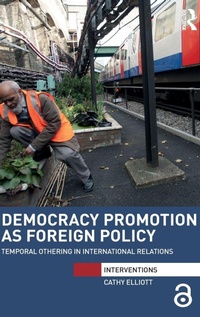
Democracy Promotion as Foreign Policy
Temporal Othering in International Relations
1st Edition
Published on 15. November 2016
Book
Hardback
214 pages
978-1-138-66972-7 (ISBN)
Description
This book looks at democracy promotion as a form of foreign policy. Elliott asks why democracy was seen to be the answer to the 7/7 bombings in London, and why it should be promoted not in Britain, but in Pakistan. The book provides a detailed answer to these questions, examining the logic and the modes of thinking that made such a response possible through analysis of the stories we tell about ourselves: stories about time, history, development, civilisation and the ineluctable spread of democracy.
Elliott argues that these narratives have become a key tool in enabling practices that differentiate selves from others, friends from enemies, the domestic from the foreign, civilisation from the barbarian. They operate with a particular conception of time and constitute a British, democratic, national identity by positing an "other" that is barbaric, alien, despotic, violent and backward. Such understandings are useful in wake of disaster, because they leave us with something to do: danger can be managed by bringing certain people and places up-to-date. However, this book shows that there are other stories to be told, and that it is possible to read stories about history against the grain and author alternative, less oppressive, versions.
Providing a genealogy drawing on material from colonial and postcolonial Britain and Pakistan, including legislation, political discourse, popular culture and government projects, this book will be of interest to scholars and students focusing on democracy promotion; genealogy; critical border studies; poststructural IR; postcolonial politics; discourse analysis; identity/subjectivity; and "the war on terror".
Elliott argues that these narratives have become a key tool in enabling practices that differentiate selves from others, friends from enemies, the domestic from the foreign, civilisation from the barbarian. They operate with a particular conception of time and constitute a British, democratic, national identity by positing an "other" that is barbaric, alien, despotic, violent and backward. Such understandings are useful in wake of disaster, because they leave us with something to do: danger can be managed by bringing certain people and places up-to-date. However, this book shows that there are other stories to be told, and that it is possible to read stories about history against the grain and author alternative, less oppressive, versions.
Providing a genealogy drawing on material from colonial and postcolonial Britain and Pakistan, including legislation, political discourse, popular culture and government projects, this book will be of interest to scholars and students focusing on democracy promotion; genealogy; critical border studies; poststructural IR; postcolonial politics; discourse analysis; identity/subjectivity; and "the war on terror".
More details
Series
Language
English
Place of publication
London
United Kingdom
Publishing group
Taylor & Francis Ltd
Target group
College/higher education
Illustrations
1 s/w Photographie bzw. Rasterbild
1 Halftones, black and white
Dimensions
Height: 240 mm
Width: 161 mm
Thickness: 16 mm
Weight
493 gr
ISBN-13
978-1-138-66972-7 (9781138669727)
Schweitzer Classification
Other editions
Additional editions
Book
06/2021
1st Edition
Routledge
€65.10
Shipment within 10-20 days
E-Book
11/2017
Routledge
€0.00
Available for download
E-Book
11/2017
Routledge
€0.00
Available for download
Person
Cathy Elliott is a Senior Teaching Fellow at the School of Public Policy, University College London. She previously worked as a development manager in Pakistan. Her research interests include poststructural international relations; time, temporality and history; politics and aesthetics and feminism and gender.
Content
Preface
Introduction
1 What is Democracy Promotion?
2 Democratic Representation
3 Disordering Histories
4 Authoring the Codes Elsewhere: Colonial Governmentality
and Teleological Time
5 Blood in the Codes: Liberal Governmentality, Democracy and Pakistan
6 Twelve Months that Shook the World: 1989 and the Salman Rushdie Affair
7 The Art of Integration: Representing British Muslims
Conclusion: Democracy promotion, Time and the "Radical Ordinary"
Introduction
1 What is Democracy Promotion?
2 Democratic Representation
3 Disordering Histories
4 Authoring the Codes Elsewhere: Colonial Governmentality
and Teleological Time
5 Blood in the Codes: Liberal Governmentality, Democracy and Pakistan
6 Twelve Months that Shook the World: 1989 and the Salman Rushdie Affair
7 The Art of Integration: Representing British Muslims
Conclusion: Democracy promotion, Time and the "Radical Ordinary"