

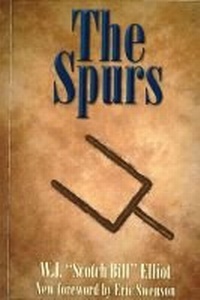
The Spurs
Published on 30. October 2009
Book
Hardback
294 pages
978-1-933337-40-1 (ISBN)
Description
Save for a very few, the true West Texas cowboy has ridden his last round - up. Gone are the dusty trail drive, the remote line camps, the fence riders, the open pasture brandings, and the chuck wagons. But stories of those bygone days remain, albeit far too few. Fortunately, a handful of those cowboys were also of the literary type. "Scotch Bill' Elliot was one of those. He had the foresight to record those stories for posterity. Without Elliot and those like him, much of the history of the settling of West Texas would have been lost.
Elliot's subjects were varied-from the killing of the last buffalo to the end of the open range, from searing droughts to winter blizzards, from lush pastures to barren prairies, from good cow horses and good companions to bad deeds done by bad men. Perhaps the greatest contribution of Elliot's book is the numerous insightful profiles of cowboys and cattlemen. The American cowboy is always remembered as an unrivaled folk hero who possessed all of the qualities that people most admire. Elliot holds the cowboy and his lifestyle in the highest esteem, but he strips away the myth and writes forthrightly about that way of life.
This is not a scholarly treatise, being thoroughly researched and meticulously documented. This is an eyewitness account by a man who lived the history and simply recorded the events as they unfolded during his lifetime. If you want a recitation of cold facts frequently punctuated by dates, this is not your book. This volume is earthy, sometimes even crude, but it tells of life the way it really was on the West Texas range. For all who want to know about the life of the cowboy and the cattlemen, the day-to-day drudgery of ranch work, ranch cooking, cowboy customs, relations with "nesters,' cowboy pranksters and recreation, and the satisfaction and exhilaration of sittin' on good horse flesh driving a herd of well - bred cattle to lush pastures-this is your book.-Eric Swenson
Save for a very few, the true West Texas cowboy has ridden his last round-up. Gone are the dusty trail drive, the remote line camps, the fence riders, the open pasture brandings, and the chuck wagons. But stories of those bygone days remain, albeit far too few. Fortunately, a handful of those cowboys were also of the literary type. "Scotch Bill' Elliot was one of those. He had the foresight to record those stories for posterity. Without Elliot and those like him, much of the history of the settling of West Texas would have been lost.
Elliot's subjects were varied-from the killing of the last buffalo to the end of the open range, from searing droughts to winter blizzards, from lush pastures to barren prairies, from good cow horses and good companions to bad deeds done by bad men. Perhaps the greatest contribution of Elliot's book is the numerous insightful profiles of cowboys and cattlemen. The American cowboy is always remembered as an unrivaled folk hero who possessed all of the qualities that people most admire. Elliot holds the cowboy and his lifestyle in the highest esteem, but he strips away the myth and writes forthrightly about that way of life.
This is not a scholarly treatise, being thoroughly researched and meticulously documented. This is an eyewitness account by a man who lived the history and simply recorded the events as they unfolded during his lifetime. If you want a recitation of cold facts frequently punctuated by dates, this is not your book. This volume is earthy, sometimes even crude, but it tells of life the way it really was on the West Texas range. For all who want to know about the life of the cowboy and the cattlemen, the day-to-day drudgery of ranch work, ranch cooking, cowboy customs, relations with "nesters,' cowboy pranksters and recreation, and the satisfaction and exhilaration of sittin' on good horse flesh driving a herd of well-bred cattle to lush pastures-this is your book.--Eric Swenson
Elliot's subjects were varied-from the killing of the last buffalo to the end of the open range, from searing droughts to winter blizzards, from lush pastures to barren prairies, from good cow horses and good companions to bad deeds done by bad men. Perhaps the greatest contribution of Elliot's book is the numerous insightful profiles of cowboys and cattlemen. The American cowboy is always remembered as an unrivaled folk hero who possessed all of the qualities that people most admire. Elliot holds the cowboy and his lifestyle in the highest esteem, but he strips away the myth and writes forthrightly about that way of life.
This is not a scholarly treatise, being thoroughly researched and meticulously documented. This is an eyewitness account by a man who lived the history and simply recorded the events as they unfolded during his lifetime. If you want a recitation of cold facts frequently punctuated by dates, this is not your book. This volume is earthy, sometimes even crude, but it tells of life the way it really was on the West Texas range. For all who want to know about the life of the cowboy and the cattlemen, the day-to-day drudgery of ranch work, ranch cooking, cowboy customs, relations with "nesters,' cowboy pranksters and recreation, and the satisfaction and exhilaration of sittin' on good horse flesh driving a herd of well - bred cattle to lush pastures-this is your book.-Eric Swenson
Save for a very few, the true West Texas cowboy has ridden his last round-up. Gone are the dusty trail drive, the remote line camps, the fence riders, the open pasture brandings, and the chuck wagons. But stories of those bygone days remain, albeit far too few. Fortunately, a handful of those cowboys were also of the literary type. "Scotch Bill' Elliot was one of those. He had the foresight to record those stories for posterity. Without Elliot and those like him, much of the history of the settling of West Texas would have been lost.
Elliot's subjects were varied-from the killing of the last buffalo to the end of the open range, from searing droughts to winter blizzards, from lush pastures to barren prairies, from good cow horses and good companions to bad deeds done by bad men. Perhaps the greatest contribution of Elliot's book is the numerous insightful profiles of cowboys and cattlemen. The American cowboy is always remembered as an unrivaled folk hero who possessed all of the qualities that people most admire. Elliot holds the cowboy and his lifestyle in the highest esteem, but he strips away the myth and writes forthrightly about that way of life.
This is not a scholarly treatise, being thoroughly researched and meticulously documented. This is an eyewitness account by a man who lived the history and simply recorded the events as they unfolded during his lifetime. If you want a recitation of cold facts frequently punctuated by dates, this is not your book. This volume is earthy, sometimes even crude, but it tells of life the way it really was on the West Texas range. For all who want to know about the life of the cowboy and the cattlemen, the day-to-day drudgery of ranch work, ranch cooking, cowboy customs, relations with "nesters,' cowboy pranksters and recreation, and the satisfaction and exhilaration of sittin' on good horse flesh driving a herd of well-bred cattle to lush pastures-this is your book.--Eric Swenson
More details
Language
English
Place of publication
Abilene
United States
Target group
Children/juvenile
US School Grade: Kindergarten, Interest Age: From 10 years
Illustrations
4 B&W Photos; 18 Drawings; 3 Documents; 1 Map
Dimensions
Height: 216 mm
Width: 140 mm
Thickness: 21 mm
Weight
522 gr
ISBN-13
978-1-933337-40-1 (9781933337401)
Copyright in bibliographic data and cover images is held by Nielsen Book Services Limited or by the publishers or by their respective licensors: all rights reserved.
Schweitzer Classification
Persons
W. J. Elliot was a native of Scotland who arrived at the headquarters of the Espuela Land and Cattle Company on April 28, 1888, to become the ranch bookkeeper. He later participated in the surveying of the town of Espuela in 1891 and managed the general store and was postmaster until the store and post office were closed in 1910. He was also a serious student of the history and geology of the Espuela area, and a number of exhibits from his geological collection will be in the permanent collection of the Spur-Dickens County Museum.