

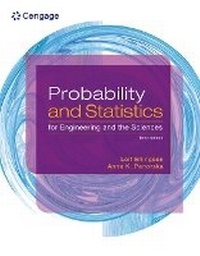
Probability and Statistics for Engineering and the Sciences
10th Edition
Published on 1. January 2026
Book
Paperback/Softback
736 pages
979-8-214-02382-3 (ISBN)
Description
Put statistical theories into practice with "Probability and Statistics for Engineering and the Sciences," 10th Edition. This calculus-based approach offers a comprehensive introduction to probability models and statistical methods common in engineering and scientific disciplines. The authors place a strong emphasis on fundamental concepts, models and methodologies, while also providing the underlying rationale for each topic. With updated content, authentic problem scenarios in examples and exercises incorporate real-world data to demonstrate practical relevance.
More details
Edition
10th edition
Language
English
Place of publication
CA
United States
Publishing group
Cengage Learning, Inc
Target group
College/higher education
Dimensions
Height: 27 mm
Width: 213 mm
Thickness: 269 mm
Weight
1520 gr
ISBN-13
979-8-214-02382-3 (9798214023823)
Copyright in bibliographic data and cover images is held by Nielsen Book Services Limited or by the publishers or by their respective licensors: all rights reserved.
Schweitzer Classification
Persons
Leif Ellingson is a professor of statistics in the Department of Mathematics and Statistics at Texas Tech University. He earned his undergraduate degree in mathematics from the University of Maryland and his master's degree and PhD in statistics from Florida State University. In addition to teaching mathematical statistics for engineers and scientists, Leif also frequently teaches introductory statistics and various graduate statistics courses. He has received multiple teaching awards from Texas Tech for his work teaching undergraduate and graduate statistics courses along with mentoring and advising graduate and undergraduate students on their research. In his spare time, Leif enjoys watching movies, reading, practicing tang soo do and above all else, spending time with his wife, Wenjing, and their son. Anna Panorska is a professor of statistics in the Department of Mathematics and Statistics of the University of Nevada Reno. She studied applied mathematics at the University of Warsaw, Poland, and earned her MS in Statistics at the University of Texas at El Paso and PhD in Mathematics (Statistics and Applied Probability track) from the University of California at Santa Barbara. She has been developing and teaching undergraduate and graduate courses in statistics and data science for many years. She received multiple awards for her research work with undergraduate and graduate students. She has been advising and collaborating with undergraduate and graduate students in engineering and science on applying statistical methods in their disciplines. She enjoys collaborative, multidisciplinary research and developed statistical methodology used in ecology, extreme climate and weather events, medicine and finance. In her spare time Anna enjoys hiking, skiing, gardening, reading, spending time with her family and playing with her dog.
Content
1. OVERVIEW AND DESCRIPTIVE STATISTICS.
Populations, Samples, and Processes. Pictorial and Tabular Methods in Descriptive Statistics. Measures of Location. Measures of Variability.
2. PROBABILITY.
Sample Spaces and Events. Axioms, Interpretations, and Properties of Probability.
Counting Techniques. Conditional Probability. Independence.
3. DISCRETE RANDOM VARIABLES AND PROBABILITY DISTRIBUTIONS.
Random Variables. Probability Distributions for Discrete Random Variables.
Expected Values. The Binomial Probability Distribution. Hypergeometric and Negative Binomial Distributions. The Poisson Probability Distribution.
4. CONTINUOUS RANDOM VARIABLES AND PROBABILITY DISTRIBUTIONS.
Probability Density Functions. Cumulative Distribution Functions and Expected Values. The Normal Distribution. The Exponential and Gamma Distributions. Other Continuous Distributions. Probability Plots.
5. JOINT PROBABILITY DISTRIBUTIONS AND RANDOM SAMPLES.
Jointly Distributed Random Variables. Expected Values, Covariance, and Correlation.
Statistics and Their Distributions. The Distribution of the Sample Mean. The Distribution of a Linear Combination.
6. POINT ESTIMATION.
Some General Concepts of Point Estimation. Methods of Point Estimation.
7. STATISTICAL INTERVALS BASED ON A SINGLE SAMPLE.
Basic Properties of Confidence Intervals. Large-Sample Confidence Intervals for a Population Mean and Proportion. Intervals Based on a Normal Population Distribution.
Confidence Intervals for the Variance and Standard Deviation of a Normal Population.
8. TESTS OF HYPOTHESIS BASED ON A SINGLE SAMPLE.
Hypotheses and Test Procedures. z Tests for Hypotheses About a Population Mean.
The One-Sample t Test. Tests Concerning a Population Proportion. Further Aspects of Hypothesis Testing.
9. INFERENCES BASED ON TWO SAMPLES.
z Tests and Confidence Intervals for a Difference between Two Population Means.
The Two-Sample t Test and Confidence Interval. Analysis of Paired Data. Inferences Concerning a Difference between Population Proportions. Inferences Concerning Two Population Variances.
10. THE ANALYSIS OF VARIANCE.
Single-Factor ANOVA. Multiple Comparisons in ANOVA. More on Single-Factor ANOVA.
11. MULTIFACTOR ANALYSIS OF VARIANCE.
Two-Factor ANOVA with Kij = 1. Two-Factor ANOVA with Kij > 1. Three-Factor ANOVA. 2p Factorial Experiments.
12. SIMPLE LINEAR REGRESSION AND CORRELATION.
The Simple Linear Regression Model. Estimating Model Parameters. Inferences About the Slope Parameter ss1. Inferences Concerning ?Y*x* and the Prediction of Future Y Values. Correlation.
13. NONLINEAR AND MULTIPLE REGRESSION.
Assessing Model Adequacy. Regression with Transformed Variables. Polynomial Regression. Multiple Regression Analysis. Other Issues in Multiple Regression.
14. GOODNESS-OF-FIT TESTS AND CATEGORICAL DATA ANALYSIS.
Goodness-of-Fit Tests When Category Probabilities Are Completely Specified. Goodness-of-Fit Tests for Composite Hypotheses. Two-Way Contingency Tables.
15. DISTRIBUTION-FREE PROCEDURES.
The Wilcoxon Signed-Rank Test. The Wilcoxon Rank-Sum Test. Distribution-Free Confidence Intervals. Distribution-Free ANOVA.
16. QUALITY CONTROL METHODS.
General Comments on Control Charts. Control Charts for Process Location. Control Charts for Process Variation. Control Charts for Attributes. CUSUM Procedures.
Acceptance Sampling.
Populations, Samples, and Processes. Pictorial and Tabular Methods in Descriptive Statistics. Measures of Location. Measures of Variability.
2. PROBABILITY.
Sample Spaces and Events. Axioms, Interpretations, and Properties of Probability.
Counting Techniques. Conditional Probability. Independence.
3. DISCRETE RANDOM VARIABLES AND PROBABILITY DISTRIBUTIONS.
Random Variables. Probability Distributions for Discrete Random Variables.
Expected Values. The Binomial Probability Distribution. Hypergeometric and Negative Binomial Distributions. The Poisson Probability Distribution.
4. CONTINUOUS RANDOM VARIABLES AND PROBABILITY DISTRIBUTIONS.
Probability Density Functions. Cumulative Distribution Functions and Expected Values. The Normal Distribution. The Exponential and Gamma Distributions. Other Continuous Distributions. Probability Plots.
5. JOINT PROBABILITY DISTRIBUTIONS AND RANDOM SAMPLES.
Jointly Distributed Random Variables. Expected Values, Covariance, and Correlation.
Statistics and Their Distributions. The Distribution of the Sample Mean. The Distribution of a Linear Combination.
6. POINT ESTIMATION.
Some General Concepts of Point Estimation. Methods of Point Estimation.
7. STATISTICAL INTERVALS BASED ON A SINGLE SAMPLE.
Basic Properties of Confidence Intervals. Large-Sample Confidence Intervals for a Population Mean and Proportion. Intervals Based on a Normal Population Distribution.
Confidence Intervals for the Variance and Standard Deviation of a Normal Population.
8. TESTS OF HYPOTHESIS BASED ON A SINGLE SAMPLE.
Hypotheses and Test Procedures. z Tests for Hypotheses About a Population Mean.
The One-Sample t Test. Tests Concerning a Population Proportion. Further Aspects of Hypothesis Testing.
9. INFERENCES BASED ON TWO SAMPLES.
z Tests and Confidence Intervals for a Difference between Two Population Means.
The Two-Sample t Test and Confidence Interval. Analysis of Paired Data. Inferences Concerning a Difference between Population Proportions. Inferences Concerning Two Population Variances.
10. THE ANALYSIS OF VARIANCE.
Single-Factor ANOVA. Multiple Comparisons in ANOVA. More on Single-Factor ANOVA.
11. MULTIFACTOR ANALYSIS OF VARIANCE.
Two-Factor ANOVA with Kij = 1. Two-Factor ANOVA with Kij > 1. Three-Factor ANOVA. 2p Factorial Experiments.
12. SIMPLE LINEAR REGRESSION AND CORRELATION.
The Simple Linear Regression Model. Estimating Model Parameters. Inferences About the Slope Parameter ss1. Inferences Concerning ?Y*x* and the Prediction of Future Y Values. Correlation.
13. NONLINEAR AND MULTIPLE REGRESSION.
Assessing Model Adequacy. Regression with Transformed Variables. Polynomial Regression. Multiple Regression Analysis. Other Issues in Multiple Regression.
14. GOODNESS-OF-FIT TESTS AND CATEGORICAL DATA ANALYSIS.
Goodness-of-Fit Tests When Category Probabilities Are Completely Specified. Goodness-of-Fit Tests for Composite Hypotheses. Two-Way Contingency Tables.
15. DISTRIBUTION-FREE PROCEDURES.
The Wilcoxon Signed-Rank Test. The Wilcoxon Rank-Sum Test. Distribution-Free Confidence Intervals. Distribution-Free ANOVA.
16. QUALITY CONTROL METHODS.
General Comments on Control Charts. Control Charts for Process Location. Control Charts for Process Variation. Control Charts for Attributes. CUSUM Procedures.
Acceptance Sampling.