

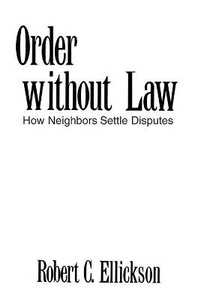
Order without Law
How Neighbors Settle Disputes
Published on 15. March 1994
Book
Paperback/Softback
316 pages
978-0-674-64169-3 (ISBN)
Description
In Order without Law, Robert Ellickson shows that law is far less important than is generally thought. He demonstrates that people largely govern themselves by means of informal rules-social norms-that develop without the aid of a state or other central coordinator. Integrating the latest scholarship in law, economics, sociology, game theory, and anthropology, Ellickson investigates the uncharted world within which order is successfully achieved without law.
The springboard for Ellickson's theory of norms is his close investigation of a variety of disputes arising from the damage created by escaped cattle in Shasta County, California. In "The Problem of Social Cost"-the most frequently cited article on law-economist Ronald H. Coase depicts farmers and ranchers as bargaining in the shadow of the law while resolving cattle-trespass disputes. Ellickson's field study of this problem refutes many of the behavioral assumptions that underlie Coase's vision, and will add realism to future efforts to apply economic analysis to law.
Drawing examples from a wide variety of social contexts, including whaling grounds, photocopying centers, and landlord-tenant relations, Ellickson explores the interaction between informal and legal rules and the usual domains in which these competing systems are employed. Order without Law firmly grounds its analysis in real-world events, while building a broad theory of how people cooperate to mutual advantage.
The springboard for Ellickson's theory of norms is his close investigation of a variety of disputes arising from the damage created by escaped cattle in Shasta County, California. In "The Problem of Social Cost"-the most frequently cited article on law-economist Ronald H. Coase depicts farmers and ranchers as bargaining in the shadow of the law while resolving cattle-trespass disputes. Ellickson's field study of this problem refutes many of the behavioral assumptions that underlie Coase's vision, and will add realism to future efforts to apply economic analysis to law.
Drawing examples from a wide variety of social contexts, including whaling grounds, photocopying centers, and landlord-tenant relations, Ellickson explores the interaction between informal and legal rules and the usual domains in which these competing systems are employed. Order without Law firmly grounds its analysis in real-world events, while building a broad theory of how people cooperate to mutual advantage.
Reviews / Votes
This immensely interesting, wide-ranging, well-written, learned, and contentious book-a superb analysis of extralegal regulation-will command a large readership among academic lawyers and social scientists, and may in the fullness of time come to be regarded as a classic of interdisciplinary legal scholarship. -- Richard A. Posner, Judge, U.S. Court of Appeals for the Seventh Circuit A welcome addition to the new literature on conflict, law, and informal social control in contemporary societies... [Order without Law] constitutes one of the most eloquent and powerful attacks yet on the widespread belief that government lies at the heart of social order in the modern world. -- M. P. Baumgartner * Contemporary Sociology * Uses theory and ethnography to explain norms in a manner that sociologists would do well to imitate. [Ellickson] presents evidence in an objective style that allows readers to reach their own verdicts, and his skillful storytelling accentuates his theoretical acumen. -- Jason Jimerson * American Journal of Sociology * [A] fascinating book... Ellickson's clean prose and considerate rhetorical style are refreshing. -- William Fischel * Land Economics *More details
Language
English
Place of publication
Cambridge, Mass
United States
Target group
Professional and scholarly
US School Grade: College Graduate Student
Illustrations
2 maps, 10 tables
Dimensions
Height: 235 mm
Width: 156 mm
Weight
417 gr
ISBN-13
978-0-674-64169-3 (9780674641693)
Copyright in bibliographic data and cover images is held by Nielsen Book Services Limited or by the publishers or by their respective licensors: all rights reserved.
Schweitzer Classification
Other editions
Additional editions
E-Book
07/2009
Harvard University Press
€40.39
Available for download
Content
Introduction Part I. Shasta County 1. Shasta County and Its Cattle Industry 2. The Politics of Cattle Trespass 3. The Resolution of Cattle-Trespass Disputes 4. Who Pays for Boundary Fences? 5. Disputes Arising out of Highway Collisions Involving Livestock 6. The Effects of Closed-Range Ordinances Part II. A Theory of Norms 7. The System of Social Control S. Shortcomings of Current Theories of Social Control 9. The Puzzle of Cooperation 10. A Hypothesis of Welfare-Maximizing Norms 11. Substantive Norms: Of Bees, Cattle, and Whales 12. Remedial Norms: Of Carrots and Sticks 13. Procedural and Constitutive Norms: Of Gossip, Ritual, and Hero Worship 14. Controller-Selecting Norms: Of Contracts, Custom, and Photocopies Part III. The Future of Norms 15. Testing the Content of Norms 16. Conclusions and Implications Appendix. Research Methods Index