

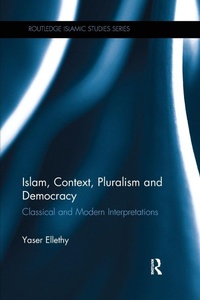
Islam, Context, Pluralism and Democracy
Classical and Modern Interpretations
1st Edition
Published on 31. March 2017
Book
Paperback/Softback
354 pages
978-0-415-79075-8 (ISBN)
Description
Islam, Context, Pluralism and Democracy aspires to clarify the tensions and congruences between the revelational and the rational, the text and the context, the limits and the horizons of contextualization in Islam, as these emanate from the Islamic interpretative tradition.
This book examines classical and modern Muslim interpretations with regard to the concepts of diachronic development, pluralism and democracy based on Arabic-Islamic sources and literature. Focusing on the parameters of semantic changes, methods of interpretation and cultural variables, it shows how this interpretative tradition offers a diversity of ideas and approaches that can be utilized in contemporary debates concerning the socio-political contextualization of Islamic genuine thought. However, within this diversity, Islam presents generic principles and core values as 'moral paradigms' that can deal with such modern challenges. Based on the analysis of core Islamic texts and key-terms related to the discussed issues, mainly from the Quran and the Sunnah, and the broader Arabic-Islamic literature, it explores the boundaries of the mutable and constant in the Islamic worldview.
Presenting classical Muslim interpretations and scholars as possible interlocutors in debates over the compatibility of Islam with challenges of modernity, this book is essential reading for researchers and postgraduates interested in Islamic Studies, Philosophy of Religion and Political Science.
This book examines classical and modern Muslim interpretations with regard to the concepts of diachronic development, pluralism and democracy based on Arabic-Islamic sources and literature. Focusing on the parameters of semantic changes, methods of interpretation and cultural variables, it shows how this interpretative tradition offers a diversity of ideas and approaches that can be utilized in contemporary debates concerning the socio-political contextualization of Islamic genuine thought. However, within this diversity, Islam presents generic principles and core values as 'moral paradigms' that can deal with such modern challenges. Based on the analysis of core Islamic texts and key-terms related to the discussed issues, mainly from the Quran and the Sunnah, and the broader Arabic-Islamic literature, it explores the boundaries of the mutable and constant in the Islamic worldview.
Presenting classical Muslim interpretations and scholars as possible interlocutors in debates over the compatibility of Islam with challenges of modernity, this book is essential reading for researchers and postgraduates interested in Islamic Studies, Philosophy of Religion and Political Science.
More details
Series
Language
English
Place of publication
London
United Kingdom
Publishing group
Taylor & Francis Ltd
Target group
College/higher education
Illustrations
1 s/w Tabelle, 37 s/w Photographien bzw. Rasterbilder
1 Tables, black and white; 37 Halftones, black and white
Dimensions
Height: 234 mm
Width: 156 mm
Thickness: 19 mm
Weight
541 gr
ISBN-13
978-0-415-79075-8 (9780415790758)
Copyright in bibliographic data and cover images is held by Nielsen Book Services Limited or by the publishers or by their respective licensors: all rights reserved.
Schweitzer Classification
Other editions
Additional editions
Book
12/2014
1st Edition
Routledge
€231.60
Shipment within 10-20 days
E-Book
11/2014
1st Edition
Routledge
€61.99
Available for download
E-Book
11/2014
1st Edition
Routledge
€61.99
Available for download
Person
Yaser Ellethy is Assistant Professor of Islamic Studies at the Faculty of Theology - VU University, Amsterdam. He holds PhDs in Islamic Theology and in Philology. He has published articles and books in English, Greek, Dutch and Arabic.
Content
Introduction 1 The Dilemma of a Diachronic Language 2 Classical Sources and Interpretations about Development 3 On Pluralism 4 On Democracy Conclusion