

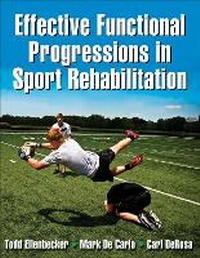
Effective Functional Progressions in Sport Rehabilitation
Published on 20. April 2009
Book
Paperback/Softback
248 pages
978-0-7360-6381-4 (ISBN)
Description
One of the most challenging tasks for a sports medicine clinician is rehabilitating an injured athlete for a successful return to competition. Effective Functional Progressions in Sport Rehabilitation provides clinicians with the strategies and tools they need to prepare their clients for the physical demands required by their sport.
This complete reference helps clinicians understand the important concepts of functional progressions and equips them to develop rehabilitation programs specific to the needs of their clients. The authors break down the text into three regional areas-upper extremities, lower extremities, and trunk-before delving into the specific anatomical and biomechanical differences within each area. They also present the neuromuscular basis for the specific approaches to each region and provide exercises in functional progressions that simulate the activity the athlete needs to perform to be effective in his or her sport again.
Clinicians will find evidence-based, functional tests and learn how to interpret and use the test results to develop specific rehabilitation programs. In that respect, this book will be particularly useful for designing individualized programs because clinicians can choose the specific exercises that will benefit their clients. Effective Functional Progressions in Sport Rehabilitation also provides
-sport-specific progressions for numerous sports, including golf, football, baseball, soccer, and running;
-kinetic chain exercises and information on the kinetic chain concept, outlining the transfer of energy between segments during functional activities and sport-specific movement patterns;
-photos that illustrate how progressions should be completed and medical art that shows the bones, muscles, and ligaments that are most often affected by injuries; and
-a recipe-like structure for functional and clinical progressions that makes it easy to see how a progression should be completed and provides continuity and ease of use across the book.
Effective Functional Progressions in Sport Rehabilitation also features an online component that allows users access to every image from the text as well as sample templates in both Microsoft Word and PowerPoint. Clinicians can select and paste the images they need into the Word document, type in specific instructions, and print it for their clients to take home as a reference. Instructors can do the same with the presentation package template, using the images and customizing text to accompany each image. The images and sample templates are available at www.HumanKinetics.com/EffectiveFunctionalProgressionsinSportRehabilitation.
With its functional progressions for all areas of the body, sport-specific progressions, photos and art that clearly depict progressions and injured areas, and its adaptability to be customized by clinicians in designing their own programs, Effective Functional Progressions in Sport Rehabilitation is the ideal tool for clinicians to use in returning athletes safely back to action.
This complete reference helps clinicians understand the important concepts of functional progressions and equips them to develop rehabilitation programs specific to the needs of their clients. The authors break down the text into three regional areas-upper extremities, lower extremities, and trunk-before delving into the specific anatomical and biomechanical differences within each area. They also present the neuromuscular basis for the specific approaches to each region and provide exercises in functional progressions that simulate the activity the athlete needs to perform to be effective in his or her sport again.
Clinicians will find evidence-based, functional tests and learn how to interpret and use the test results to develop specific rehabilitation programs. In that respect, this book will be particularly useful for designing individualized programs because clinicians can choose the specific exercises that will benefit their clients. Effective Functional Progressions in Sport Rehabilitation also provides
-sport-specific progressions for numerous sports, including golf, football, baseball, soccer, and running;
-kinetic chain exercises and information on the kinetic chain concept, outlining the transfer of energy between segments during functional activities and sport-specific movement patterns;
-photos that illustrate how progressions should be completed and medical art that shows the bones, muscles, and ligaments that are most often affected by injuries; and
-a recipe-like structure for functional and clinical progressions that makes it easy to see how a progression should be completed and provides continuity and ease of use across the book.
Effective Functional Progressions in Sport Rehabilitation also features an online component that allows users access to every image from the text as well as sample templates in both Microsoft Word and PowerPoint. Clinicians can select and paste the images they need into the Word document, type in specific instructions, and print it for their clients to take home as a reference. Instructors can do the same with the presentation package template, using the images and customizing text to accompany each image. The images and sample templates are available at www.HumanKinetics.com/EffectiveFunctionalProgressionsinSportRehabilitation.
With its functional progressions for all areas of the body, sport-specific progressions, photos and art that clearly depict progressions and injured areas, and its adaptability to be customized by clinicians in designing their own programs, Effective Functional Progressions in Sport Rehabilitation is the ideal tool for clinicians to use in returning athletes safely back to action.
Reviews / Votes
"Overall, this is a very useful textbook for all clinicians working directly with athletes at any level. It provides concise, accurate, and clinically useful information for understanding sports injuries, rehabilitation, and return to play progressions."-Doody's Book Review (4-star review)
More details
Edition
New edition
Language
English
Place of publication
Champaign, IL
United States
Publishing group
Human Kinetics Publishers
Target group
Professional and scholarly
Interest Age: From 18 to 99 years
Edition type
New edition
Product notice
Paperback (trade)
Dimensions
Height: 279 mm
Width: 216 mm
Thickness: 14 mm
Weight
703 gr
ISBN-13
978-0-7360-6381-4 (9780736063814)
Copyright in bibliographic data and cover images is held by Nielsen Book Services Limited or by the publishers or by their respective licensors: all rights reserved.
Schweitzer Classification
Other editions
Additional editions
Todd S. Ellenbecker | Mark De Carlo | Eduardo De Rose
Effective Functional Progressions in Sport Rehabilitation
E-Book
04/2009
1st Edition
Human Kinetics
€91.99
Available for download
Persons
Todd S. Ellenbecker, DPT, CSCS, is clinic director for Physiotherapy Associates Scottsdale Sports Clinic in Scottsdale, Arizona, and the national director for Clinical Research Physiotherapy Associates. He has been a physical therapist for more than 35 years, specializing in orthopedic and sports physical therapy. He is also a certified strength and conditioning specialist.
Ellenbecker is the primary author of more than 20 peer-reviewed research publications in orthopedic and sport physical therapy, and he is the primary author of more than 10 books in these fields. He serves as director of Sports Medicine ATP Tour (Association of Tennis Professionals) and chairman of the United States Tennis Association Sport Science Committee. He is a member of the American Physical Therapy Association (APTA), the American College of Sports Medicine (ACSM), and the Society for Tennis Medicine and Science.
In 2007 Ellenbecker received the Ron Peyton Award for sport physical therapy, and in 2008 he earned the International Tennis Hall of Fame Education Merit Award.
Mark S. De Carlo, PT, MHA, SCS, ATC, is vice president of clinical services for the Methodist Sport Medicine/The Orthopaedic Specialists in Indianapolis. He has more than 23 years of clinical experience with high school, college, and professional athletes and has more than 40 published articles and book chapters to his credit. A certified athletic trainer and board-certified sports clinical specialists, De Carlo is president of the Sports Physical Therapy Section for the APTA and current board member of the International Federation of Sports Physical Therapy.
Carl DeRosa, PT, PhD, FAPTA, is a professor of physical therapy at Northern Arizona University and co-owner of DeRosa Physical Therapy in Flagstaff, Arizona. Dr. DeRosa completed his physical therapy education at the Mayo Clinic and earned his master's and doctoral degrees in human anatomy. His scholarly interests over the past 25 years have been focused on the anatomy and mechanics of the human spine and shoulder girdle with particular emphasis on their relationship to orthopedics, sport, and rehabilitation sciences. He has co-authored several textbooks, textbook chapters, journal articles, and two series for home study. In addition to research and invited presentations throughout the United States, Dr. DeRosa has presented his work at numerous national and international conferences, including the International Federation of Manual Therapists' World Congress on Low Back and Pelvic Pain. In recognition of his contributions to the profession of physical therapy, Dr. DeRosa was awarded the Lucy Clair Service Award and, in addition, was selected by the APTA Board of Directors as a Maley Lecturer. He is a Catherine Worthingham Fellow of the APTA.
Ellenbecker is the primary author of more than 20 peer-reviewed research publications in orthopedic and sport physical therapy, and he is the primary author of more than 10 books in these fields. He serves as director of Sports Medicine ATP Tour (Association of Tennis Professionals) and chairman of the United States Tennis Association Sport Science Committee. He is a member of the American Physical Therapy Association (APTA), the American College of Sports Medicine (ACSM), and the Society for Tennis Medicine and Science.
In 2007 Ellenbecker received the Ron Peyton Award for sport physical therapy, and in 2008 he earned the International Tennis Hall of Fame Education Merit Award.
Mark S. De Carlo, PT, MHA, SCS, ATC, is vice president of clinical services for the Methodist Sport Medicine/The Orthopaedic Specialists in Indianapolis. He has more than 23 years of clinical experience with high school, college, and professional athletes and has more than 40 published articles and book chapters to his credit. A certified athletic trainer and board-certified sports clinical specialists, De Carlo is president of the Sports Physical Therapy Section for the APTA and current board member of the International Federation of Sports Physical Therapy.
Carl DeRosa, PT, PhD, FAPTA, is a professor of physical therapy at Northern Arizona University and co-owner of DeRosa Physical Therapy in Flagstaff, Arizona. Dr. DeRosa completed his physical therapy education at the Mayo Clinic and earned his master's and doctoral degrees in human anatomy. His scholarly interests over the past 25 years have been focused on the anatomy and mechanics of the human spine and shoulder girdle with particular emphasis on their relationship to orthopedics, sport, and rehabilitation sciences. He has co-authored several textbooks, textbook chapters, journal articles, and two series for home study. In addition to research and invited presentations throughout the United States, Dr. DeRosa has presented his work at numerous national and international conferences, including the International Federation of Manual Therapists' World Congress on Low Back and Pelvic Pain. In recognition of his contributions to the profession of physical therapy, Dr. DeRosa was awarded the Lucy Clair Service Award and, in addition, was selected by the APTA Board of Directors as a Maley Lecturer. He is a Catherine Worthingham Fellow of the APTA.
Content
Part I. Components of Functional Progressions
Chapter 1. Introduction to Functional Progression
Benefits of a Functional Progression
Clinical Guidelines for Functional Progression
Guidelines for Initiating a Functional Progression
Summary
Chapter 2. Developing Successful Functional Progression Programs
Key Components of Functional Progression Programs
Kinetic Link Principle
Summary
Part II. Regional Functional Progressions
Chapter 3. Upper Extremity
Anatomy of the Upper Extremity
Muscular Stabilization of the Upper Extremity
Biomechanics of the Upper Extremity
Injuries
Functional Testing of the Upper Extremity
Functional Exercise Progressions
Summary
Chapter 4. Lower Extremity
Anatomy of the Lower Extremity
Muscular Stabilization of the Lower Extremity
Biomechanics of the Lower Extremity
Injuries
Functional Testing of the Lower Extremity
Clinical Exercise Progressions
Functional Exercise Progressions
Summary
Chapter 5. Trunk
Anatomy of the Trunk
Muscular Stabilization of the Trunk
Biomechanics of the Trunk
Injuries
Functional Testing of the Trunk
Functional Exercise Tests and Progressions
Summary
Chapter 1. Introduction to Functional Progression
Benefits of a Functional Progression
Clinical Guidelines for Functional Progression
Guidelines for Initiating a Functional Progression
Summary
Chapter 2. Developing Successful Functional Progression Programs
Key Components of Functional Progression Programs
Kinetic Link Principle
Summary
Part II. Regional Functional Progressions
Chapter 3. Upper Extremity
Anatomy of the Upper Extremity
Muscular Stabilization of the Upper Extremity
Biomechanics of the Upper Extremity
Injuries
Functional Testing of the Upper Extremity
Functional Exercise Progressions
Summary
Chapter 4. Lower Extremity
Anatomy of the Lower Extremity
Muscular Stabilization of the Lower Extremity
Biomechanics of the Lower Extremity
Injuries
Functional Testing of the Lower Extremity
Clinical Exercise Progressions
Functional Exercise Progressions
Summary
Chapter 5. Trunk
Anatomy of the Trunk
Muscular Stabilization of the Trunk
Biomechanics of the Trunk
Injuries
Functional Testing of the Trunk
Functional Exercise Tests and Progressions
Summary