

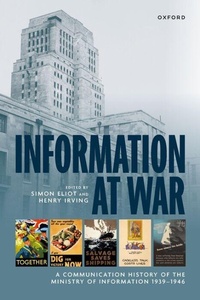
Information at War
A Communication History of the Ministry of Information 1939-1946
Published on 8. June 2026
Book
Hardback
736 pages
978-0-19-284473-6 (ISBN)
Description
The short-lived Ministry of Information (MoI, 1939-1946) had an outsized impact. It played a key role in the Allied war effort, and its work has reverberated in British culture ever since: from its much darker version (as the 'Ministry of Truth') in Orwell's Nineteen Eighty-Four to memes based on the slogan 'Keep Calm and Carry On'. But despite its long legacy, it has been the subject of only limited scholarly investigation.
This multi-authored volume offers the first comprehensive and global history of the MoI. It explores the variety of tools it used to issue and control information, which ranged from the censorship of personal communications to the production of propaganda films. The book demonstrates the remarkable breadth and depth of its activities. It explores the MoI's use of a range of media, from pamphlets and posters to public meetings, films and exhibitions; its attempts to justify Britain's empire and imagine a post-war world; and its truly transcontinental reach, with a consolidated presence in many countries in Africa, the Americas, Asia, Australasia, and Europe. The book also establishes that the MoI was an inherently ambivalent institution: its negative side (the threat of an un-British level of state control) offset by its perceived ability to generate a sense of national purpose at a time of crisis.
The book sheds light on an important but little-understood chapter of British wartime history. The lively and highly illustrated chapters raise important and timely questions about the nature of state surveillance, information, and propaganda in an increasingly connected world.
This multi-authored volume offers the first comprehensive and global history of the MoI. It explores the variety of tools it used to issue and control information, which ranged from the censorship of personal communications to the production of propaganda films. The book demonstrates the remarkable breadth and depth of its activities. It explores the MoI's use of a range of media, from pamphlets and posters to public meetings, films and exhibitions; its attempts to justify Britain's empire and imagine a post-war world; and its truly transcontinental reach, with a consolidated presence in many countries in Africa, the Americas, Asia, Australasia, and Europe. The book also establishes that the MoI was an inherently ambivalent institution: its negative side (the threat of an un-British level of state control) offset by its perceived ability to generate a sense of national purpose at a time of crisis.
The book sheds light on an important but little-understood chapter of British wartime history. The lively and highly illustrated chapters raise important and timely questions about the nature of state surveillance, information, and propaganda in an increasingly connected world.
More details
Language
English
Place of publication
Oxford
United Kingdom
Target group
College/higher education
Dimensions
Height: 241 mm
Width: 169 mm
Thickness: 43 mm
Weight
1382 gr
ISBN-13
978-0-19-284473-6 (9780192844736)
Copyright in bibliographic data and cover images is held by Nielsen Book Services Limited or by the publishers or by their respective licensors: all rights reserved.
Schweitzer Classification
Persons
Simon Eliot is Professor Emeritus of the History of the Book, IES, School of Advanced Study, University of London. He is co-founder and served as second president of the Society for the History of Authorship, Reading and Publishing. He is the author of over fifty articles and of Some Patterns and Trends in British Publishing, 1800-1919 (1994); co-editor of Publishers' Circular/English Catalogue 1837-1900 (1988), Literary Cultures and the Material Book (2007), The Blackwell Companion to the History of the Book (2007, 2019), Allied Communication to the Public during the Second World War (2020); and general editor of The History of Oxford University Press (four volumes, 2013-17).
Henry Irving is a Senior Lecturer in Public History at Leeds Beckett University. He has worked on the project 'A Communication History of the Ministry of Information' since 2014. Henry specialises in the MoI's work on the 'home front'. His research has been published in leading journals, including the English Historical Review and Historical Research, and collections, most recently The Routledge Handbook of Information History (2025). His research has also been felt in the classroom, where his students often find themselves asked to censor a newspaper report or devise a publicity campaign. Henry is a Fellow of the Royal Historical Society, a Senior Fellow of the Higher Education Academy, and has held a British Academy Innovation Fellowship to apply his knowledge of wartime publicity to the promotion of the circular economy. Information at War is his first book.
Henry Irving is a Senior Lecturer in Public History at Leeds Beckett University. He has worked on the project 'A Communication History of the Ministry of Information' since 2014. Henry specialises in the MoI's work on the 'home front'. His research has been published in leading journals, including the English Historical Review and Historical Research, and collections, most recently The Routledge Handbook of Information History (2025). His research has also been felt in the classroom, where his students often find themselves asked to censor a newspaper report or devise a publicity campaign. Henry is a Fellow of the Royal Historical Society, a Senior Fellow of the Higher Education Academy, and has held a British Academy Innovation Fellowship to apply his knowledge of wartime publicity to the promotion of the circular economy. Information at War is his first book.
Volume editor
Professor Emeritus and Senior Reserach Fellow, Institute of English Studies, School of Advanced StudyProfessor Emeritus and Senior Research Fellow, Institute of English Studies, School of Advanced Study, University of London
Senior Lecturer in Public History, School of Humanities and Social SciencesSenior Lecturer in Public History, School of Humanities and Social Sciences, Leeds Beckett University
Content
Simon Eliot and Henry Irving: Introduction PART I EVOLUTION 1: Henry Irving: The Planning Stage, 1935-9 2: Henry Irving: Confusion, 1939-40 3: Henry Irving: The Limits of Influence, 1940-1 4: Henry Irving: Efficiency over Power, 1941-6 PART II OPERATION 5: Simon Eliot: Life in Senate House 6: Henry Irving: News Management and Censorship 7: Simon Eliot: The Postal and Telegraph Censorship 8: Simon Eliot and Henry Irving: Home Intelligence, Morale, and Market Research 9: Simon Eliot: Publications Mostly for British Readers 10: Simon Eliot: Publications Mostly for Readers Abroad 11: Simon Eliot and Jane McArthur: Photographs Division, the Graphic Arts, and Censorship 12: Jenna Lundin Aral: The Exhibitions Division 13: Simon Eliot and Hollie Price: The Films Division 14: Simon Eliot: Public Meetings Part III Combined Operations 15: Henry Irving: Home Publicity Campaigns 16: Louis Allday, Christopher Bannister and Marc Wiggam: Campaigns Abroad 17: Simon Eliot and Marc Wiggam: The Regions and Their Histories Part IV Legacy 18: Simon Eliot, Katherine M. Howells and Henry Irving: The Afterlife of the Ministry of Information