

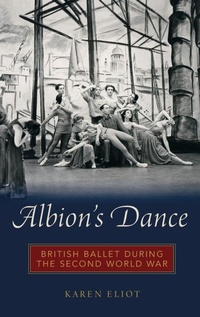
Albion's Dance
British Ballet during the Second World War
Published on 13. October 2016
Book
Hardback
238 pages
978-0-19-934762-9 (ISBN)
Description
When the Second World War broke out, ballet in Britain was only a few decades old. Few had imagined that it would establish roots in a nation long thought to be unresponsive to dance. Nevertheless, the war proved to be a boon for ballet dancers, choreographers and audiences, for the nation's dancers were forced to look inward to their own identity and sources of creativity. As author Karen Eliot demonstrates in this fascinating book, instead of withering during the enforced isolation of war, ballet in Britain flourished, exhibiting a surprising heterogeneity and vibrant populism that moved ballet outside its typical elitist surroundings to be seen by uninitiated, often enthusiastic audiences. Ballet was thought to help boost audience morale, to render solace to the soul-weary and to afford entertainment and diversion to those who simply craved a few hours of distraction. Government authorities came to see that ballet could serve as a tool of propaganda; the ways it functioned within the larger public discourse of propaganda and sacrifice, and how it answered a public mood of pragmatism and idealism, are also topics in this story of the development of a national ballet identity. This narrative has several key players-- dance critics, male and female dancers, producers, audiences, and choreographers. Exploring the so-called "ballet boom" during WWII, the larger story of this book is one of how art and artists thrive during conflict, and how they respond pragmatically and creatively to privation and duress.
Reviews / Votes
"An enthralling story of how diverse groups of unsung dancers and choreographers changed the landscape of British ballet through their courageous work during the war. With her rigorous and deft handling of the sources, Eliot makes a major contribution to dance scholarship."--Geraldine Morris, Reader in Dance University of Roehampton"A detailed, insightful account of ballet in Britain during World War II, Albion's Dance probes the complexities and paradoxes of wartime - its socio-political and artistic realignments; its grittiness and transcendences - and how ballet contributed to reshaping the cultural landscape. The book is essential reading for dance students, teachers and scholars, and for all of us interested in new histories of ballet and its place on the world stage
today."--Angela Kane, Professor of Dance, University of Michigan
"Eliot bases much of her study on her extensive investigation of dancers>' memoirs and writings of dance critics, and the result is a book that is both well-researched and fascinating." --L.K. Rosenberg, Miami University, Choice
More details
Language
English
Place of publication
New York
United States
Illustrations
9 images
Dimensions
Height: 240 mm
Width: 161 mm
Thickness: 17 mm
Weight
526 gr
ISBN-13
978-0-19-934762-9 (9780199347629)
Copyright in bibliographic data and cover images is held by Nielsen Book Services Limited or by the publishers or by their respective licensors: all rights reserved.
Schweitzer Classification
Other editions
Additional editions
E-Book
08/2016
1st Edition
OUP eBook
€53.49
Available for download
E-Book
08/2016
1st Edition
OUP eBook
€41.49
Available for download
Person
Karen Eliot danced in the Merce Cunningham Dance Company during the 1980s. She is a Professor in the Department of Dance at The Ohio State University where she has taught for over 20 years. Her books include Dancing Lives: Five Female Dancers from the Ballet d'Action to Merce Cunningham (2007), and the edited anthology, Dance on its Own Terms: Histories and Methodologies (2013) with co-editor Melanie Bales. She serves on the advisory board of Dance Chronicle. Her articles appear in: Dance Chronicle; Dance Gazette; The American Society for Eighteenth-Century Studies Book Reviews Online; and Dance Research Journal.
Content
Preface
Introduction
Chapter One: The British Ballet and its Critics at the Onset of War
Chapter Two: Making Ballet Central to British Wartime Experience
Chapter Three: The Dancers' Experience
Chapter Four: Propaganda, Publicity, and Social Pressure: Ballet in Discourse and Deed
Chapter Five: The Function of the Classics in Wartime
Chapter Six: Programming the Repertoire
Chapter Seven: British Choreography during the War
Afterword
Index
Introduction
Chapter One: The British Ballet and its Critics at the Onset of War
Chapter Two: Making Ballet Central to British Wartime Experience
Chapter Three: The Dancers' Experience
Chapter Four: Propaganda, Publicity, and Social Pressure: Ballet in Discourse and Deed
Chapter Five: The Function of the Classics in Wartime
Chapter Six: Programming the Repertoire
Chapter Seven: British Choreography during the War
Afterword
Index