

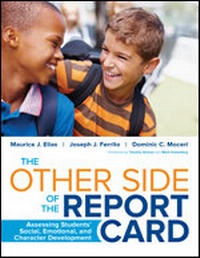
The Other Side of the Report Card
Assessing Students' Social, Emotional, and Character Development
1st Edition
Published on 29. February 2016
Book
Paperback/Softback
112 pages
978-1-4833-8667-6 (ISBN)
Description
To better serve the whole child, look at the whole report card.
Students are more than their academic grades-you know it and their parents know it. The progress they make in social-emotional learning and character development is essential to their success in school and in life. But while educators have made great strides in improving grading for academic achievement, we've left too many teachers still guessing when it comes to outdated behavior ratings and comment sections.
That's where this book comes in. Grounded in research and in the author's work with teachers and administrators, it offers guidance on retooling report cards to better reflect the whole child, integrating SEL and CD into any school- or district-wide grading system. Resources include
Guided exercises for analyzing existing report cards
Samples and suggested report card designs
Tips on improving communication with parents
Case studies highlighting common challenges
Testimonials from teachers and students
"When you take report cards to the next level, you make sure that communication reflects all of the important characteristics of success-and ensure that students develop the skills they need for the future. This book brilliantly illuminates the key role played by social-emotional learning in each student's development and it challenges the tradition of relegating the SEL/EQ observations to the back of the report card. If we want to develop better communities, this book shows the way."
Dr. Neil MacNeill PhD, EdD - Head Master
Ellenbrook Indpendent Primary School
"The ultimate goal of misbehavior is attention. When children don't get the attention they need through the proper behavior, they will get it any way they can. Children want to be loved and cared about. SEL will help them to learn the proper ways to get attention. It will also help teachers better understand the misbehaviors and redirect students toward positive behavior."
Pamela L. Opel - Teacher, Intervention Specialist
Gulfport School District
Students are more than their academic grades-you know it and their parents know it. The progress they make in social-emotional learning and character development is essential to their success in school and in life. But while educators have made great strides in improving grading for academic achievement, we've left too many teachers still guessing when it comes to outdated behavior ratings and comment sections.
That's where this book comes in. Grounded in research and in the author's work with teachers and administrators, it offers guidance on retooling report cards to better reflect the whole child, integrating SEL and CD into any school- or district-wide grading system. Resources include
Guided exercises for analyzing existing report cards
Samples and suggested report card designs
Tips on improving communication with parents
Case studies highlighting common challenges
Testimonials from teachers and students
"When you take report cards to the next level, you make sure that communication reflects all of the important characteristics of success-and ensure that students develop the skills they need for the future. This book brilliantly illuminates the key role played by social-emotional learning in each student's development and it challenges the tradition of relegating the SEL/EQ observations to the back of the report card. If we want to develop better communities, this book shows the way."
Dr. Neil MacNeill PhD, EdD - Head Master
Ellenbrook Indpendent Primary School
"The ultimate goal of misbehavior is attention. When children don't get the attention they need through the proper behavior, they will get it any way they can. Children want to be loved and cared about. SEL will help them to learn the proper ways to get attention. It will also help teachers better understand the misbehaviors and redirect students toward positive behavior."
Pamela L. Opel - Teacher, Intervention Specialist
Gulfport School District
Reviews / Votes
This book brilliantly illuminates the key role played by social-emotional learning in each student's development and it challenges the tradition of relegating the SEL/EQ observations to the back of the report card. If we want to develop better communities, this book shows the way. -- Dr. Neil MacNeill PhD, EdD - Head Master The ultimate goal of misbehavior is attention. When children don't get the attention they need through the proper behavior, they will get it any way they can. Children want to be loved and cared about. When teachers incorporate SEL and character development it helps students learn the proper ways to get attention. It will also help teachers better understand the misbehaviors and redirect students toward positive behavior. -- Pamela L. Opel - Teacher, Intervention Specialist "The Other Side of the Report Card is a complete implementation guide to help school districts develop or improve how they convey to families the social, emotional, and character strengths and needs of their children in a culturally appropriate way. With the use of takeaway points, examples, checklists, research, and resources, district teams have the "soup to nuts" process to document that other side of the report card and share information needed to support the success of every student." -- Susan Gorin, CAE "The Other Side of the Report Card by Maurice Elias, Joseph Ferrito, and Dominic Moceri is a rich resource for educators who want to figure out how best to report on students' social, emotional, and character development. Most teachers are used to simply selecting from a menu of comments to?? describe a student's behavior on a report card. Dr. Elias et al suggest that it should be much more than that. Rather than simply accepting the premise that "what gets measured is what's important," Dr. Elias argues that if it is important, it should be measured. The book is full of examples, research, case studies, and, what I really liked, a nice framework for faculty discussion. Each chapter begins with key takeaways and reflection points that will help focus a faculty committee determined to improve its evaluation system. Chapter 7 is particularly useful as it gives a checklist of important considerations. The authors focus on both SEL and character, acknowledge their differences, but show that each could be part of a school's evaluation system. As we all strive to educate future citizens and recognize that focusing on academic achievement is not enough, The Other Side of the Report Card looks to be just what educators need to focus and assess on those elements needed for success in school and in life." -- Becky Sipos, President & CEOMore details
Language
English
Place of publication
Thousand Oaks
United States
Publishing group
SAGE Publications Inc
Target group
Professional and scholarly
Dimensions
Height: 279 mm
Width: 216 mm
Weight
315 gr
ISBN-13
978-1-4833-8667-6 (9781483386676)
Copyright in bibliographic data and cover images is held by Nielsen Book Services Limited or by the publishers or by their respective licensors: all rights reserved.
Schweitzer Classification
Persons
Maurice J. Elias, PhD, is Professor, Psychology Department, Rutgers University, Director, Social-Emotional and Character Development Lab (www.secdlab.org), Co-Director of the Rutgers-based Academy for SEL in Schools, which offers online certificates in SEL Instruction and School Leadership (SELinSchools.org), and a member of the Leadership Team for SEL4NJ and SEL4US (www.SEL4US.org). He received the Joseph E. Zins Memorial Senior Scholar Award for Social-Emotional Learning from CASEL , the Sanford McDonnell Award for Lifetime Achievement in Character Education, and the Jane Bostrum Service to School Psychology Award. Dr. Elias is a past winner of the Lela Rowland Prevention Award, the Ernest McMahon Class of 1930 Award for service to New Jersey, and the American Psychological Association/Society for Community Research and Action's Distinguished Contribution to Practice and Ethnic Minority Mentoring awards. His books include Emotionally Intelligent Parenting, The Educator's Guide to Emotional Intelligence and Academic Achievement: Social-Emotional Learning in the Classroom, and The Other Side of the Report Card: Assessing Students' Social, Emotional, and Character Development (how schools and districts can integrate social-emotional and character development systematically into their ongoing student report cards). Most recently, he is the coauthor of The Joys & Oys of Parenting: Insights and Wisdom From the Jewish Tradition, Boost Emotional Intelligence in Students: 30 Flexible Research-Based Lessons to Build EQ Skills, Nurturing Students' Character: Everyday Teaching Activities for Social-Emotional Learning, and Social-Emotional Learning Lab: A Comprehensive SEL Resource Kit (with Victoria Poedubicky).
He writes a blog on SECD for Edutopia (www.edutopia.org/profile/mauricej-elias) and can be reached at secdlab@gmail.com. His Twitter handles are @SELinSchools and @SECDLab.
Take a look at a review on The Other Side of the Report Card from the New Jersey Association of School Psychologists at https://us.corwin.com/sites/default/files/review_of_the_other_side_njasp_0.pdf.
Joseph J. Ferrito recently earned his doctoral degree from the Graduate School of Applied and Professional Psychology at Rutgers University. He is a native of Monroe Township, New Jersey and a graduate of Marist College where he majored in psychology. Clinically, J.J. trained and worked across levels of care ranging from public schools and in-home services, to residential and inpatient treatment facilities. His clinical work has focused on children, adolescents and families, particularly those who have been exposed to various traumatic experiences. He completed an APA-accredited internship at Sharp HealthCare in San Diego, California and is currently a post-doctoral fellow at the Audrey Hepburn Children's House at Hackensack University Medical Center in New Jersey.
Throughout his graduate training, J.J. taught several undergraduate courses and conducted research under the mentorship of Dr. Maurice J. Elias through the Social-Emotional Learning (SEL) Lab at Rutgers University. Developing feasible methods for assessing SEL and related skills in schools has been a focus of this research and this work has generated several publications in various forms. J.J. hopes to continue this work and combine it with his interest in trauma and resiliency to enhance evidence-based methods of prevention and promotion on a national and international level.
Take a look at a review on The Other Side of the Report Card, published by the New Jersey Association of School Psychologists here.
Dominic C. Moceri graduated with his Ph.D. in clinical psychology from Rutgers, The State University of New Jersey. While at Rutgers, Dominic's research focused on quantifying the dissemination, implementation, sustainability, and scalability of evidence-based practices in schools and other settings. Dominic was co-principal investigator of the initial SEL Report Card Indicator studies, the foundation for this book. Additionally, he was the lead creator of the Schools Implementing Towards Sustainability (SITS) scale, a user-friendly and scalable measure of the system of sustainable implementation framework (Moceri et al., 2012). He received his M.S. in clinical psychology from Rutgers and his B.A. with honors in psychology from the University of Michigan.
Dr. Moceri currently practices cognitive-behavioral therapy and conducts psychological assessments with children, adolescents, and adults in his home state of Michigan. He assesses and treats a wide variety of presenting problems, including anxiety, depression, inattention, hyperactivity, oppositionality, and rage attacks. He specializes in the treatment of obsessive-compulsive disorder, anxiety disorders, and tic disorders using exposure and response prevention and habit reversal training.
Take a look at a review on The Other Side of the Report Card, published by the New Jersey Association of School Psychologists here.
He writes a blog on SECD for Edutopia (www.edutopia.org/profile/mauricej-elias) and can be reached at secdlab@gmail.com. His Twitter handles are @SELinSchools and @SECDLab.
Take a look at a review on The Other Side of the Report Card from the New Jersey Association of School Psychologists at https://us.corwin.com/sites/default/files/review_of_the_other_side_njasp_0.pdf.
Joseph J. Ferrito recently earned his doctoral degree from the Graduate School of Applied and Professional Psychology at Rutgers University. He is a native of Monroe Township, New Jersey and a graduate of Marist College where he majored in psychology. Clinically, J.J. trained and worked across levels of care ranging from public schools and in-home services, to residential and inpatient treatment facilities. His clinical work has focused on children, adolescents and families, particularly those who have been exposed to various traumatic experiences. He completed an APA-accredited internship at Sharp HealthCare in San Diego, California and is currently a post-doctoral fellow at the Audrey Hepburn Children's House at Hackensack University Medical Center in New Jersey.
Throughout his graduate training, J.J. taught several undergraduate courses and conducted research under the mentorship of Dr. Maurice J. Elias through the Social-Emotional Learning (SEL) Lab at Rutgers University. Developing feasible methods for assessing SEL and related skills in schools has been a focus of this research and this work has generated several publications in various forms. J.J. hopes to continue this work and combine it with his interest in trauma and resiliency to enhance evidence-based methods of prevention and promotion on a national and international level.
Take a look at a review on The Other Side of the Report Card, published by the New Jersey Association of School Psychologists here.
Dominic C. Moceri graduated with his Ph.D. in clinical psychology from Rutgers, The State University of New Jersey. While at Rutgers, Dominic's research focused on quantifying the dissemination, implementation, sustainability, and scalability of evidence-based practices in schools and other settings. Dominic was co-principal investigator of the initial SEL Report Card Indicator studies, the foundation for this book. Additionally, he was the lead creator of the Schools Implementing Towards Sustainability (SITS) scale, a user-friendly and scalable measure of the system of sustainable implementation framework (Moceri et al., 2012). He received his M.S. in clinical psychology from Rutgers and his B.A. with honors in psychology from the University of Michigan.
Dr. Moceri currently practices cognitive-behavioral therapy and conducts psychological assessments with children, adolescents, and adults in his home state of Michigan. He assesses and treats a wide variety of presenting problems, including anxiety, depression, inattention, hyperactivity, oppositionality, and rage attacks. He specializes in the treatment of obsessive-compulsive disorder, anxiety disorders, and tic disorders using exposure and response prevention and habit reversal training.
Take a look at a review on The Other Side of the Report Card, published by the New Jersey Association of School Psychologists here.
Content
Introduction
Annotated Table of Contents
Process Overview and How this Guide can be Utilized
Chapter 1- Is it Realistic to Include SEL Skills and Character on Report Cards?
Chapter 2 - Methods Currently in Practice: Yours and Others'
Chapter 3 - Adapting Your Report Card Comments for SEL and/or Character
Chapter 4 - Implementation and Case Study Examples
Chapter 5 - Implementation with Case Study Examples for Schools with Current SEL or Character Programming
Chapter 6 - Most Frequent Challenges Addressed and Overcome: Reassuring and Involving Parents, Aligning to Early Childhood Education and Career and Technical Education Goals
Chapter 7 - Checklist of Important Considerations
Chapter 8 - Literature Review on Previous Studies Related to "The Other Side" of the Report Card
Chapter 9 - Guidelines and Resources for Social-Emotional and Character Development Programming in Schools
Essential Reference Tables
Table 1: The CASEL 5: Definitions and Skills Examples
Table 2 Character Strengths and Behavioral Indicators
Table 3 - Steps to Evaluating Current Report Card Comments in Your School
Table 4 - Common Characteristics of Student Behavior by Grade and the Overlap with SEL
Table 5 - Common Characteristics of Student Behavior by Grade and the Overlap with Character
Table 6 - Example: SEL Likert Rating System
Table 7 - Example: Character Likert Rating System
Table 8 - Example: SEL Rubric Rating System
Table 9 - Example: Character Rubric Rating System
Online Supplement - Developmentally Adapted SEL Likert Rating System With References
Online Supplement- SEL Skill Trajectory Grades 1-12
Resources
Annotated Table of Contents
Process Overview and How this Guide can be Utilized
Chapter 1- Is it Realistic to Include SEL Skills and Character on Report Cards?
Chapter 2 - Methods Currently in Practice: Yours and Others'
Chapter 3 - Adapting Your Report Card Comments for SEL and/or Character
Chapter 4 - Implementation and Case Study Examples
Chapter 5 - Implementation with Case Study Examples for Schools with Current SEL or Character Programming
Chapter 6 - Most Frequent Challenges Addressed and Overcome: Reassuring and Involving Parents, Aligning to Early Childhood Education and Career and Technical Education Goals
Chapter 7 - Checklist of Important Considerations
Chapter 8 - Literature Review on Previous Studies Related to "The Other Side" of the Report Card
Chapter 9 - Guidelines and Resources for Social-Emotional and Character Development Programming in Schools
Essential Reference Tables
Table 1: The CASEL 5: Definitions and Skills Examples
Table 2 Character Strengths and Behavioral Indicators
Table 3 - Steps to Evaluating Current Report Card Comments in Your School
Table 4 - Common Characteristics of Student Behavior by Grade and the Overlap with SEL
Table 5 - Common Characteristics of Student Behavior by Grade and the Overlap with Character
Table 6 - Example: SEL Likert Rating System
Table 7 - Example: Character Likert Rating System
Table 8 - Example: SEL Rubric Rating System
Table 9 - Example: Character Rubric Rating System
Online Supplement - Developmentally Adapted SEL Likert Rating System With References
Online Supplement- SEL Skill Trajectory Grades 1-12
Resources