

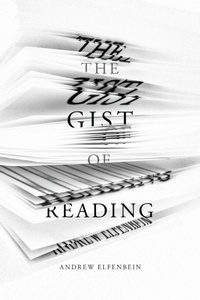
The Gist of Reading
Published on 16. January 2018
Book
Paperback/Softback
272 pages
978-1-5036-0385-1 (ISBN)
Description
What happens to books as they live in our long-term memory? Why do we find some books entertaining and others not? And how does literary influence work on writers in different ways? Grounded in the findings of empirical psychology, this book amends classic reader-response theory and attends to neglected aspects of reading that cannot be explained by traditional literary criticism.
Reading arises from a combination of two kinds of mental work: automatic and controlled processes. Automatic processes, such as the ability to see visual symbols as words, are the result of constant practice; controlled processes, such as predicting what might occur next in a story, arise from readers' conscious use of skills and background knowledge. When we read, automatic and controlled processes work together to create the "gist" of reading, the constant interplay between these two kinds of processes. Andrew Elfenbein not only explains how we read today, but also uses current knowledge about reading to consider readers of past centuries, arguing that understanding gist is central to interpreting the social, psychological, and political impact of literary works. The result is the first major revisionary account of reading practices in literary criticism since the 1970s.
Reading arises from a combination of two kinds of mental work: automatic and controlled processes. Automatic processes, such as the ability to see visual symbols as words, are the result of constant practice; controlled processes, such as predicting what might occur next in a story, arise from readers' conscious use of skills and background knowledge. When we read, automatic and controlled processes work together to create the "gist" of reading, the constant interplay between these two kinds of processes. Andrew Elfenbein not only explains how we read today, but also uses current knowledge about reading to consider readers of past centuries, arguing that understanding gist is central to interpreting the social, psychological, and political impact of literary works. The result is the first major revisionary account of reading practices in literary criticism since the 1970s.
Reviews / Votes
"Deftly combining research from cognitive psychology with historical insight and careful literary criticism, Andrew Elfenbein convincingly argues that everyday reading practices are more complex than most literary scholars have imagined and that literary reading is not particularly a special case of reading practices. The Gist of Reading promises to help set a new standard for integrative scholarship."-G. Gabrielle Starr, President, Pomona College "Andrew Elfenbein does not simply describe cognitive psychological findings, but, more dramatically, he considers new ways of interrogating these findings and of developing approaches to literary criticism. The Gist of Reading fills a niche, establishes new ideas and conclusions, and is itself a pleasure to read."-David Rapp, Northwestern University "Elfenbein demonstrates how reading for the gist has been central to both literary production and consumption for centuries, as well as implicitly present (but repressed) in scholarly modes of reading.The concept of gist... is Elfenbein's most innovative contribution to current conceptions of literary reading. Unlike the mind's automatic responses, gist is crucially formed after the person has stopped moving their eyes across the page."-Milan Terlunen, The Oxonian Review "What happens when you read a book? Although cognitive approaches to literature, including reader psychology, have grown considerably in recent decades, Andrew Elfenbein is the first to address this question in a full-length monograph, directed at literary scholars. In a series of well-organized, lucid chapters that bring in-depth knowledge of reading psychology to bear on nineteenth-century contexts, Elfenbein persuasively argues for the indispensability of this field in literary theory....The Gist of Reading is thus a key contribution to the increasing sophistication of cognitive literary studies, bolstering claims for the social, affective, and intellectual value of literary pedagogy and scholarship."-Nancy Easterlin, College LiteratureMore details
Edition
New edition
Language
English
Place of publication
Palo Alto
United States
Target group
Professional and scholarly
Edition type
New edition
Product notice
Paperback (trade)
Dimensions
Height: 228 mm
Width: 151 mm
Thickness: 20 mm
Weight
401 gr
ISBN-13
978-1-5036-0385-1 (9781503603851)
Copyright in bibliographic data and cover images is held by Nielsen Book Services Limited or by the publishers or by their respective licensors: all rights reserved.
Schweitzer Classification
Person
Andrew Elfenbein is Professor of English at the University of Minnesota.
Content
Introduction: Interdisciplinarity: I, Too, Dislike It
1. Doing What Comes Automatically
2. Three Readers Reading
3. Reading On- and Offline
4. Hard Reading
5. Easy Reading
6. That's Entertainment?
7. On Influence
Conclusion: On Methodology
1. Doing What Comes Automatically
2. Three Readers Reading
3. Reading On- and Offline
4. Hard Reading
5. Easy Reading
6. That's Entertainment?
7. On Influence
Conclusion: On Methodology