

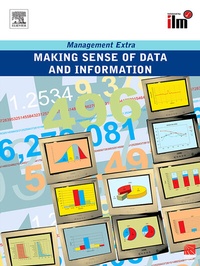
Making Sense of Data and Information
Management Extra
1st Edition
Published on 22. March 2007
Book
Paperback/Softback
114 pages
978-0-08-046521-0 (ISBN)
Description
Managers need to be able to make sense of data and to use it selectively to answer key questions: Why has quality fallen in the last week? Should we subcontract or employ more people? What will consumer demand be in the future? They need to be able to assess the value of data and to detect what is and what isn't spin.
The focus is on analysing numbers. On their own, figures tell us very little. To become meaningful they need to be processed and analysed and it is the patterns that emerge from this that provide the information that is needed for decision-making.
The book is arranged in four themes. It starts by considering the value of information in organisations and by assessing how effectively the information is used in a management role. It then goes on to look at different options for presenting figures so that trends become clearer and patterns simpler to spot. As well as making data easier to interpret, the techniques the book presents are valuable communication tools that will help the reader use information more effectively with others.
The last two themes then provide a toolkit of techniques that you can use to investigate situations and help solve problems. These include statistical and operational techniques as well as computer tools. Like any toolkit, the key to using it properly lies in knowing not only what each tool does but when to use it. This book will help the reader to develop this ability by applying the methods that are described within a business context.
The focus is on analysing numbers. On their own, figures tell us very little. To become meaningful they need to be processed and analysed and it is the patterns that emerge from this that provide the information that is needed for decision-making.
The book is arranged in four themes. It starts by considering the value of information in organisations and by assessing how effectively the information is used in a management role. It then goes on to look at different options for presenting figures so that trends become clearer and patterns simpler to spot. As well as making data easier to interpret, the techniques the book presents are valuable communication tools that will help the reader use information more effectively with others.
The last two themes then provide a toolkit of techniques that you can use to investigate situations and help solve problems. These include statistical and operational techniques as well as computer tools. Like any toolkit, the key to using it properly lies in knowing not only what each tool does but when to use it. This book will help the reader to develop this ability by applying the methods that are described within a business context.
More details
Series
Language
English
Place of publication
Oxford
United Kingdom
Publishing group
Taylor & Francis Ltd
Target group
College/higher education
Professional Practice & Development
Illustrations
Illustrated
Dimensions
Height: 297 mm
Width: 210 mm
Weight
460 gr
ISBN-13
978-0-08-046521-0 (9780080465210)
Copyright in bibliographic data and cover images is held by Nielsen Book Services Limited or by the publishers or by their respective licensors: all rights reserved.
Schweitzer Classification
Other editions
Additional editions
Book
06/2017
1st Edition
Routledge
€297.61
Shipment within 10-20 days
E-Book
06/2013
1st Edition
Routledge
€69.99
Available for download
E-Book
06/2013
1st Edition
Routledge
€69.99
Available for download
Person
Elearn
Content
List of activities, List of figures, List of tables, Series preface, Introduction: Making sense of data and information, 1. Becoming a critical thinker, 2. Finding and showing the message in numbers, 3. Using computer tools, 4. Analytical statistics, References