

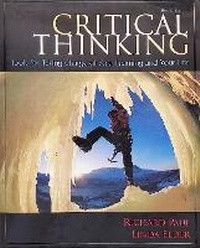
Critical Thinking
Tools for Taking Charge of Your Learning and Your Life
3rd Edition
Published on 10. September 2011
Book
Paperback/Softback
528 pages
978-1-5381-3948-6 (ISBN)
Description
Written by two of the leading experts in the field, this introductory text presents critical thinking as a process for taking charge of and responsibility for one's thinking.
Based in theory developed over the last 30 years, Richard Paul and Linda Elder's text focuses on an integrated, comprehensive concept of critical thinking that is both substantive and practical. It fosters the development of basic intellectual skills students need to think through content in any class, subject, or discipline, as well as through any problem or issue they face. Simply stated, this text offers students the intellectual tools students need for lifelong learning, and rational, conscientious living.
Now available from Rowman & Littlefield, the third edition features streamlined chapters, Think for Yourself activities, and a complete glossary of critical thinking terms. The Foundation for Critical Thinking continually offers new supplementary resources on its website (www.CriticalThinking.org) and online critical thinking community.
Based in theory developed over the last 30 years, Richard Paul and Linda Elder's text focuses on an integrated, comprehensive concept of critical thinking that is both substantive and practical. It fosters the development of basic intellectual skills students need to think through content in any class, subject, or discipline, as well as through any problem or issue they face. Simply stated, this text offers students the intellectual tools students need for lifelong learning, and rational, conscientious living.
Now available from Rowman & Littlefield, the third edition features streamlined chapters, Think for Yourself activities, and a complete glossary of critical thinking terms. The Foundation for Critical Thinking continually offers new supplementary resources on its website (www.CriticalThinking.org) and online critical thinking community.
Reviews / Votes
Every semester I learn more about myself when teaching critical thinking. I have always used the Socratic method when teaching other courses, but due to actually teaching a "Critical Thinking" course and using this particular textbook, I find myself incorporating the traits and standards into ALL the courses. This, after all, is what it is all about! -- Rochelle R. Brunson, Alvin Community College Paul and Elder are two of the experts in the field of Critical Thinking and this book is one of the best on the market today. -- Jan C. Graham, Mayland Community CollegeMore details
Edition
3rd edition
Language
English
Place of publication
United States
Publishing group
Bloomsbury Publishing Plc
Target group
College/higher education
US School Grade: From College Freshman to College Graduate Student
Dimensions
Height: 231 mm
Width: 190 mm
Thickness: 21 mm
Weight
785 gr
ISBN-13
978-1-5381-3948-6 (9781538139486)
Copyright in bibliographic data and cover images is held by Nielsen Book Services Limited or by the publishers or by their respective licensors: all rights reserved.
Schweitzer Classification
Other editions
Additional editions
E-Book
03/2020
3rd Edition
Foundation for Critical Thinking
€73.99
Available for download
E-Book
03/2020
3rd Edition
The Foundation for Critical Thinking
€73.99
Available for download
Persons
Dr. Linda Elder is an educational psychologist who has taught both psychology and critical thinking at the college level. She has been President of the Foundation for Critical Thinking and the Executive Director of the Center for Critical Thinking for almost 25 years. She has a special interest in the relation of thought and emotion, as well as the cognitive and affective. She has developed an original theory of the stages of critical thinking development. Elder has coauthored four books on critical thinking, as well as all 23 titles found in the Thinker's Guide Library.
Dr. Richard Paul was a leading proponent of critical thinking and through his work and legacy remains an international authority in the field. He founded the Center for Critical Thinking at Sonoma State University in 1980, followed by the Foundation for Critical Thinking. He developed concepts, principles, and theory essentials to a robust and fairminded conception of critical thinking and authored more than 200 articles and seven books on the topic. He presented workshops to hundreds of thousands of educators over his 35-year career as a leader in the critical thinking movement.
Dr. Richard Paul was a leading proponent of critical thinking and through his work and legacy remains an international authority in the field. He founded the Center for Critical Thinking at Sonoma State University in 1980, followed by the Foundation for Critical Thinking. He developed concepts, principles, and theory essentials to a robust and fairminded conception of critical thinking and authored more than 200 articles and seven books on the topic. He presented workshops to hundreds of thousands of educators over his 35-year career as a leader in the critical thinking movement.
Content
Introduction
Chapter 1: Become a Fairminded Thinker
Chapter 2: The First Four Stages of Development: At What Level of Thinking Would You Place Yourself?
Chapter 3: Self-Understanding
Chapter 4: The Parts of Thinking
Chapter 5: Standards for Thinking
Chapter 6: Ask Questions That Lead to Good Thinking
Chapter 7: Master the Thinking, Master the Content
Chapter 8: Discover How the Best Thinkers Learn
Chapter 9: Redefine Grades as Levels of Thinking and Learning
Chapter 10: Make Decisions and Solve Problems
Chapter 11: Deal with Your Irrational Mind
Chapter 12: How to Detect Media Bias and Propaganda in National and World News
Chapter 13: Fallacies: The Art of Mental Trickery and Manipulation
Chapter 14: Develop as an Ethical Reasoner
Chapter 16: Strategic Thinking
Chapter 17: Becoming an Advanced Thinker: Our Conclusion
Appendix A: a brief history of the idea of critical thinking
Appendix B: sample analysis of the logic of . . .
Glossary
Chapter 1: Become a Fairminded Thinker
Chapter 2: The First Four Stages of Development: At What Level of Thinking Would You Place Yourself?
Chapter 3: Self-Understanding
Chapter 4: The Parts of Thinking
Chapter 5: Standards for Thinking
Chapter 6: Ask Questions That Lead to Good Thinking
Chapter 7: Master the Thinking, Master the Content
Chapter 8: Discover How the Best Thinkers Learn
Chapter 9: Redefine Grades as Levels of Thinking and Learning
Chapter 10: Make Decisions and Solve Problems
Chapter 11: Deal with Your Irrational Mind
Chapter 12: How to Detect Media Bias and Propaganda in National and World News
Chapter 13: Fallacies: The Art of Mental Trickery and Manipulation
Chapter 14: Develop as an Ethical Reasoner
Chapter 16: Strategic Thinking
Chapter 17: Becoming an Advanced Thinker: Our Conclusion
Appendix A: a brief history of the idea of critical thinking
Appendix B: sample analysis of the logic of . . .
Glossary