

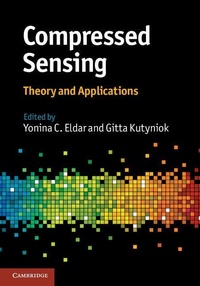
Compressed Sensing
Theory and Applications
Published on 17. May 2012
Book
Hardback
558 pages
978-1-107-00558-7 (ISBN)
Description
Compressed sensing is an exciting, rapidly growing field, attracting considerable attention in electrical engineering, applied mathematics, statistics and computer science. This book provides the first detailed introduction to the subject, highlighting theoretical advances and a range of applications, as well as outlining numerous remaining research challenges. After a thorough review of the basic theory, many cutting-edge techniques are presented, including advanced signal modeling, sub-Nyquist sampling of analog signals, non-asymptotic analysis of random matrices, adaptive sensing, greedy algorithms and use of graphical models. All chapters are written by leading researchers in the field, and consistent style and notation are utilized throughout. Key background information and clear definitions make this an ideal resource for researchers, graduate students and practitioners wanting to join this exciting research area. It can also serve as a supplementary textbook for courses on computer vision, coding theory, signal processing, image processing and algorithms for efficient data processing.
Reviews / Votes
'... a charming encouragement to fascinating scientific adventure for talented students. Also ... a solid reference platform for researchers in many fields.' Artur Przelaskowski, IEEE Communications MagazineMore details
Language
English
Place of publication
Cambridge
United Kingdom
Target group
Professional and scholarly
Illustrations
9 Tables, black and white; 26 Halftones, unspecified; 102 Line drawings, unspecified
Dimensions
Height: 250 mm
Width: 175 mm
Thickness: 34 mm
Weight
1130 gr
ISBN-13
978-1-107-00558-7 (9781107005587)
Copyright in bibliographic data and cover images is held by Nielsen Book Services Limited or by the publishers or by their respective licensors: all rights reserved.
Schweitzer Classification
Other editions
Additional editions
E-Book
06/2012
1st Edition
Cambridge University Press
€90.49
Available for download
E-Book
05/2012
Cambridge University Press
€76.49
Available for download
Persons
Yonina C. Eldar is a Professor in the Department of Electrical Engineering at the Technion, Israel Institute of Technology, a Research Affiliate with the Research Laboratory of Electronics at the Massachusetts Institute of Technology, and a Visiting Professor at Stanford University, California. She has received numerous awards for excellence in research and teaching, including the Wolf Foundation Krill Prize for Excellence in Scientific Research, the Hershel Rich Innovation Award, the Weizmann Prize for Exact Sciences, the Michael Bruno Memorial Award from the Rothschild Foundation, and the Muriel and David Jacknow Award for Excellence in Teaching. She is an Associate Editor for several journals in the areas of signal processing and mathematics and a Signal Processing Society Distinguished Lecturer. Gitta Kutyniok is an Einstein Professor in the Department of Mathematics at the Technische Universitaet Berlin, Germany. She has been a Postdoctoral Fellow at Princeton University, New Jersey, Stanford University, California, and Yale University, Connecticut, and a Full Professor at the Universitaet Osnabrueck, Germany. Her research and teaching has been recognized by various awards, including a Heisenberg Fellowship and the von Kaven Prize by the German Research Foundation, an Einstein Chair by the Einstein Foundation in Berlin, awards by the Universitaet Paderborn and the Justus-Liebig Universitaet Giessen for Excellence Research, as well as the Weierstrass Prize for Outstanding Teaching. She is an Associate Editor and also Corresponding Editor for several journals in the areas of applied mathematics.
Content
1. Introduction to compressed sensing Mark A. Davenport, Marco F. Duarte, Yonina C. Eldar and Gitta Kutyniok; 2. Second generation sparse modeling: structured and collaborative signal analysis Alexey Castrodad, Ignacio Ramirez, Guillermo Sapiro, Pablo Sprechmann and Guoshen Yu; 3. Xampling: compressed sensing of analog signals Moshe Mishali and Yonina C. Eldar; 4. Sampling at the rate of innovation: theory and applications Jose Antonia Uriguen, Yonina C. Eldar, Pier Luigi Dragotta and Zvika Ben-Haim; 5. Introduction to the non-asymptotic analysis of random matrices Roman Vershynin; 6. Adaptive sensing for sparse recovery Jarvis Haupt and Robert Nowak; 7. Fundamental thresholds in compressed sensing: a high-dimensional geometry approach Weiyu Xu and Babak Hassibi; 8. Greedy algorithms for compressed sensing Thomas Blumensath, Michael E. Davies and Gabriel Rilling; 9. Graphical models concepts in compressed sensing Andrea Montanari; 10. Finding needles in compressed haystacks Robert Calderbank, Sina Jafarpour and Jeremy Kent; 11. Data separation by sparse representations Gitta Kutyniok; 12. Face recognition by sparse representation Arvind Ganesh, Andrew Wagner, Zihan Zhou, Allen Y. Yang, Yi Ma and John Wright.