

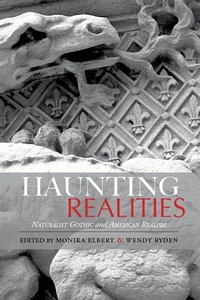
Haunting Realities
Naturalist Gothic and American Realism
Published on 19. July 2022
Book
Paperback/Softback
304 pages
978-0-8173-6059-7 (ISBN)
Description
An innovative collection of essays examining the sometimes paradoxical alignment of Realism and Naturalism with the Gothic in American literature to highlight their shared qualities
Following the golden age of British Gothic in the late eighteenth century, the American Gothic's pinnacle is often recognized as having taken place during the decades of American Romanticism. However, Haunting Realities explores the period of American Realism-the end of the nineteenth century-to discover evidence of fertile ground for another age of Gothic proliferation.
At first glance, "Naturalist Gothic" seems to be a contradiction in terms. While the Gothic is known for its sensational effects, with its emphasis on horror and the supernatural, the doctrines of late nineteenth-century Naturalism attempted to move away from the aesthetics of sentimentality and stressed sobering, mechanistic views of reality steeped in scientific thought and the determinism of market values and biology. Nonetheless, what binds Gothicism and Naturalism together is a vision of shared pessimism and the perception of a fearful, lingering presence that ominously haunts an impending modernity. Indeed, it seems that in many Naturalist works reality is so horrific that it can only be depicted through Gothic tropes that prefigure the alienation and despair of modernism.
In recent years, research on the Gothic has flourished, yet there has been no extensive study of the links between the Gothic and Naturalism, particularly those which stem from the early American Realist tradition. Haunting Realities is a timely volume that addresses this gap and is an important addition to scholarly work on both the Gothic and Naturalism in the American literary tradition.
Following the golden age of British Gothic in the late eighteenth century, the American Gothic's pinnacle is often recognized as having taken place during the decades of American Romanticism. However, Haunting Realities explores the period of American Realism-the end of the nineteenth century-to discover evidence of fertile ground for another age of Gothic proliferation.
At first glance, "Naturalist Gothic" seems to be a contradiction in terms. While the Gothic is known for its sensational effects, with its emphasis on horror and the supernatural, the doctrines of late nineteenth-century Naturalism attempted to move away from the aesthetics of sentimentality and stressed sobering, mechanistic views of reality steeped in scientific thought and the determinism of market values and biology. Nonetheless, what binds Gothicism and Naturalism together is a vision of shared pessimism and the perception of a fearful, lingering presence that ominously haunts an impending modernity. Indeed, it seems that in many Naturalist works reality is so horrific that it can only be depicted through Gothic tropes that prefigure the alienation and despair of modernism.
In recent years, research on the Gothic has flourished, yet there has been no extensive study of the links between the Gothic and Naturalism, particularly those which stem from the early American Realist tradition. Haunting Realities is a timely volume that addresses this gap and is an important addition to scholarly work on both the Gothic and Naturalism in the American literary tradition.
More details
Series
Language
English
Place of publication
Alabama
United States
Target group
Professional and scholarly
Product notice
Paperback (trade)
Unsewn / adhesive bound
Illustrations
1 b&w figure
Dimensions
Height: 226 mm
Width: 150 mm
Thickness: 25 mm
Weight
454 gr
ISBN-13
978-0-8173-6059-7 (9780817360597)
Copyright in bibliographic data and cover images is held by Nielsen Book Services Limited or by the publishers or by their respective licensors: all rights reserved.
Schweitzer Classification
Persons
Monika Elbert is a professor of English at Montclair State University and coeditor of Romantic Education in Nineteenth-Century American Literature: National and Transatlantic Contexts and Transnational Gothic: Literary and Social Exchanges in the Long Nineteenth Century.
Wendy Ryden is an associate professor of English at Long Island University Post and coauthor of Reading, Writing, and the Rhetorics of Whiteness.