

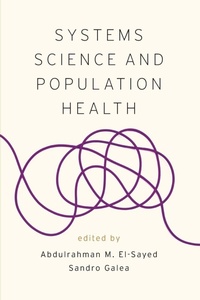
Systems Science and Population Health
Published on 6. April 2017
Book
Paperback/Softback
240 pages
978-0-19-049239-7 (ISBN)
Description
Population health is complex and multileveled, encompassing dynamic interactions between cells, societies, and everything in between. Our typical approach to studying population health, however, remains oriented around a reductionist approach to conceptualizing, empirically analyzing, and intervening to improve population health. The trouble is that interventions founded on simplifying a complex world often do not work, sometimes yielding failure or, even worse, harm. The difficult truth is that "silver bullet" health science often fails, and understanding these failures can help us improve our approach to health science, and, ultimately, population health.
SYSTEMS SCIENCE AND POPULATION HEALTH employs principles from across a range of sciences to refine the way we understand population health. By augmenting traditional analytic approaches with new tools like machine learning, microsimulation, and social network analysis, population health can be studied as a dynamic and complex system. This allows us to understand population health as a complex whole, offering new insights and perspectives that stand to improve the health of the public. This text offers the first educational and practical guide to this forward-thinking approach.
Comprising 17 chapters from the vanguard of population health, epidemiology, computer science, and medicine, this book offers a three-part introduction to the subject:
DT An intellectual and conceptual history of systems science as it intersects with population health
DT Concise, introductory overviews of important and emerging methodological tools in systems science, including systems dynamics, agent-based modeling, microsimulation, social network analysis, and machine-learning-all with relevant examples drawn from population health literature
DT An exploration of future implications for systems science and its applications to our understanding of population health issues
For researchers, students, and practitioners, SYSTEMS SCIENCE AND POPULATION HEALTH redefines many of the foundational elements of how we understand population health. It should not be missed.
SYSTEMS SCIENCE AND POPULATION HEALTH employs principles from across a range of sciences to refine the way we understand population health. By augmenting traditional analytic approaches with new tools like machine learning, microsimulation, and social network analysis, population health can be studied as a dynamic and complex system. This allows us to understand population health as a complex whole, offering new insights and perspectives that stand to improve the health of the public. This text offers the first educational and practical guide to this forward-thinking approach.
Comprising 17 chapters from the vanguard of population health, epidemiology, computer science, and medicine, this book offers a three-part introduction to the subject:
DT An intellectual and conceptual history of systems science as it intersects with population health
DT Concise, introductory overviews of important and emerging methodological tools in systems science, including systems dynamics, agent-based modeling, microsimulation, social network analysis, and machine-learning-all with relevant examples drawn from population health literature
DT An exploration of future implications for systems science and its applications to our understanding of population health issues
For researchers, students, and practitioners, SYSTEMS SCIENCE AND POPULATION HEALTH redefines many of the foundational elements of how we understand population health. It should not be missed.
More details
Language
English
Place of publication
New York
United States
Target group
College/higher education
Dimensions
Height: 234 mm
Width: 156 mm
Thickness: 14 mm
Weight
412 gr
ISBN-13
978-0-19-049239-7 (9780190492397)
Copyright in bibliographic data and cover images is held by Nielsen Book Services Limited or by the publishers or by their respective licensors: all rights reserved.
Schweitzer Classification
Other editions
Additional editions
Abdulrahman M. El-Sayed | Sandro Galea
Systems Science and Population Health
E-Book
02/2017
1st Edition
OUP eBook
€47.49
Available for download
Abdulrahman M. El-Sayed | Sandro Galea
Systems Science and Population Health
E-Book
02/2017
1st Edition
OUP eBook
€47.49
Available for download
Persons
Abdulrahman M. El-Sayed, MD, DPhil, is a public health physician and epidemiologist. He serves the City of Detroit as the Executive Director of the Detroit Health Department and Health Officer. Under his leadership, the Detroit Health Department has emerged as a state and national leader in promoting healthy air quality, lead elimination, and public health innovation. Dr. El-Sayed's research explores urban health policy, the social determinants of health, and health inequalities. Previously, he was a professor in the Department of Epidemiology at Columbia University.
Sandro Galea, MD, DrPH, is a physician and an epidemiologist interested in the social production of health of urban populations. His work explores innovative cells-to-society approaches to population health questions. He is interested in advancing a consequentialist approach to population health scholarship. He currently serves as Robert A. Knox Professor and Dean of the School of Public Health at Boston University. He is a past president of the Society for Epidemiologic Research, and an elected member of the National Academy of Medicine.
Together they have been engaged in systems science scholarship and education for more than 15 years.
Sandro Galea, MD, DrPH, is a physician and an epidemiologist interested in the social production of health of urban populations. His work explores innovative cells-to-society approaches to population health questions. He is interested in advancing a consequentialist approach to population health scholarship. He currently serves as Robert A. Knox Professor and Dean of the School of Public Health at Boston University. He is a past president of the Society for Epidemiologic Research, and an elected member of the National Academy of Medicine.
Together they have been engaged in systems science scholarship and education for more than 15 years.
Content
1.Introduction
Abdulrahman M. El-Sayed
SECTION 1: Simplicity, complexity and population health
2. Reductionism at the dawn of population health
Kristin Heitman
3. Wrong answers: when simple interpretations create complex problems
David S. Fink, Katherine M. Keyes
4. Complexity: the evolution towards 21st century science
Anton Palma, David W. Lounsbury
5. Systems thinking in population health research and policy
Stephen Mooney
SECTION 2: Methods in systems population health
6. Generation of systems maps: mapping complex systems of population health
Helen de Pinho
7. Systems dynamics models
Eric Lofgren
8. Agent-based modeling
Brandon Marshall
9. Microsimulation
Sanjay Basu
10. Social network analysis: the ubiquity of social networks
and their importance for population health
Douglas A. Luke, Amar Dhand, Bobbi J. Carothers
SECTION 3: Systems science towards a consequential population health
11. Machine learning
James H. Faghmous
12. Systems science and the social determinants of population health
David S. Fink, Katherine M. Keyes, Magdalena Cerda
13. Systems approaches to understanding how the environment
influences population health and population health interventions
Melissa Tracy
14. Systems of behavior and population health
Mark Orr, Kathryn Ziemer, Daniel Chen
15. Systems under your skin
Karina Standahl Olsen, Hege Bovelstad, Eiliv Lund
16. Frontiers in health modeling
Nathaniel Osgood
17. Systems science and population health
Abdulrahman M. El-Sayed, Sandro Galea
Abdulrahman M. El-Sayed
SECTION 1: Simplicity, complexity and population health
2. Reductionism at the dawn of population health
Kristin Heitman
3. Wrong answers: when simple interpretations create complex problems
David S. Fink, Katherine M. Keyes
4. Complexity: the evolution towards 21st century science
Anton Palma, David W. Lounsbury
5. Systems thinking in population health research and policy
Stephen Mooney
SECTION 2: Methods in systems population health
6. Generation of systems maps: mapping complex systems of population health
Helen de Pinho
7. Systems dynamics models
Eric Lofgren
8. Agent-based modeling
Brandon Marshall
9. Microsimulation
Sanjay Basu
10. Social network analysis: the ubiquity of social networks
and their importance for population health
Douglas A. Luke, Amar Dhand, Bobbi J. Carothers
SECTION 3: Systems science towards a consequential population health
11. Machine learning
James H. Faghmous
12. Systems science and the social determinants of population health
David S. Fink, Katherine M. Keyes, Magdalena Cerda
13. Systems approaches to understanding how the environment
influences population health and population health interventions
Melissa Tracy
14. Systems of behavior and population health
Mark Orr, Kathryn Ziemer, Daniel Chen
15. Systems under your skin
Karina Standahl Olsen, Hege Bovelstad, Eiliv Lund
16. Frontiers in health modeling
Nathaniel Osgood
17. Systems science and population health
Abdulrahman M. El-Sayed, Sandro Galea