

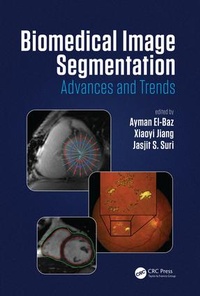
Biomedical Image Segmentation
Advances and Trends
1st Edition
Published on 17. November 2016
Book
Hardback
526 pages
978-1-4822-5855-4 (ISBN)
Description
As one of the most important tasks in biomedical imaging, image segmentation provides the foundation for quantitative reasoning and diagnostic techniques. A large variety of different imaging techniques, each with its own physical principle and characteristics (e.g., noise modeling), often requires modality-specific algorithmic treatment. In recent years, substantial progress has been made to biomedical image segmentation. Biomedical image segmentation is characterized by several specific factors. This book presents an overview of the advanced segmentation algorithms and their applications.
Reviews / Votes
"The book provides a current and thorough overview of some commonly used image segmentation algorithms for medical imaging. The overview of a wide selection of methods is helpful, and I also found it very convenient to see implementation details collected in one single volume. This makes the book a good reference book for both researchers in the field, and could also be helpful for software engineers in the medical industry implementing methods for medical practitioners."- Kristian Sandberg, Computational Solutions, Inc., Colorado, USA
More details
Language
English
Place of publication
Bosa Roca
United States
Publishing group
Taylor & Francis Inc
Target group
College/higher education
Professional and scholarly
Researchers, medical scientists, radiologists, practitioners, computer scientists in medical imaging and image segmentation.
Illustrations
210 farbige Abbildungen, 34 s/w Tabellen
34 Tables, black and white; 210 Illustrations, color
Dimensions
Height: 254 mm
Width: 178 mm
Weight
1315 gr
ISBN-13
978-1-4822-5855-4 (9781482258554)
Copyright in bibliographic data and cover images is held by Nielsen Book Services Limited or by the publishers or by their respective licensors: all rights reserved.
Schweitzer Classification
Other editions
Additional editions
Book
12/2019
1st Edition
CRC Press
€171.20
Shipment within 15-20 days
E-Book
11/2016
CRC Press
€165.99
Available for download
E-Book
11/2016
CRC Press
€165.99
Available for download
Persons
Ayman El-Baz, Ph.D, is an associate professor in the Department of Bioengineering at the University of Louisville, Kentucky, USA. Dr. El-Baz has twelve years of hands-on experience in the fields of bioimaging modeling and computer-assisted diagnostic systems. He has developed new techniques for analyzing 3D medical images. His work has been reported at several prestigious international conferences (e.g., CVPR, ICCV, MICCAI, etc.) and in journals (e.g., IEEE TIP, IEEE TBME, IEEE TITB, Brain, etc.). His work related to novel image analysis techniques for lung cancer and autism diagnosis have earned him multiple awards, including: first place at the annual Research Louisville 2002, 2005, 2006, 2007, 2008, 2010, 2011 and 2012 meetings, and the "Best Paper Award in Medical Image Processing" from the prestigious ICGST International Conference on Graphics, Vision, and Image Processing (GVIP-2005). Dr. El-Baz has authored or coauthored more than 300 technical articles.
Xiaoyi Jiang studied computer science at Peking University and received his Ph.D and Venia Docendi (Habilitation) degree in computer science from University of Bern, Switzerland. He was an associate professor at Technical University of Berlin, Germany. Since 2002, he has been a full professor of computer science at University of Muenster, Germany. Currently, he is editor-in-chief of the Int. Journal of Pattern Recognition and Artificial Intelligence and also serves on the advisory board and editorial board of several journals including Pattern Recognition, IEEE Trans. on Systems, Man, and Cybernetics - Part B, and Chinese Science Bulletin. His research interests include biomedical image analysis, 3D image analysis, and structural pattern recognition. He is a PI of the new Cluster of Excellence "Cells in Motion" funded by the German Excellence Initiative, a senior member of IEEE, and a fellow of IAPR.
Xiaoyi Jiang studied computer science at Peking University and received his Ph.D and Venia Docendi (Habilitation) degree in computer science from University of Bern, Switzerland. He was an associate professor at Technical University of Berlin, Germany. Since 2002, he has been a full professor of computer science at University of Muenster, Germany. Currently, he is editor-in-chief of the Int. Journal of Pattern Recognition and Artificial Intelligence and also serves on the advisory board and editorial board of several journals including Pattern Recognition, IEEE Trans. on Systems, Man, and Cybernetics - Part B, and Chinese Science Bulletin. His research interests include biomedical image analysis, 3D image analysis, and structural pattern recognition. He is a PI of the new Cluster of Excellence "Cells in Motion" funded by the German Excellence Initiative, a senior member of IEEE, and a fellow of IAPR.
Content
Brief Surveys of Segmentation Algorithm Classes. Level Set Segmentation: A Survey. Dynamic Programming Based Medical Image Segmentation. Optimal Graph-Based Surface Segmentation and Applications. Medical Image Segmentation Incorporating Physical Noise Models. Atlas-Based Medical Image Segmentation. Applications. Retinal Image Segmentation. Spine Segmentation. Arterial Wall Segmentation. Segmentation of the Left Ventricle. Multi-Atlas-Based Simultaneous Labeling of Longitudinal Dynamic Cortical Surfaces in Infants. Rotational Slice-Based Prostate Segmentation. Automated Nucleus and Cytoplasm Segmentation of Overlapping Cervical Cells. Deformable Atlas for Multi-Structure Segmentation. A Variational Framework for Joint Detection and Segmentation of Ovarian Cancer Metastases. Incorporating Shape Variability in Image Segmentation via Implicit Template Deformation. Cell Orientation Entrophy (COrE): Predicting Biochemical Recurrence from Prostate Cancer Tissue Microarrays. Left Ventricle Segmentation from Cardiac MRI Combining Level Set Methods with Deep Belief Networks. Infrared Target Tracking, Recognition, an Segmentation Using Shape-Award Level Set.