

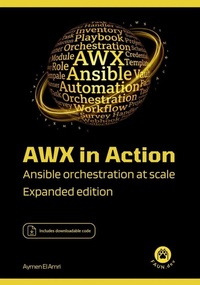
AWX in Action
Ansible Orchestration at Scale
2nd Edition
Published on 17. May 2026
Book
Paperback/Softback
206 pages
978-2-488111-00-3 (ISBN)
Description
You know Ansible. Your playbooks work. But your team is drowning in YAML sprawl, missed schedules, untracked changes, and "who ran what when" questions nobody can answer.
AWX fixes this if you know how to wield it.
AWX in Action: Ansible Orchestration at Scale is the practical guide for Ansible users ready to graduate from command-line scripts to a production-grade automation platform. AWX is the most powerful way to scale Ansible beyond CLI execution. But the official docs are dense, the moving parts are many, and most teams adopt AWX without ever using half of what it can do.
This book changes that.
Written by Aymen El Amri - cloud-native engineer with 15+ years in production systems, founder of FAUN.dev, and recognized by TechBeacon among the top 100 DevOps professionals to follow - this guide distills years of consulting engagements and battle-tested workshop teaching into a single hands-on reference.
What you'll learn
In this guide, you'll work through AWX, the web-based interface for Ansible, and learn how to use it to scale your automation. Here's what you'll cover:
Installation and Configuration: Set up AWX in your environment using Docker or Kubernetes. The official docs are overwhelming; this guide cuts to a clean, repeatable setup.
Organizations, Users, and Teams: Structure AWX with organizations, users, and teams to manage permissions and secure your automation.
Hosts and Inventories: Create and manage static and dynamic (e.g., AWS) inventories, group hosts, add credentials, and use constructed inventories for advanced cases.
Projects, Templates, and Jobs: The core of AWX. Create projects, configure job templates, run ad hoc commands, launch and schedule jobs, and orchestrate complex flows with workflow templates and surveys. You'll also cover signature validation, project sync, notifications, and job artifacts, with practical examples and best practices throughout.
AWX CLI: Install and authenticate the CLI, generate organization-scoped tokens, and manage, import, and export resources.
Execution Environments and Instances: Build custom execution environments with Ansible Builder and Runner. Manage execution and hop instances, instance groups, clustering, container groups, and capacity, with the internals explained so you can scale and run AWX in HA.
Settings: Configure authentication, job settings, logging, cache, and debugging.
Monitoring and Status Views: Use the dashboard, jobs, schedules, activity streams, management jobs, notifications, logging, and metrics, including a head start on Prometheus monitoring.
Real-World Example: Tie it together. Use custom execution environments and external roles, build a workflow with scheduling and notifications, and launch jobs from the AWX CLI, the AWX API, and your CI pipelines.
By the end, you'll have what you need to roll out AWX confidently, solo or with a team.
Who this book is for
Experienced Ansible users, DevOps engineers, SREs, sysadmins, and platform teams who want to move beyond ansible-playbook and operate Ansible like production infrastructure - not just script it.
What sets this book apart
Built from real consulting engagements and a battle-tested workshop, not vendor marketing. Every chapter explains not just how AWX works but why - so you can debug, extend, and operate it long after you finish reading.
More details
Person
Aymen El Amri is a software engineer, author, and founder of FAUN.dev, a platform and newsletter network serving hundreds of thousands of developers across DevOps, cloud native, Kubernetes, and applied AI. He writes practical, hands-on technical books for engineers, covering Docker, Kubernetes, Ansible, AWX, Python, and large language models. His work focuses on turning complex infrastructure and AI topics into clear, example-driven guides that practitioners can apply immediately. More at FAUN.dev.