

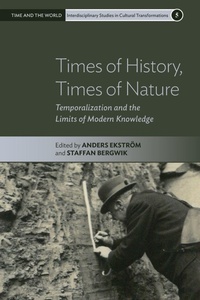
Times of History, Times of Nature
Temporalization and the Limits of Modern Knowledge
Published on 1. April 2024
Book
Paperback/Softback
360 pages
978-1-80539-311-5 (ISBN)
Description
As climate change becomes an increasingly important part of public discourse, the relationship between time in nature and history is changing. Nature can no longer be considered a slow and immobile background to human history, and the future can no longer be viewed as open and detached from the past. Times of History, Times of Nature engages with this historical shift in temporal sensibilities through a combination of detailed case studies and synthesizing efforts. Focusing on the history of knowledge, media theory, and environmental humanities, this volume explores the rich and nuanced notions of time and temporality that have emerged in response to climate change.
Reviews / Votes
"Climate unsettles our current knowledge system; we must rethink our understanding of time. This collected volume is an ambitious effort, and very forward-looking. The volume editors recognize that we are entering a conceptual realm where we might not recognize the new." * Stefan Tanaka, University of California San DiegoMore details
Series
Language
English
Place of publication
Oxford
United Kingdom
Target group
Professional and scholarly
Product notice
Paperback (trade)
Illustrations
Bibliography; Index
Dimensions
Height: 229 mm
Width: 152 mm
Thickness: 19 mm
Weight
522 gr
ISBN-13
978-1-80539-311-5 (9781805393115)
DOI
10.3167/9781800733237
Copyright in bibliographic data and cover images is held by Nielsen Book Services Limited or by the publishers or by their respective licensors: all rights reserved.
Schweitzer Classification
Persons
Anders Ekstroem is a Professor at the Department of History of Science and Ideas at Uppsala University, Sweden. His most recent publications include a co-edited volume on the History of Participatory Media (Routledge, 2011), the article "Remediation, Time and Disaster", in Theory, Culture & Society 33:5 (2016), and a chapter for the Routledge Handbook of Museum Media and Communication (2019).
Content
List of illustrations
Introduction: Dividing Times
Staffan Bergwik and Anders Ekstroem
PART I: ERAS OF SYNCHRONIZATION
Chapter 1. Stratigraphies of Time and History: Beyond the Outrages upon Humanity's Self-Love
Helge Jordheim
Chapter 2. The Production and Distribution of Synchronized Time in Sweden, 1850-1914
Gustav Holmberg
Chapter 3. Environmental Times: Synchronizing Human-Earth Temporalities from Annales to Anthropocene, 1920s to 2020s
Sverker Soerlin
PART II: BIOCULTURAL TIMES
Chapter 4. Forest Time and the Passions of Economic Man
Julia Nordblad
Chapter 5. Little Red Ring Binders: Early Red List Temporalities
Marit Ruge Bjaerke
Chapter 6. Oil and Vikings: Temporal Alignments within Norwegian Petroleum Fields
Lise Camilla Ruud
PART III: TIME-BINDING KNOWLEDGES AND VISUAL GENRES
Chapter 7. Temporal Poetics of Planetary Transformations: Alexander von Humboldt and the Geo-Anthropological History of the Americas
Adam Wickberg Mansson
Chapter 8. Discovering Moravian History: The Many Times and Sources of an Unknown Land, c. 1830-1860
Emma Hagstroem Molin
Chapter 9. Synchronising Nature and Culture: Mediating Time in Geochronology and Dendrochronology 1900-1945
Staffan Bergwik
PART IV: RECORDING AND ENVISIONING CLIMATE TIMES
Chapter 10. On Record: Political Temperature and the Temporalities of Climate Change
Eric Paglia and Erik Isberg
Chapter 11. Model Time and Target Years: On the End of Time in IPCC Futures
Nina Wormbs
Chapter 12. Encountering the Geological Live: Temporalization in the Age of Natural Media
Anders Ekstroem
Conclusion
Staffan Bergwik and Anders Ekstroem
Introduction: Dividing Times
Staffan Bergwik and Anders Ekstroem
PART I: ERAS OF SYNCHRONIZATION
Chapter 1. Stratigraphies of Time and History: Beyond the Outrages upon Humanity's Self-Love
Helge Jordheim
Chapter 2. The Production and Distribution of Synchronized Time in Sweden, 1850-1914
Gustav Holmberg
Chapter 3. Environmental Times: Synchronizing Human-Earth Temporalities from Annales to Anthropocene, 1920s to 2020s
Sverker Soerlin
PART II: BIOCULTURAL TIMES
Chapter 4. Forest Time and the Passions of Economic Man
Julia Nordblad
Chapter 5. Little Red Ring Binders: Early Red List Temporalities
Marit Ruge Bjaerke
Chapter 6. Oil and Vikings: Temporal Alignments within Norwegian Petroleum Fields
Lise Camilla Ruud
PART III: TIME-BINDING KNOWLEDGES AND VISUAL GENRES
Chapter 7. Temporal Poetics of Planetary Transformations: Alexander von Humboldt and the Geo-Anthropological History of the Americas
Adam Wickberg Mansson
Chapter 8. Discovering Moravian History: The Many Times and Sources of an Unknown Land, c. 1830-1860
Emma Hagstroem Molin
Chapter 9. Synchronising Nature and Culture: Mediating Time in Geochronology and Dendrochronology 1900-1945
Staffan Bergwik
PART IV: RECORDING AND ENVISIONING CLIMATE TIMES
Chapter 10. On Record: Political Temperature and the Temporalities of Climate Change
Eric Paglia and Erik Isberg
Chapter 11. Model Time and Target Years: On the End of Time in IPCC Futures
Nina Wormbs
Chapter 12. Encountering the Geological Live: Temporalization in the Age of Natural Media
Anders Ekstroem
Conclusion
Staffan Bergwik and Anders Ekstroem