

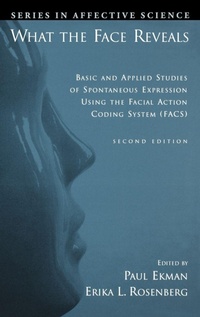
What the Face Reveals
Basic and Applied Studies of Spontaneous Expression Using the Facial Action Coding System (FACS)
2nd Edition
Published on 12. May 2005
Book
Hardback
672 pages
978-0-19-517964-4 (ISBN)
Description
While we have known for centuries that facial expressions can reveal what people are thinking and feeling, it is only recently that the face has been studied scientifically for what it can tell us about internal states, social behavior, and psychopathology. Today's widely available, sophisticated measuring systems have allowed us to conduct a wealth of new research on facial behavior that has contributed enormously to our understanding of the relationship between facial expression and human psychology. The chapters in this volume present the state-of-the-art in this research. They address key topics and questions, such as the dynamic and morphological differences between voluntary and involuntary expressions, the relationship between what people show on their faces and what they say they feel, whether it is possible to use facial behavior to draw distinctions among psychiatric populations, and how far research on automating facial measurement has progressed. The book also includes follow-up commentary on all of the original research presented and a concluding integration and critique of all the contributions made by Paul Ekman.
As an essential reference for all those working in the area of facial analysis and expression, this volume will be indispensable for a wide range of professionals and students in the fields of psychology, psychiatry, and behavioral medicine.
As an essential reference for all those working in the area of facial analysis and expression, this volume will be indispensable for a wide range of professionals and students in the fields of psychology, psychiatry, and behavioral medicine.
Reviews / Votes
What the Face Reveals dramatically illustrates the value of precise measurement of facial behavior in illuminating an impressive range of issues in basic and applied research. The chapters present innovative state-of-the-art applications of facial measurement, and the commentaries by authors and editors greatly enrich the readers experience. This is affective science of the highest quality, brimming with intriguing findings and promising new directions. * Robert W. Levenson, Professor of Psychology, University of California, Berkeley and Director of the Institute of Personality and Social Research and the Berkeley Psychophysiology Laboratory *More details
Series
Edition
2nd Revised edition
Language
English
Place of publication
New York
United States
Target group
Professional and scholarly
Edition type
Revised edition
Illustrations
31 halftones, 30 line illus.
Dimensions
Height: 240 mm
Width: 161 mm
Thickness: 40 mm
Weight
1148 gr
ISBN-13
978-0-19-517964-4 (9780195179644)
Copyright in bibliographic data and cover images is held by Nielsen Book Services Limited or by the publishers or by their respective licensors: all rights reserved.
Schweitzer Classification
Other editions
Additional editions
Paul Ekman | Erika L. Rosenberg
What the Face Reveals
Basic and Applied Studies of Spontaneous Expression Using the Facial Action Coding System (FACS)
E-Book
04/2005
2nd Edition
OUP USA
€61.99
Available for download
Paul Ekman | Erika L. Rosenberg
What the Face Reveals
Basic and Applied Studies of Spontaneous Expression Using the Facial Action Coding System (FACS)
E-Book
04/2005
2nd Edition
OUP USA
€61.99
Available for download
Previous edition

Book
02/1998
2nd Edition
Oxford University Press Inc
€35.96
Article exhausted; check for reprint
Persons
Paul Ekman was a Professor of Psychology for 32 years in the Department of Psychiatry at the University of California at San Francisco. He also served as chief psychologist in the U.S. Army, Fort Dix New Jersey from 1958-1960. His interests have focused on two separate, but related topics: He originally focused on nonverbal behavior, and by the mid-60s concentrated on the expression and physiology of emotion. His other interest is interpersonal deception. His research program was supported by grants from the National Institute of Mental Health, the National Science Foundation, and the Advanced Research Projects Agency of the DOD, loosely affiliated with UCSF. His many honors have included the Distinguished Scientific Contribution Award of the American Psychological Association in 1991, and an honorary doctor of humane letters from the University of Chicago in 1994. Dr. Ekman retired from UCSF in 2004.
Content
AFTERWORD: IS THE STARTLE REACTION AN EMOTION?; 2. THE ASYMMETRY OF FACIAL ACTIONS IS INCONSISTENT WITH MODELS OF HEMISPHERIC SPECIALIZATION; AFTERWORD: ASYMMETRY IN FACIAL MUSCULAR ACTIONS; AFTERWORD: ERIKA ROSENBERG; AFTERWORD: THE FACS IN HUMOR RESEARCH; AFTERWORD: LAUGHTER AND TEMPERAMENT; AFTERWORD: ON KNOWING ANOTHER'S PAIN; AFTERWORD: THE CONSISTENCY OF FACIAL EXPRESSIONS OF PAIN; AFTERWORD: SMILES WHEN LYING; AFTERWORD: SOME THOUGHTS ON FACS. DYNAMIC MARKERS OF EMOTION AND BASEBALL; AFTERWORD: COMPONENTS AND RECOGNITION OF FACIAL EXPRESSIONS IN THE COMMUNICATION OF EMOTION BY ACTORS GILLES KIROUAC; AFTERWORD: URSULA HESS; AFTERWORD: FACIAL EXPRESSIONS AS A WINDOW ON SENSORY EXPERIENCE AND AFFECT IN NEWBORN INFANTS; AFTERWORD: A MEASURE OF EARLY JOY; AFTERWORD: RAINER KRAUSE; AFTERWORD: NONVERBAL EXPRESSION OF PSYCHOLOGICAL STATES IN PSYCHIATRIC PATIENTS; AFTERWORD: PERSPECTIVES FOR STUDIES FOR PSYCHOPATHOLOGY AND PSYCHOTHERAPY; AFTERWORD: FROM PAMS TO TRAPS: INVESTIGATING GUILT FEELINGS WITH FACS; AFTERWORD: FACIAL EXPRESSION, PERSONALITY, AND PSYCHOPATHOLOGY; AFTERWORD: PAUL EKMAN, ERIKA L. ROSENBERG, MARGARET CHESNEY; AFTERWORD: ERIKA L. ROSENBERG AND PAUL EKMAN; AFTERWORD: USING FACS TO IDENTIFY CONTEXTUAL FACTORS INFLUENCING CRAVING; CONCLUSION: WHAT WE HAVE LEARNED BY MEASURING FACIAL BEHAVIOR