

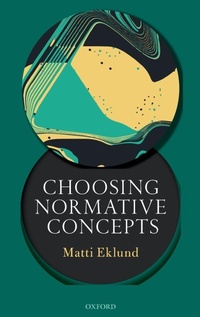
Choosing Normative Concepts
Published on 17. August 2017
Book
Hardback
232 pages
978-0-19-871782-9 (ISBN)
Description
Theorists working on metaethics and the nature of normativity typically study goodness, rightness, what ought to be done, and so on. In their investigations they employ and consider our actual normative concepts. But the actual concepts of goodness, rightness, and what ought to be done are only some of the possible normative concepts there are. There are other possible concepts, ascribing different properties. Matti Eklund explores the consequences of this thought, for example for the debate over normative realism, and for the debate over what it is for concepts and properties to be normative. Conceptual engineering - the project of considering how our concepts can be replaced by better ones - has become a central topic in philosophy. Eklund applies this methodology to central normative concepts and discusses the special complications that arise in this case. For example, since talk of improvement is itself normative, how should we, in the context, understand talk of a concept being better?
Reviews / Votes
Matti Eklund's excellent Choosing Normative Concepts is a rich and wide-ranging book. ... The book is well-argued, engaging, clear and simple in style, and rewards careful study. I highly recommend it to anyone with an interest in metaethics and metanormativity. * Nicholas Drake, Journal of Moral Philosophy * In all, this is a highly interesting book, full of important and useful theoretical resources, relevant and often neglected distinctions, and lots of things to think about for those working in meta-ethics. The book raises a lot of very relevant and fruitful questions for further research, and as such, definitely merits close consideration * Sebastian Koehler, Ethics Theory and Moral Practice * An extremely rewarding exploration of a number of issues central to meta-normative debates. * Matthew Bedke, The Philosophical Review * An excellent work of philosophy. * Stephanie Leary, Inquiry * Eklunds discussion of thick concepts, objectionable normative concepts, and slurs (which runs throughout the book but comes to a head in chap. 9) is especially rich and interesting. * Sarah Zoe Raskoff, University of Arizona, Ethics * [Eklund's] extraordinarily rich and original book focuses on revealing new problems and possibilities that anyone with serious interest in metaethics can learn from ... I recommend the book wholeheartedly. * Tristram McPherson, Notre Dame Philosophical Reviews *More details
Language
English
Place of publication
Oxford
United Kingdom
Target group
College/higher education
Dimensions
Height: 240 mm
Width: 161 mm
Thickness: 17 mm
Weight
517 gr
ISBN-13
978-0-19-871782-9 (9780198717829)
Copyright in bibliographic data and cover images is held by Nielsen Book Services Limited or by the publishers or by their respective licensors: all rights reserved.
Schweitzer Classification
Other editions
Additional editions
Matti Eklund
Choosing Normative Concepts
E-Book
08/2017
1st Edition
OUP eBook
€17.99
Available for download
Matti Eklund
Choosing Normative Concepts
E-Book
08/2017
1st Edition
OUP eBook
€17.99
Available for download
Person
Matti Eklund is Chair Professor of Theoretical Philosophy at Uppsala University. He received his PhD from MIT in 2000. Previously he has taught at a number of other universities, including University of Colorado-Boulder and Cornell University. He has published on a variety of topics in metaphysics, philosophy of language, philosophy of logic, and metaethics.
Content
1: Ardent Realism
2: Alternative Normative Concepts
3: Qualifications and Objections
4: Normative Concepts
5: Normative Properties
6: Presentationalism
7: Being Against What Is Plainly Right
8: Connections
9: Thick Concepts
10: Some Metaphilosophical Issues
11: Concluding Remarks
2: Alternative Normative Concepts
3: Qualifications and Objections
4: Normative Concepts
5: Normative Properties
6: Presentationalism
7: Being Against What Is Plainly Right
8: Connections
9: Thick Concepts
10: Some Metaphilosophical Issues
11: Concluding Remarks