


Regulatory Politics in Transition
Published on 1. July 1993
Book
Paperback/Softback
288 pages
978-0-8018-4558-1 (ISBN)
Description
Regulatory policy affects the nation's economic life, having a great impact on industries, businesses, workers and consumers. In this book, Eisner argues that to understand fully the importance of regulatory policy, we need to survey the critical policy shifts brought about during the Progressive period, the New Deal and the contemporary period. Eisner adopts a regulatory regime framework to address the combination of policy change and institutional innovation in each period. The Progressive period, Eisner explains, saw the creation of a "market regime" in which new policies were created to preserve markets or create market-like results. The New Deal brought an "associational regime", one in which power was vested in economic associations that were integrated into a regulatory system designed to promote stability. The late 1960s and early 1970s brought a new "societal regime", in which policies addressed the social consequences of economic activities in the areas of environmental protection and occupational health.
But it was displaced by the "efficiency regime", a response to the poor economic performance of the 1970s and the growing faith in the market as an alternative to regulatory policies. For each of these periods, Eisner examines economic-structural changes and the prevailing political-economic and administrative theories that conditioned the design of new policies and institutions. Throughout, Eisner adds an historical dimension to the discussion of regulation by showing how policies and institutions were shaped by particular historical and political circumstances.
But it was displaced by the "efficiency regime", a response to the poor economic performance of the 1970s and the growing faith in the market as an alternative to regulatory policies. For each of these periods, Eisner examines economic-structural changes and the prevailing political-economic and administrative theories that conditioned the design of new policies and institutions. Throughout, Eisner adds an historical dimension to the discussion of regulation by showing how policies and institutions were shaped by particular historical and political circumstances.
Reviews / Votes
"The major strength of 'Regulatory Politics in Transition' is that it systematically assesses a defining element of the modern American state, namely, regulatory policy...I suspect that many of us interested in the history of regulation or business-government relations will be cribbing lectures from [this book]."--Richard A. Harris, 'American Political Science Review'More details
Series
Language
English
Place of publication
Baltimore, MD
United States
Target group
College/higher education
Professional and scholarly
Dimensions
Height: 229 mm
Width: 152 mm
Weight
380 gr
ISBN-13
978-0-8018-4558-1 (9780801845581)
Copyright in bibliographic data is held by Nielsen Book Services Limited or its licensors: all rights reserved.
Schweitzer Classification
Other editions
New editions
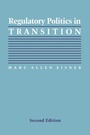
Marc Allen Eisner
Regulatory Politics in Transition
Book
12/2000
2nd Edition
Johns Hopkins University Press
€37.50
Article not available for order