

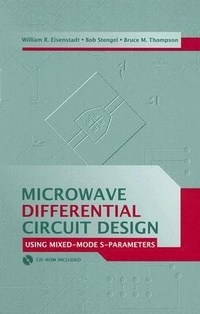
Microwave Differential Circuit Design Using Mixed Mode S-Parameters
Published in April 2006
Book
Paperback/Softback
244 pages
978-1-58053-933-3 (ISBN)
Description
New, powerful mixed-mode scattering parameter techniques are earning rave reviews among wireless and microwave engineers, because they have proved to be highly effective design tools for optimizing the performance of integrated circuits, components, and systems. Now, for the first time, these techniques are explained in full detail by the inventors themselves. This groundbreaking guide uses the original research and application work in the field to describe mixed-mode S-parameter principles and provide practitioners with expert advice on how to use these tools for their own microwave design projects. The book includes over 150 illustrations that support key topics.
New, powerful mixed-mode scattering parameter techniques are earning rave reviews among wireless and microwave engineers, because they have proved to be highly effective design tools for optimizing the performance of integrated circuits, components, and systems. Now, for the first time, these techniques are explained in full detail by the inventors themselves. This groundbreaking guide uses the original research and application work in the field to describe mixed-mode S-parameter principles and provide practitioners with expert advice on how to use these tools for their own microwave design projects. The book includes over 150 illustrations that support key topics.
New, powerful mixed-mode scattering parameter techniques are earning rave reviews among wireless and microwave engineers, because they have proved to be highly effective design tools for optimizing the performance of integrated circuits, components, and systems. Now, for the first time, these techniques are explained in full detail by the inventors themselves. This groundbreaking guide uses the original research and application work in the field to describe mixed-mode S-parameter principles and provide practitioners with expert advice on how to use these tools for their own microwave design projects. The book includes over 150 illustrations that support key topics.
More details
Edition
Unabridged edition
Language
English
Place of publication
Norwood
United States
Target group
College/higher education
Professional and scholarly
Edition type
Unabridged edition
Dimensions
Height: 237 mm
Width: 159 mm
Thickness: 19 mm
Weight
480 gr
ISBN-13
978-1-58053-933-3 (9781580539333)
Copyright in bibliographic data and cover images is held by Nielsen Book Services Limited or by the publishers or by their respective licensors: all rights reserved.
Schweitzer Classification
Other editions
Additional editions
William Eisenstadt
Microwave Differential Circuit Design Using Mixed Mode S-Parameters
E-Book
01/2006
1st Edition
Artech House
€111.99
Available for download
Persons
William R. Eisenstadt is an associate professor in the department of electrical and computer engineering at the University of Florida. Bob Stengel is a fellow of the technical staff with Motorola Labs, Plantation FL. Bruce M. Thompson is a distinguished member of technical staff with Motorola Labs, Plantation, Florida.
William R. Eisenstadt is an associate professor in the department of electrical and computer engineering at the University of Florida. Bob Stengel is a fellow of the technical staff with Motorola Labs, Plantation FL. Bruce M. Thompson is a distinguished member of technical staff with Motorola Labs, Plantation, Florida.
William R. Eisenstadt is an associate professor in the department of electrical and computer engineering at the University of Florida. Bob Stengel is a fellow of the technical staff with Motorola Labs, Plantation FL. Bruce M. Thompson is a distinguished member of technical staff with Motorola Labs, Plantation, Florida.
Content
Why Use Differential or Balanced Signal Processing? Mixed-Mode Scattering Parameter Theory. Balanced Transmission Line Basics. Balanced Small Signal Amplifier Analysis. Mixed-Mode Applied to Three-Port Hybrid Splitters and Combiners. Mixed-Mode Applied to Four-Terminal Components. Mixed-Mode Analysis Extended to Time Domain.