

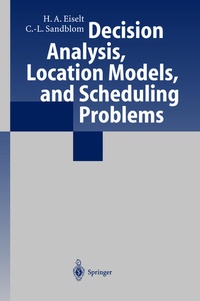
Decision Analysis, Location Models, and Scheduling Problems
Published on 27. October 2003
Book
Hardback
XII, 457 pages
978-3-540-40338-8 (ISBN)
Description
The purpose of this book is to provide readers with an introduction to the fields of decision making, location analysis, and project and machine scheduling. The combination of these topics is not an accident: decision analysis can be used to investigate decision seenarios in general, location analysis is one of the prime examples of decision making on the strategic Ievel, project scheduling is typically concemed with decision making on the tactical Ievel, and machine scheduling deals with decision making on the operational Ievel. Some of the chapters were originally contributed by different authors, and we have made every attempt to unify the notation, style, and, most importantly, the Ievel of the exposition. Similar to our book on Integer Programming and Network Models (Eiselt and Sandblom, 2000), the emphasis of this volume is on models rather than solution methods. This is particularly important in a book that purports to promote the science of decision making. As such, advanced undergraduate and graduate students, as weil as practitioners, will find this volume beneficial. While different authors prefer different degrees of mathematical sophistication, we have made every possible attempt to unify the approaches, provide clear explanations, and make this volume accessible to as many readers as possible.
Reviews / Votes
From the reviews:
"Decision Analysis, Location Models, and Scheduling Problems is best described as a broad review of topics relating to decision sciences. . The authors move quickly into detailed topics, gearing the book for an advanced audience. . it could serve nicely as the primary text for advanced OR courses intended to survey many topics in decision making. Eiselt and Sandblom provide several examples illustrating the use of the different methodologies, which may also make the book appealing to practitioners." (Brian Denton, Interfaces, Vol. 35 (3), 2005)
More details
Edition
2004 ed.
Language
English
Place of publication
Berlin
Germany
Publishing group
Springer Berlin
Target group
Professional and scholarly
Research
Illustrations
XII, 457 p.
Dimensions
Height: 241 mm
Width: 160 mm
Thickness: 30 mm
Weight
869 gr
ISBN-13
978-3-540-40338-8 (9783540403388)
DOI
10.1007/978-3-540-24722-7
Schweitzer Classification
Other editions
Additional editions
H. A. Eiselt | Carl-Louis Sandblom
Decision Analysis, Location Models, and Scheduling Problems
Book
11/2010
Springer
€160.49
Shipment within 7-9 days
Persons
Dr. H.A. Eiselt is a Professor of Business Administration at the University of New Brunswick (Canada) and an Adjunct Professor with the Department of Industrial Engineering at Dalhousie University (Canada). He is an Associate Editor and Book Review Editor of INFOR. Dr. Eiselt is also a member of the Advisory or Editorial Boards of Computers & Operations Research, and the International Journal of Operations and Quantitative Management. His main research interests are in various aspects of location analysis and decision theory. He has (co-) authored over 120 research articles and written and edited twelve books.
Dr. C-L. Sandblom is an Adjunct and Emeritus Professor of Industrial Engineering at Dalhousie University (Canada). He holds a Ph.D. from the University of Birmingham (UK). Prior to joining Dalhousie, he taught at the Universities of Lund (Sweden), Birmingham (UK) and Concordia University (Canada). Dr. Sandblom has published over 50 research papers and eight books
Content
Notation.- I: Analysis of Decision Making.- 1 Multicriteria Decision Making.- 2 Games Against Nature.- 3 Game Theory.- II: Location and Layout Decisions.- 1 Fundamentals of Location and Layout Problems.- 2 Location Models on Networks.- 3 Continuous Location Models.- 4 Other Location Models.- 5 Layout Models.- III: Project Scheduling.- 1 Unconstrained Time Project Scheduling.- 2 Project Scheduling with Resource Constraints.- IV: Machine Scheduling Models.- 1 Fundamentals of Machine Scheduling.- 2 Single Machine Scheduling.- 3 Parallel Machine Models.- 4 Dedicated Machine and Resource-Constrained Models.- References.