

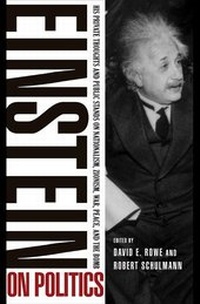
Einstein on Politics
His Private Thoughts and Public Stands on Nationalism, Zionism, War, Peace, and the Bomb
Published on 6. May 2007
Book
Hardback
560 pages
978-0-691-12094-2 (ISBN)
Description
The most famous scientist of the twentieth century, Albert Einstein was also one of the century's most outspoken political activists. Deeply engaged with the events of his tumultuous times, from the two world wars and the Holocaust, to the atomic bomb and the Cold War, to the effort to establish a Jewish homeland, Einstein was a remarkably prolific political writer, someone who took courageous and often unpopular stands against nationalism, militarism, anti-Semitism, racism, and McCarthyism. In Einstein on Politics, leading Einstein scholars David Rowe and Robert Schulmann gather Einstein's most important public and private political writings and put them into historical context. The book reveals a little-known Einstein--not the ineffectual and nave idealist of popular imagination, but a principled, shrewd pragmatist whose stands on political issues reflected the depth of his humanity. Nothing encapsulates Einstein's profound involvement in twentieth-century politics like the atomic bomb. Here we read the former militant pacifist's 1939 letter to President Franklin D. Roosevelt warning that Germany might try to develop an atomic bomb.
But the book also documents how Einstein tried to explain this action to Japanese pacifists after the United States used atomic weapons to destroy Hiroshima and Nagasaki, events that spurred Einstein to call for international control of nuclear technology. A vivid firsthand view of how one of the twentieth century's greatest minds responded to the greatest political challenges of his day, Einstein on Politics will forever change our picture of Einstein's public activism and private motivations. ON PACIFISM "When those who are bound together by pacifist ideals hold a meeting they are always consorting with their own kind only. They are like sheep huddled together while the wolves wait outside. I think pacifist speakers have this difficulty: they usually reach their own crowd, who are pacifists already. The sheep's voice does not get beyond this circle and therefore is ineffective...Real pacifists, those who are not up in the clouds but who think and count realities, must fearlessly try to do things of practical value to the cause and not merely speak about pacifism. Deeds are needed. Mere words do not get pacifists anywhere."
--Two Percent Speech, New York, 1930 ON HITLER "Hitler appeared, a man with limited intellectual abilities and unfit for any useful work, bursting with envy and bitterness against all whom circumstance and nature had favored over him. Springing from the lower middle class, he had just enough class conceit to hate even the working class which was struggling for greater equality in living standards. But it was the culture and education which had been denied him forever that he hated most of all. In his desperate ambition for power he discovered that his speeches, confused and pervaded with hate as they were, received wild acclaim by those whose situa-tion and orientation resembled his own. He picked up this human flotsam on the streets and in the taverns and organized them around himself. This is the way he launched his political career."--On Hitler, 1935 ON ZIONISM "Just one more personal word on the question of partition. I should much rath-er see reasonable agreement with the Arabs on the basis of living together in peace than the creation of a Jewish state.
Apart from practical consideration, my awareness of the essential nature of Judaism resists the idea of a Jewish state with borders, an army, and a measure of temporal power no matter how modest. I am afraid of the inner damage Judaism will sustain--especially from the development of a narrow nationalism within our own ranks, against which we have already had to fight strongly, even without a Jewish state."-- Our Debt to Zionism, 1938 ON MILITARISM "I must frankly confess that the foreign policy of the United States since the termination of hostilities has reminded me, sometimes irresistibly, of the attitude of Germany under Kaiser Wilhelm II...It is characteristic of the military mentality that non-human factors (atom bombs, strategic bases, weapons of all sorts, the possession of raw materials, etc.) are held essential, while the human being, his desires and thought--in short, the psychological factors--are considered as unimportant and secondary...The general inse-curity that goes hand in hand with this results in the sacrifice of the citizen's civil rights to the supposed welfare of the state. Political witch-hunting, controls of all sorts (e.g., control of teaching and research, of the press, and so forth) appear inevitable, and for this reason do not encounter that popular resistance, which, were it not for the military mentality, would provide a protection.
"--The Military Mentality, 1947
But the book also documents how Einstein tried to explain this action to Japanese pacifists after the United States used atomic weapons to destroy Hiroshima and Nagasaki, events that spurred Einstein to call for international control of nuclear technology. A vivid firsthand view of how one of the twentieth century's greatest minds responded to the greatest political challenges of his day, Einstein on Politics will forever change our picture of Einstein's public activism and private motivations. ON PACIFISM "When those who are bound together by pacifist ideals hold a meeting they are always consorting with their own kind only. They are like sheep huddled together while the wolves wait outside. I think pacifist speakers have this difficulty: they usually reach their own crowd, who are pacifists already. The sheep's voice does not get beyond this circle and therefore is ineffective...Real pacifists, those who are not up in the clouds but who think and count realities, must fearlessly try to do things of practical value to the cause and not merely speak about pacifism. Deeds are needed. Mere words do not get pacifists anywhere."
--Two Percent Speech, New York, 1930 ON HITLER "Hitler appeared, a man with limited intellectual abilities and unfit for any useful work, bursting with envy and bitterness against all whom circumstance and nature had favored over him. Springing from the lower middle class, he had just enough class conceit to hate even the working class which was struggling for greater equality in living standards. But it was the culture and education which had been denied him forever that he hated most of all. In his desperate ambition for power he discovered that his speeches, confused and pervaded with hate as they were, received wild acclaim by those whose situa-tion and orientation resembled his own. He picked up this human flotsam on the streets and in the taverns and organized them around himself. This is the way he launched his political career."--On Hitler, 1935 ON ZIONISM "Just one more personal word on the question of partition. I should much rath-er see reasonable agreement with the Arabs on the basis of living together in peace than the creation of a Jewish state.
Apart from practical consideration, my awareness of the essential nature of Judaism resists the idea of a Jewish state with borders, an army, and a measure of temporal power no matter how modest. I am afraid of the inner damage Judaism will sustain--especially from the development of a narrow nationalism within our own ranks, against which we have already had to fight strongly, even without a Jewish state."-- Our Debt to Zionism, 1938 ON MILITARISM "I must frankly confess that the foreign policy of the United States since the termination of hostilities has reminded me, sometimes irresistibly, of the attitude of Germany under Kaiser Wilhelm II...It is characteristic of the military mentality that non-human factors (atom bombs, strategic bases, weapons of all sorts, the possession of raw materials, etc.) are held essential, while the human being, his desires and thought--in short, the psychological factors--are considered as unimportant and secondary...The general inse-curity that goes hand in hand with this results in the sacrifice of the citizen's civil rights to the supposed welfare of the state. Political witch-hunting, controls of all sorts (e.g., control of teaching and research, of the press, and so forth) appear inevitable, and for this reason do not encounter that popular resistance, which, were it not for the military mentality, would provide a protection.
"--The Military Mentality, 1947
Reviews / Votes
One of Choice's Outstanding Academic Titles for 2007 "A goldmine for readers interested in Einstein as an engaged intellectual of his era. Editors David E. Rowe and Robert Schulmann have done an excellent job of collecting, thematically assembling and historically contextualizing Einstein's private letters and public statements on the great political issues of his time."--Yaron Ezrahi, Nature "Editors David E. Rowe and Robert Schulmann have done an excellent job of collecting, thematically assembling and historically contextualizing Einstein's private letters and public statements on the great political issues of his time. The book is also a fascinating record of Einstein's private thoughts and public stance on the reception of the relativity revolution. Included here are his reaction to the virulent anti-Semitic, anti-relativity German scientists, his tortured relations with the Prussian Academy of Sciences after the rise of the Nazis and his later expressed identification with Galileo for his struggle 'to overcome the anthropocentric and mythical thinking of his contemporaries and to lead them back to an objective and causal attitude towards the cosmos.'"--C. R. Macauley, Nature "Einstein on Politics treats all these issues in detail by combining his most important statements--both public and private--in thematic chapters and by carefully contextualizing each statement. The result is fascinating, illuminating and sometimes moving, resonating both with today's noisy debates about nuclear weapons, international terrorism and civil liberties, and with the ethical dilemmas with which we struggle in the quieter recesses of the mind."--Andrew Robinson, New Scientist "[G]reat as Einstein's allure remains, the majority of people will probably wish to read just one Einstein book, and this is one they should strongly consider. In addition to being comprehensive, accessible and well written, it is clearly the most up to date, making sensible use of the latest and most authoritative scholarship."--Daniel J. Kennefick, American Scientist online "This brilliant anthology of [Einstein's] journalism and private correspondence brings to life his lucid contributions to the raging debates of the last century over the bomb, his humanitarian objections to war, his belief in a socialist economy and the apparent contradiction between his advocacy of internationalism and his support for Zionism."--David Harounoff, Tribune "To enhance understanding of Einstein's humanism and activism, Rowe and Schulmann have gathered, organized, and explicated a full spectrum of his reflections, allowing the reader direct access to Einstein's reasoning as he confronts a world of violence rendered exponentially more catastrophic by virtue of his own scientific breakthroughs. Powerful in its personal and political disclosures, this is an essential primary source."--Booklist "Offers readers a panoramic view of his writings on Zionism and anti-Semitism, nationalism, the fate of Jews during the Holocaust, war, peace, pacifism and nuclear proliferation. Einstein was a vigorous stylist and these selections from his private correspondence attest to his fluency with words."--Sheldon Kirshner, Canadian Jewish News "Anyone with an interest in Einstein's non-scientific activities in the public realm will profit from reading this book."--Hubert Goenner, Nature Physics "The most renowned scientist of the last century was famous not only for his seminal contributions to making sense of the universe, from the very large to the very small, but also for his humanism and interest in promoting the possibility of a world without conflict. This book collects many of Einstein's letters and essays that discuss issues pertaining exclusively to his views on the latter. They cover an incredible range of topics from WWI to the UN and much that embroiled the Western world in between. The editors have provided good introductions to each chapter, following Einstein's discursions in chronological order."--N. Sadanand, Choice "Utilizing a meticulously collected set of both published and unpublished materials, the editors set forth in admirable detail his writings on the issues of the day, which are inextricably connected to his support for the Zionist movement and the creation of Israel. If readers connect Einstein only to the world of science and mathematics, this volume will clearly serve to expand their horizons."--Sanford R. Silverburg, AJL Newsletter "[T]he documents presented are quite valuable, and the book deserves a wide readership for that alone."--Matthew Stanley, Historical Studies in Natural Sciences "Einstein was an important man, and Rowe and Schulmann edited an important book about him"--Antoine Capet, H-Net "This book, ingeniously put together by Rowe and Schulmann, provides a thematic and chronological frame of reference that allows a lucid view of Einstein's political passions, which up to now have been largely unknown even to the interested public. It is a multiply rewarding book, one that all readers are bound to enjoy."--Kosta Tsipis, Journal of Cold War Studies "Einstein on Politics is an excellent and thought-provoking volume, which can be of interest to scholars as well as to the public at large."--Giorgio Baruchello, European Legacy "David E. Rowe and Robert Schulmann have compiled exactly the book readers ... may want to consult during or after reading a biography of the 'mere scientist' who held passionate and often outspoken views on the major issues of his time."--Stuart Mitchner, Town Topics (Princeton, NJ)More details
Language
English
Place of publication
New Jersey
United States
Target group
College/higher education
Professional and scholarly
Product notice
Trade binding
Illustrations
24 halftones.
Dimensions
Height: 229 mm
Width: 152 mm
Weight
936 gr
ISBN-13
978-0-691-12094-2 (9780691120942)
Copyright in bibliographic data and cover images is held by Nielsen Book Services Limited or by the publishers or by their respective licensors: all rights reserved.
Schweitzer Classification
Other editions
New editions
Albert Einstein | David E. Rowe | Robert Schulmann
Einstein on Politics
His Private Thoughts and Public Stands on Nationalism, Zionism, War, Peace, and the Bomb
Book
11/2013
Princeton University Press
€24.00
Shipment within 10-20 days
Additional editions
Albert Einstein | David E. Rowe | Robert Schulmann
Einstein on Politics
His Private Thoughts and Public Stands on Nationalism, Zionism, War, Peace, and the Bomb
E-Book
11/2013
1st Edition
Princeton University Press
from
€82.95
Available for download
Persons
David E. Rowe is Professor of the History of Mathematics and Natural Sciences at Johannes Gutenberg University in Mainz, Germany, and a former member of the Einstein Papers Project. Robert Schulmann, a former Boston University history professor, is former head of the Einstein Papers Project. He coedited "Albert Einstein, Mileva Maric: The Love Letters" and many volumes of "The Collected Papers of Albert Einstein" (all Princeton).
Content
List of Texts vii Preface xix Note on Sources and Method xxxi Acknowledgments xxxiii Historical Introduction 1 Chapter 1. The First World War and Its Impact, 1914-1921 61 Chapter 2. Science Meets Politics: The Relativity Revolution, 1918-1923 93 Chapter 3. Anti-Semitism and Zionism, 1919-1930 136 Chapter 4. Internationalism and European Security, 1922-1932 189 Chapter 5. Articles of Faith, 1930-1933 223 Chapter 6. Hitler's Germany and the Threat to European Jewry, 1933-1938 266 Chapter 7. The Fate of the Jews, 1939-1949 315 Chapter 8. The Second World War, Nuclear Weapons, and World Peace, 1939-1950 356 Chapter 9. Soviet Russia, Political Economy, and Socialism, 1918-1952 406 Chapter 10. Political Freedom and the Threat of Nuclear War, 1931-1955 459 Bibliography 509 Index 515 Plate Credits 524