

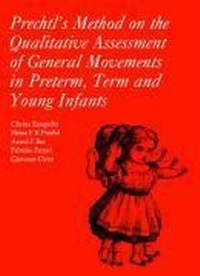
Prechtl's Method on the Qualitative Assessment of General Movements in Preterm, Term and Young Infants
Published on 16. February 2005
Book
Paperback/Softback
104 pages
978-1-898683-40-7 (ISBN)
Description
A quick, non-invasive, non-intrusive and cost-effective method with high reliability and high validity is much in demand for the early detection of neurological anomalies which point to cerebral palsy and developmental deficits later on in life. Over his years as a distinguished developmental neurologist, Heinz Prechtl has devised such a method; a qualitative assessment of general movements (GMs) as a specific predictor for neurological impairments. His method is described in this book. GMs form part of a distinct pattern of movements in preterm babies, term newborns and young infants. They are complex, frequent, and usually of sufficient length. Changes in the normal quality of GMs are a reliable indicator of brain dysfunction. Includes a CD-ROM giving 15 cases selected from the book. Each is of about one minute in duration and demonstrates the different age-specific movement patterns.
More details
Other editions
Additional editions
Christa Einspieler | Heinz F. R. Prechtl | Arend Bos
Prechtl's Method on the Qualitative Assessment of General Movements in Preterm, Term and Young Infants
E-Book
09/2008
1st Edition
Mac Keith Press
€53.99
Available for download
Persons
DOB April 29, 1953.
Content
Authors' appointments; Introduction: how it all came about; 1. Basic concepts of developmental neurology; 2. What are spontaneous movements?; 3. How to record and assess general movements?; 4. What could interfere with the quality of movements?; 5. How objective, reliable and valid is the general movement assessment?; 6. The clinical application of the method; 7. Quantitative assessment is an insensitive indicator of an impaired integrity of the nervous system; 8. Brain ultrasound and general movement assessment; 9. Neurological examination and general movement assessment; 10. What other methods of general movement exist?; Epilogue; References; Index.