

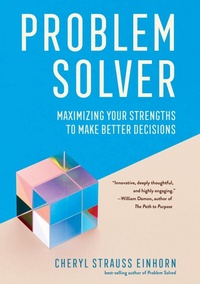
Problem Solver
Maximizing Your Strengths to Make Better Decisions
Published on 15. March 2023
Book
Paperback/Softback
192 pages
978-1-5017-6803-3 (ISBN)
Description
Winner of the Independent Press Award in Psychology
Our decisions are expressions of who we are and how we move through the world. Rarely, though, do we examine our decisions or even look inward to consider the psychology of our decision-making. Instead, we often make decisions based on what we call instinct (which relies on cognitive bias), false assumptions, mis-remembering, and mental mistakes. Truthfully, we don't see the world as it is; we see it as we are.
We can develop self-knowledge about our decision-making styles. We can wake ourselves up to how biases cloud our judgment and impede good decision-making-and we can counter bias. From there, we can transform our decision-making habits to make better big decisions alone and together. Problem Solver provides you with tools to identify:
* The five basic decision-making approaches, or "Problem Solver Profiles" (PSPs): Adventurer, Detective, Listener, Thinker, and Visionary
* Your dominant-and secondary-PSPs
* Tools to assess other peoples' PSPs
* Each PSP's decision-making strengths, blind spots, and biases
* How your PSP impacts your outlook on life and your risk appetite
* How to use your PSP to maximize your decision strengths
Replete with real-life examples and replicable strategies to apply new decision-making skills for your immediate benefit, Problem Solver will do more than help you look out into a future; it will equip you to move forward, with confidence, into your future.
Our decisions are expressions of who we are and how we move through the world. Rarely, though, do we examine our decisions or even look inward to consider the psychology of our decision-making. Instead, we often make decisions based on what we call instinct (which relies on cognitive bias), false assumptions, mis-remembering, and mental mistakes. Truthfully, we don't see the world as it is; we see it as we are.
We can develop self-knowledge about our decision-making styles. We can wake ourselves up to how biases cloud our judgment and impede good decision-making-and we can counter bias. From there, we can transform our decision-making habits to make better big decisions alone and together. Problem Solver provides you with tools to identify:
* The five basic decision-making approaches, or "Problem Solver Profiles" (PSPs): Adventurer, Detective, Listener, Thinker, and Visionary
* Your dominant-and secondary-PSPs
* Tools to assess other peoples' PSPs
* Each PSP's decision-making strengths, blind spots, and biases
* How your PSP impacts your outlook on life and your risk appetite
* How to use your PSP to maximize your decision strengths
Replete with real-life examples and replicable strategies to apply new decision-making skills for your immediate benefit, Problem Solver will do more than help you look out into a future; it will equip you to move forward, with confidence, into your future.
More details
Series
Language
English
Place of publication
United States
Publishing group
Cornell University Press
Product notice
Paperback (trade)
Dimensions
Height: 248 mm
Width: 174 mm
Thickness: 11 mm
Weight
356 gr
ISBN-13
978-1-5017-6803-3 (9781501768033)
Copyright in bibliographic data and cover images is held by Nielsen Book Services Limited or by the publishers or by their respective licensors: all rights reserved.
Schweitzer Classification
Other editions
Additional editions
E-Book
03/2023
Cornell University East Asia Program
€13.49
Available for download
Person
Cheryl Strauss Einhorn is the creator of the AREA Method, a decision-making system for individuals, companies, and nonprofits to solve complex problems. Cheryl is the founder of the decision-sciences company Decisive, offering leadership training, curriculum, coaching, and professional development services, and an adjunct professor at Cornell University. She is the author of the award-winning books Problem Solved and Investing in Financial Research. For more information visit areamethod.com.
Content
Introduction: The Data of Living
To Know Thyself: How to Use This Book
1. How Do You Decide?
2. Lexicon, Situationality, & Community
3. The Adventurer
4. The Detective
5. The Listener
6. The Thinker
7. The Visionary
8. Hunt Like the Cheetah
9. PSPs & Risk Profiles
10. PSPs & Cognitive Biases
11. Ambiguity versus Uncertainty
12. Using PSPs to Bolster Strengths
13. How PSPs Color Our Relationship with Data
14. Situationality and Dynamic Decision-Making
15. The Relationship between PSPs and Life Outlook
To Know Thyself: How to Use This Book
1. How Do You Decide?
2. Lexicon, Situationality, & Community
3. The Adventurer
4. The Detective
5. The Listener
6. The Thinker
7. The Visionary
8. Hunt Like the Cheetah
9. PSPs & Risk Profiles
10. PSPs & Cognitive Biases
11. Ambiguity versus Uncertainty
12. Using PSPs to Bolster Strengths
13. How PSPs Color Our Relationship with Data
14. Situationality and Dynamic Decision-Making
15. The Relationship between PSPs and Life Outlook