

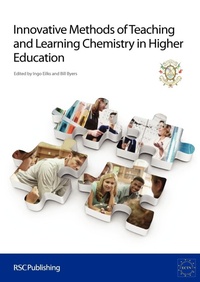
Innovative Methods of Teaching and Learning Chemistry in Higher Education
Rsc
Published on 21. July 2009
Book
Paperback/Softback
272 pages
978-1-84755-958-6 (ISBN)
Description
Two recent initiatives from the EU, namely the Bologna Process and the Lisbon Agenda are likely to have a major influence on European Higher Education. It seems unlikely that traditional teaching approaches, which supported the elitist system of the past, will promote the mobility, widened participation and culture of 'life-long learning' that will provide the foundations for a future knowledge-based economy. There is therefore a clear need to seek new approaches to support the changes which will inevitably occur. The European Chemistry Thematic Network (ECTN) is a network of some 160 university chemistry departments from throughout the EU as well as a number of National Chemical Societies (including the RSC) which provides a discussion forum for all aspects of higher education in chemistry. This handbook is a result of one of their working groups, who identified and collated good practice with respect to innovative methods in Higher Level Chemistry Education. It provides a comprehensive overview of innovations in university chemistry teaching from a broad European perspective. The generation of this book through a European Network, with major national chemical societies and a large number of chemistry departments as members make the book unique. The wide variety of scholars who have contributed to the book, make it interesting and invaluable reading for both new and experienced chemistry lecturers throughout the EU and beyond. The book is aimed at chemistry education at universities and other higher level institutions and at all academic staff and anyone interested in the teaching of chemistry at the tertiary level. Although newly appointed teaching staff are a clear target for the book, the innovative aspects of the topics covered are likely to prove interesting to all committed chemistry lecturers.
More details
Language
English
Place of publication
Cambridge
United Kingdom
Target group
College/higher education
Professional and scholarly
Product notice
Unsewn / adhesive bound
Dimensions
Height: 299 mm
Width: 212 mm
Thickness: 17 mm
Weight
641 gr
ISBN-13
978-1-84755-958-6 (9781847559586)
DOI
10.1039/9781839169212
Copyright in bibliographic data and cover images is held by Nielsen Book Services Limited or by the publishers or by their respective licensors: all rights reserved.
Schweitzer Classification
Other editions
Additional editions
Ingo Eilks | Bill Byers
Innovative Methods of Teaching and Learning Chemistry in Higher Education
E-Book
11/2015
1st Edition
Royal Society of Chemistry
€27.49
Available for download
Persons
Prof. Dr. Ingo Eilks is Professor in Chemistry Education at the University of Bremen. He has extensive experience in curriculum development and science education research and has over 240 published articles. He is working group leader in ECTN-4 (European Chemistry Thematic Network) in a project concerning innovative methods in university chemistry education. Dr. Bill Byers is Senior Lecturer in Chemistry at the University of Ulster, with 37 years university teaching experience, who has contributed to a wide range of educational development programmes and international conferences on Chemical Education. He was the 2002 recipient of the RSC Silver Medal and Tertiary Education Award and is particularly interested in promoting more active and independent approaches to learning.
Content
Innovative Approaches to Teaching Chemistry at the University Level - A Project of ECTN 4;
The need to innovate chemistry teaching at the university level: A pedagogical justification;
Teaching about the unique empirical and model-based nature of chemistry;
Problem- and context-based approaches to promoting learning;
Research-based teaching;
Innovations in practical work;
Cooperative learning and peer-tutoring;
Online support and online assessment of lectures and lab-work;
From multimedia and visualization towards a grid implementation of teaching and learning activities;
Chemistry learning beyond the lecture hall;
Assessment ;
Training programs for newly appointed chemistry teaching staff
The need to innovate chemistry teaching at the university level: A pedagogical justification;
Teaching about the unique empirical and model-based nature of chemistry;
Problem- and context-based approaches to promoting learning;
Research-based teaching;
Innovations in practical work;
Cooperative learning and peer-tutoring;
Online support and online assessment of lectures and lab-work;
From multimedia and visualization towards a grid implementation of teaching and learning activities;
Chemistry learning beyond the lecture hall;
Assessment ;
Training programs for newly appointed chemistry teaching staff