

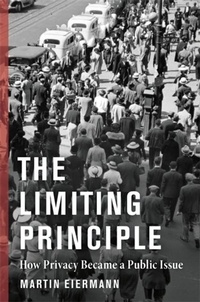
The Limiting Principle
How Privacy Became a Public Issue
Published on 29. July 2025
Book
Paperback/Softback
360 pages
978-0-231-21888-7 (ISBN)
Description
Winner, 2026 Harrison C. White Outstanding Book Award, Decision-Making, Social Networks, and Society Section, American Sociological Association
Winner, 2026 Outstanding Book Award, Altruism, Morality, and Social Solidarity Section, American Sociological Association
The concept of privacy is central to public life in the United States. It is the fulcrum of countless conflicts over reproductive rights and consumer protection, the power of tech companies and the reach of state surveillance. How did privacy come to take on such import, and what have the consequences been for American institutions and society?
Martin Eiermann traces the transformation of privacy from a set of informal cultural norms into a potent political issue. Around the turn of the twentieth century, in a nation that was searching for order amid rapid change and frequent moral panics about the ills of modern life, privacy spoke to emerging social problems and new technological realities. During this tumultuous period, political mobilization and judicial contestation shaped a legal, institutional, and administrative privacy architecture that has partly endured into the twenty-first century. Eiermann rebuts the claim that technological change renders privacy obsolete, demonstrating that the concept became increasingly capacious when it was applied to the social problems and political disputes of the information age. And he shows that it is often the selectivity-not the ubiquity-of governmental and corporate data collection that should elicit our concerns.
Drawing on rich archival materials and computational research methods, The Limiting Principle provides a deeply original sociological account of the history, social significance, and limitations of privacy in the modern United States.
Winner, 2026 Outstanding Book Award, Altruism, Morality, and Social Solidarity Section, American Sociological Association
The concept of privacy is central to public life in the United States. It is the fulcrum of countless conflicts over reproductive rights and consumer protection, the power of tech companies and the reach of state surveillance. How did privacy come to take on such import, and what have the consequences been for American institutions and society?
Martin Eiermann traces the transformation of privacy from a set of informal cultural norms into a potent political issue. Around the turn of the twentieth century, in a nation that was searching for order amid rapid change and frequent moral panics about the ills of modern life, privacy spoke to emerging social problems and new technological realities. During this tumultuous period, political mobilization and judicial contestation shaped a legal, institutional, and administrative privacy architecture that has partly endured into the twenty-first century. Eiermann rebuts the claim that technological change renders privacy obsolete, demonstrating that the concept became increasingly capacious when it was applied to the social problems and political disputes of the information age. And he shows that it is often the selectivity-not the ubiquity-of governmental and corporate data collection that should elicit our concerns.
Drawing on rich archival materials and computational research methods, The Limiting Principle provides a deeply original sociological account of the history, social significance, and limitations of privacy in the modern United States.
Reviews / Votes
Eiermann shows that the issue of privacy has become the bearer of a host of social problems, legal concerns, and political conflicts. With wit and erudition, his historical argument musters an unusually wide body of evidence and touches on many of the most important controversies of our day. This is a compelling and insightful work. -- Bruce G. Carruthers, author of <i>The Economy of Promises: Trust, Power, and Credit in America</i> What should be known? By whom? For what purposes? As Martin Eiermann argues in this elegant and innovative analysis, "privacy" is not a settled legal concept but an evolving response to threats of urbanization, commercialization, and our dependence on the firms, professionals, and governments entrusted with our personal secrets. -- Elisabeth S. Clemens, author of <i>Civic Gifts: Voluntarism and the Making of the American Nation-State</i> Martin Eiermann's masterful study of the "Early Information Age" in America reveals how privacy evolved from a private concern into a public obsession, and how a "limiting principle" on state, corporate, and public surveillance became inscribed in jurisprudence, regulation, and urban space. An indispensable antidote against our presentist myopia. -- Marion Fourcade, coauthor of <i>The Ordinal Society</i> Rather than ask what privacy is or why it has vanished, Martin Eiermann provocatively reframes the question: how did privacy become foundational to political discussions and social debates, and then U.S. institutions and laws, in the first place? With stunning precision, he illuminates the early-twentieth-century emergence of the "privacy architecture" within which Americans still live. -- Sarah E. Igo, author of <i>The Known Citizen: A History of Privacy in Modern America</i> One of the key strengths of the book is its methodological rigor....By foregrounding a critical orientation to how privacy has been (and continues to be) unevenly applied in US history, Eiermann offers a historically grounded framework for understanding the continued erosion of privacy in contemporary surveillance regimes. * Surveillance and Society *More details
Series
Language
English
Place of publication
New York
United States
Target group
Professional and scholarly
College/higher education
Product notice
Paperback (trade)
Illustrations
20 b&w illustrations
Dimensions
Height: 230 mm
Width: 155 mm
Thickness: 23 mm
Weight
562 gr
ISBN-13
978-0-231-21888-7 (9780231218887)
Copyright in bibliographic data and cover images is held by Nielsen Book Services Limited or by the publishers or by their respective licensors: all rights reserved.
Schweitzer Classification
Other editions
Additional editions
E-Book
07/2025
1st Edition
Columbia University Press
€35.99
Available for download
Person
Martin Eiermann is an assistant professor of sociology at the University of Wisconsin-Madison.
Content
Preface
Introduction: Privacy for a New Age
1. Under the Eaves of the Home: Domestic Privacy and the Cultivation of Self
2. In the Glare of the Calcium: Privacy in the Early Information Age
3. The Chief Curse of the Tenement: Moral Anxieties and the Codification of Privacy in Urban Life
4. Inviolate Personalities: Individual Privacy in an Era of Informational Persons
5. A Modern Legal Fact: How Privacy Gained a Foothold in American Jurisprudence
6. Governance by Exception: Bureaucratic Rule and the Limits of Privacy
Conclusion: Privacy in an Age of Surveillance
Methodological Coda
Acknowledgments
Notes
Bibliography
Index
Introduction: Privacy for a New Age
1. Under the Eaves of the Home: Domestic Privacy and the Cultivation of Self
2. In the Glare of the Calcium: Privacy in the Early Information Age
3. The Chief Curse of the Tenement: Moral Anxieties and the Codification of Privacy in Urban Life
4. Inviolate Personalities: Individual Privacy in an Era of Informational Persons
5. A Modern Legal Fact: How Privacy Gained a Foothold in American Jurisprudence
6. Governance by Exception: Bureaucratic Rule and the Limits of Privacy
Conclusion: Privacy in an Age of Surveillance
Methodological Coda
Acknowledgments
Notes
Bibliography
Index