

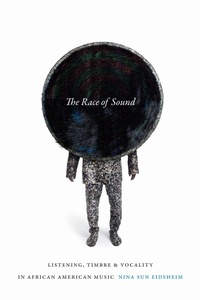
The Race of Sound
Listening, Timbre, and Vocality in African American Music
Published on 11. January 2019
Book
Hardback
288 pages
978-0-8223-6856-4 (ISBN)
Description
In The Race of Sound Nina Sun Eidsheim traces the ways in which sonic attributes that might seem natural, such as the voice and its qualities, are socially produced. Eidsheim illustrates how listeners measure race through sound and locate racial subjectivities in vocal timbre-the color or tone of a voice. Eidsheim examines singers Marian Anderson, Billie Holiday, and Jimmy Scott as well as the vocal synthesis technology Vocaloid to show how listeners carry a series of assumptions about the nature of the voice and to whom it belongs. Outlining how the voice is linked to ideas of racial essentialism and authenticity, Eidsheim untangles the relationship between race, gender, vocal technique, and timbre while addressing an undertheorized space of racial and ethnic performance. In so doing, she advances our knowledge of the cultural-historical formation of the timbral politics of difference and the ways that comprehending voice remains central to understanding human experience, all the while advocating for a form of listening that would allow us to hear singers in a self-reflexive, denaturalized way.
Reviews / Votes
"Should be required reading in music education-and no doubt it will become required reading in many academic disciplines that touch on voice studies." - Marit MacArthur (Yale Review) "An important read within sound studies and race studies." - Jeff Donison (Journal of Radio & Audio Media) "The Race of Sound is brimming with insight and originality. Not every chapter contributes new knowledge (e.g., Eidsheim is not the first to note that black classical singers were constrained by listener expectations), but in tandem they constitute a groundbreaking argument that should inform all listeners and be part of all music courses. If enough readers take Eidsheim's work to heart, we can begin to counter the effect of institutions that create and perpetuate the racialized voice." - Sandra Jean Graham (ARSC Journal) "Eidsheim demonstrates an impressive ability to weave together different critical modes and diverse topics without faltering in her project.... New and established scholars interested in the study of race, gender, voice, and/or African American musics will find much to engage with in Eidsheim's push toward nonessentializing listening."- Alex C. Valin (Women and Music) "Like Eidsheim's earlier work, The Race of Sound presents meticulously researched, compelling, and detailed accounts of reception, race, and voice throughout the careers of important historical figures. The author provides ample evidence to support her groundbreaking arguments that will give readers a new understanding of how we construct voice, race, and identity every time we engage in the act of listening." - Victoria Malawey (MUSICultures) "The Race of Sound is ... an insightful addition to the growing body of work on the voice.... We continue to live in a time in which Black voices struggle to be heard. The Race of Sound contributes to this struggle in recognition and joins the record of activist scholarship that centres and respects Black humanity." - Natalie Hyacinth (Feminist Review) "This book should be required reading for faculty members everywhere. . . . By asking listeners to reflect on their assumptions . . . The Race of Sound seeks greater freedom for Black musicians and people, opening the door to new possibilities for us all." - Loren Kajikawa (Journal of the American Musicology Society) "The Race of Sound allows us to rethink our understanding of identities through voice and thus better understand the social construction of race and gender. Brilliantly written, as approachable as it is accurate, The Race of Sound goes beyond the framework of musicology alone to embrace all cultural studies." (Translated from French) - Jean-Rene Larue (Volume) "Eidsheim provides an elaborate and powerful addition to music scholarship and sound studies as well as to humanities disciplines more broadly. . . . In exposing the plethora of mechanisms that build cultural lenses though which we hear voice, her work serves to puncture even the most trained musical ear or the deepest listener." - Kira Dralle (Notes)
More details
Series
Language
English
Place of publication
North Carolina
United States
Target group
Professional and scholarly
Product notice
Cloth over boards
Illustrations
38 illustrations
Dimensions
Height: 234 mm
Width: 157 mm
Thickness: 20 mm
Weight
522 gr
ISBN-13
978-0-8223-6856-4 (9780822368564)
Copyright in bibliographic data and cover images is held by Nielsen Book Services Limited or by the publishers or by their respective licensors: all rights reserved.
Schweitzer Classification
Person
Nina Sun Eidsheim is Professor of Musicology at the University of California, Los Angeles, and the author of Sensing Sound: Singing and Listening as Vibrational Practice, also published by Duke University Press.
Content
Acknowledgments xi
Introduction. The Acousmatic Question: Who Is This? 1
1. Formal and Informal Pedagogies: Believing in Race, Teaching Race, Hearing Race 39
2. Phantom Genealogy: Sonic Blackness and the American Operatic Timbre 61
3. Familiarity as Strangeness: Jimmy Scott and the Question of Black Timbral Masculinity 91
4. Race as Zeros and Ones: Vocaloid Refused, Reimagined, and Repurposed 115
5. Bifurcated Listening: The Inimitable, Imitated Billie Holiday 151
6. Widening Rings of Being: The Singer as Stylist and Technician 177
Appendix 201
Notes 205
Bibliography 243
Index 259
Introduction. The Acousmatic Question: Who Is This? 1
1. Formal and Informal Pedagogies: Believing in Race, Teaching Race, Hearing Race 39
2. Phantom Genealogy: Sonic Blackness and the American Operatic Timbre 61
3. Familiarity as Strangeness: Jimmy Scott and the Question of Black Timbral Masculinity 91
4. Race as Zeros and Ones: Vocaloid Refused, Reimagined, and Repurposed 115
5. Bifurcated Listening: The Inimitable, Imitated Billie Holiday 151
6. Widening Rings of Being: The Singer as Stylist and Technician 177
Appendix 201
Notes 205
Bibliography 243
Index 259