

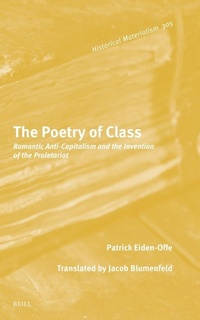
The Poetry of Class
Romantic Anti-Capitalism and the Invention of the Proletariat
Published on 28. September 2023
Book
Hardback
320 pages
978-90-04-68545-1 (ISBN)
Description
In the early 19th century, a new social collective emerged out of impoverished artisans, urban rabble, wandering rural lower classes, bankrupt aristocrats and precarious intellectuals, one that would soon be called the proletariat. But this did not yet exist as a unified, homogeneous class with affiliated political parties. The motley appearance, the dreams and longings of these figures, torn from all economic certainties, found new forms of narration in romantic novellas, reportages, social-statistical studies, and monthly bulletins. But soon enough, these disorderly, violent, nostalgic, errant, and utopian figures were denigrated as reactionary and anarchic by the heads of the labour movement, since they did not fit into their grand linear vision of progress. In this book, Patrick Eiden-Offe tells their story, tracing the making of the proletariat in Voermarz Germany (1815-1848) through the writings of figures like Ludwig Tieck, Moses Hess, Wilhelm Weitling, Georg Weerth, Friedrich Engels, Louise Otto-Peters, Ernst Willkomm, and Georg Buechner, and in so doing, revealing a striking similarity to the disorderly classes of today.
More details
Series
Language
English
Place of publication
Leiden
Netherlands
Target group
Professional and scholarly
Product notice
sewn/stitched
Cloth over boards
Dimensions
Height: 239 mm
Width: 157 mm
Thickness: 23 mm
Weight
590 gr
ISBN-13
978-90-04-68545-1 (9789004685451)
Copyright in bibliographic data and cover images is held by Nielsen Book Services Limited or by the publishers or by their respective licensors: all rights reserved.
Schweitzer Classification
Persons
Patrick Eiden-Offe, Ph.D. (1971), is a permanent research associate at the Leibniz-Zentrum fuer Literatur- und Kulturforschung in Berlin. He has published three books in German, Das Reich der Demokratie. Hermann Brochs "Der Tod des Vergil" (Fink, 2011), Die Poesie der Klasse (Matthes & Seitz, 2017) and Hegels Logik Lesen (Matthes & Seitz, 2021), and is currently writing an intellectual biography of Georg Lukacs.
Content
Translator's Note
Introduction
?1?Class and Classification, Proletariat and Proletarianisation
?2?The Proletariat: a Non-identical Subject
?3?Romantic Anti-capitalism
?4?Historiography of Rescue
?5?Proletarian Identity: Openness and (Self-)Enclosure
?6?Inverse Relevance of the Vormaerz
?7?Literary History as Social History: Class as Figure
1 Small Masters and Journeymen: from Guild to Movement
?1?Romantic Anti-capitalism: Ludwig Tieck's The Young Master Carpenter
?2?Journeymen Culture and the Workers' Movement: Wilhelm Weitling
?3?Georg Weerth and the Break with Guild Traditions
2 'We? Tricky Question!' on the Search for Class Identity in Proletarian Journals
?1?Negations: 'Bourgeois' and 'Intellectual Prolatarians'
?2?Ascension: 'We' Want to Be Buerger
?3?Activation: What 'We' Should Be
?4?Affirmation: 'We' Who Raise Our Voices
3 Counting the People: Class Statistics
?1?Statistics and Social Agitation: The Hessian Messenger
?2?Statistics in the Service of Revolution: Gesellschaftsspiegel
4 Miserabilism and Critique: from the Poverty of Literature to the Poverty of Theory
?1?Ludwig Tieck and the Wolves of London
?2?German Misery, German Verse: Engels as Narrative Theorist
?3?Striking Stereotypes: Ernst Dronke's 'Rich and Poor'
?4?The Family Romance of the Proletarian
?5?Relentlessness
?6?Mysteres - Misere
?7?Misery in Relations: Production, World Market, Needs
?8?Poverty and Quality of Life: Disposable Time
5 Wage Labour and Slavery: Unfulfilled Promises of Freedom
?1?Allegories of Class: 'Steam King' and 'White Slaves'
?2?Point of Comparison: Weitling's 'Politics of Slavery'
?3?The 'Semblance of Liberty' and Real Slavery: Engels
?4?Class Slavery
?5?Why 'White Slaves'?
?6?Theory as Mystification: the Cult of the Industrial Worker and Global Critique
?7?The Universality of Proletarianisation
6 Representing the 'Labouring Poor'
?1?The Possibilities of Literature: Ernst Willkomm's White Slaves or the Sufferings of the People
?2?Engels and the Invention of Social Reportage
?3?The Reporter in the Field: 'The Great Towns'
7 Class in Struggle
?1?Witches' Sabbath as Early Modern Class Struggle: Tieck
?2?The Witches' Sabbath of the Class Struggles in France: Boerne
?3?Social War on Lake Zurich: Weitling
?4?Primitive Rebels in Lower Lusatia: Willkomm
?5?Rescuing the Rebels
?6?Revenge and Class
?7?The Machine Breakers
?8?Is It O.K. to Be a Luddite?
?9?Towards a Pure Strike: Georg Weerth's Fragment of a Novel
?10?The Struggle for the Family Wage, the Feminisation of Factory Work and the Masculinisation of the Workers' Movement
Conclusion: the Return of Romantic Anti-capitalism
Epilogue: Romantic 'Anti-capitalism' from Above
Bibliography
Index
Introduction
?1?Class and Classification, Proletariat and Proletarianisation
?2?The Proletariat: a Non-identical Subject
?3?Romantic Anti-capitalism
?4?Historiography of Rescue
?5?Proletarian Identity: Openness and (Self-)Enclosure
?6?Inverse Relevance of the Vormaerz
?7?Literary History as Social History: Class as Figure
1 Small Masters and Journeymen: from Guild to Movement
?1?Romantic Anti-capitalism: Ludwig Tieck's The Young Master Carpenter
?2?Journeymen Culture and the Workers' Movement: Wilhelm Weitling
?3?Georg Weerth and the Break with Guild Traditions
2 'We? Tricky Question!' on the Search for Class Identity in Proletarian Journals
?1?Negations: 'Bourgeois' and 'Intellectual Prolatarians'
?2?Ascension: 'We' Want to Be Buerger
?3?Activation: What 'We' Should Be
?4?Affirmation: 'We' Who Raise Our Voices
3 Counting the People: Class Statistics
?1?Statistics and Social Agitation: The Hessian Messenger
?2?Statistics in the Service of Revolution: Gesellschaftsspiegel
4 Miserabilism and Critique: from the Poverty of Literature to the Poverty of Theory
?1?Ludwig Tieck and the Wolves of London
?2?German Misery, German Verse: Engels as Narrative Theorist
?3?Striking Stereotypes: Ernst Dronke's 'Rich and Poor'
?4?The Family Romance of the Proletarian
?5?Relentlessness
?6?Mysteres - Misere
?7?Misery in Relations: Production, World Market, Needs
?8?Poverty and Quality of Life: Disposable Time
5 Wage Labour and Slavery: Unfulfilled Promises of Freedom
?1?Allegories of Class: 'Steam King' and 'White Slaves'
?2?Point of Comparison: Weitling's 'Politics of Slavery'
?3?The 'Semblance of Liberty' and Real Slavery: Engels
?4?Class Slavery
?5?Why 'White Slaves'?
?6?Theory as Mystification: the Cult of the Industrial Worker and Global Critique
?7?The Universality of Proletarianisation
6 Representing the 'Labouring Poor'
?1?The Possibilities of Literature: Ernst Willkomm's White Slaves or the Sufferings of the People
?2?Engels and the Invention of Social Reportage
?3?The Reporter in the Field: 'The Great Towns'
7 Class in Struggle
?1?Witches' Sabbath as Early Modern Class Struggle: Tieck
?2?The Witches' Sabbath of the Class Struggles in France: Boerne
?3?Social War on Lake Zurich: Weitling
?4?Primitive Rebels in Lower Lusatia: Willkomm
?5?Rescuing the Rebels
?6?Revenge and Class
?7?The Machine Breakers
?8?Is It O.K. to Be a Luddite?
?9?Towards a Pure Strike: Georg Weerth's Fragment of a Novel
?10?The Struggle for the Family Wage, the Feminisation of Factory Work and the Masculinisation of the Workers' Movement
Conclusion: the Return of Romantic Anti-capitalism
Epilogue: Romantic 'Anti-capitalism' from Above
Bibliography
Index