

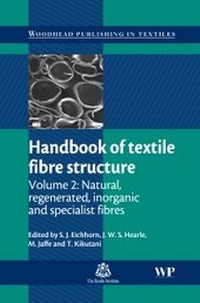
Handbook of Textile Fibre Structure
Volume 2: Natural, Regenerated, inorganic and Specialist Fibres
Published on 26. October 2009
Book
Hardback
536 pages
978-1-84569-730-3 (ISBN)
Description
Due to their complexity and diversity, understanding the structure of textile fibres is of key importance. This authoritative two-volume collection provides a comprehensive review of the structure of an extensive range of textile fibres.
Volume 2 begins by reviewing natural fibres such as cellulosic, cotton, protein, wool and silk fibres. Part two considers regenerated cellulosic, protein, alginate, chitin and chitosan fibres. The final part of the book discusses inorganic fibres such as glass, carbon and ceramic fibres as well as specialist fibres such as thermally and chemically-resistant fibres, optical and hollow fibres. Chapters review how fibre structure contributes to key mechanical properties. A companion volume reviews the structure of manufactured polymer fibres.
Edited by leading authorities on the subject and with a team of international authors, the two volumes of the Handbook of textile fibre structure is an essential reference for textile technologists, fibre scientists, textile engineers and those in academia.
Volume 2 begins by reviewing natural fibres such as cellulosic, cotton, protein, wool and silk fibres. Part two considers regenerated cellulosic, protein, alginate, chitin and chitosan fibres. The final part of the book discusses inorganic fibres such as glass, carbon and ceramic fibres as well as specialist fibres such as thermally and chemically-resistant fibres, optical and hollow fibres. Chapters review how fibre structure contributes to key mechanical properties. A companion volume reviews the structure of manufactured polymer fibres.
Edited by leading authorities on the subject and with a team of international authors, the two volumes of the Handbook of textile fibre structure is an essential reference for textile technologists, fibre scientists, textile engineers and those in academia.
More details
Series
Language
English
Place of publication
Cambridge
United Kingdom
Publishing group
Elsevier Science & Technology
Target group
College/higher education
Professional and scholarly
Dimensions
Height: 234 mm
Width: 156 mm
Weight
930 gr
ISBN-13
978-1-84569-730-3 (9781845697303)
Copyright in bibliographic data and cover images is held by Nielsen Book Services Limited or by the publishers or by their respective licensors: all rights reserved.
Schweitzer Classification
Other editions
Additional editions
Stephen Eichhorn | J. W. S. Hearle | M. Jaffe
Handbook of Textile Fibre Structure
Volume 2: Natural, Regenerated, inorganic and Specialist Fibres
E-Book
10/2009
Woodhead Publishing
€230.00
Available for download
Persons
Dr Stephen Eichhorn is Senior Lecturer in Polymer Physics and Biomaterials in the Materials Science Centre at the University of Manchester. He is a member of the ACS Cellulose and Renewable Materials Division and the Institute of Physics. J. W. S. Hearle, M.A., Sc.D., Ph.D., C.Text F.T.I (Hon.), F.Inst.P, is Emeritus Professor of Textile Technology in the University of Manchester, UK. Professor Michael Jaffe was with Celanese and Hoechst Celanese Research in the USA before leaving for the Biomedical Engineering Department at New Jersey Institute of Technology. Dr Takeshi Kikutani is a Professor in the Department of Organic and Polymeric Materials at the Tokyo Institute of Technology. He is a member of the Polymer Processing Society and The Society of Fiber Science and Technology, Japan.
Content
Part 1 Natural fibres: An introduction to cellulosic fibres; The structure of cotton and other plant fibres; An introduction to protein fibres; The structure and properties of wool and hair fibres; The structure of silk. Part 2 Regenerated natural fibres: The structure of man-made cellulosic fibres; Regenerated protein fibres: A review; The structure of alginate, chitin and chitosan fibres. Part 3 Manufactured non-polymer fibres: The structure and properties of glass fibres; The structure of carbon fibres; Processing, structure and properties of ceramic fibres; Structure and properties of asbestos; Thermally and chemically resistant textile fibres: Structure and properties; Structure, properties and characteristics of optical fibres; Production and applications of hollow fibers.