

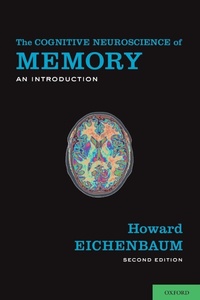
The Cognitive Neuroscience of Memory
An Introduction
2nd Edition
Published on 12. January 2012
Book
Paperback/Softback
428 pages
978-0-19-977861-4 (ISBN)
Description
This clear and accessible textbook introduces the brain's remarkable capacity for memory. The text was developed for undergraduate and beginning graduate students, but it will also be of use to cognitive scientists, biologists, and psychologists who seek an introduction to biological investigations of memory. Like the first edition, this fully-updated second edition begins with a history of memory research, starting with a 'Golden Era' at the turn of the 20th century, and progressing to our current understanding of the neurobiology of memory. Subsequent sections of the book discuss the cellular basis of memory, amnesia in humans and animals, the physiology of memory, declarative, procedural, and emotional memory systems, memory consolidation, and the control of memory by the prefrontal cortex.
The book is organized into four sections, which highlight the major themes of the text. The first theme is connection, which considers how memory is fundamentally based on alterations in the connectivity of neurons. This section of the book covers the most well studied models of cellular mechanisms of neural plasticity that may underlie memory. The second theme is cognition, which involves fundamental issues in the psychological structure of memory. This section of the book considers the competition among views on the nature of cognitive processes that underlie memory, and tells how the controversy was eventually resolved. The third theme is compartmentalization, which is akin to the classic problem of memory localization. However, unlike localization, the notion of "compartments" is intended to avoid the notion that particular memories are pigeon-holed into specific loci, and instead emphasize that different forms of memory are accomplished by distinct modules or brain systems. This section of the book surveys the evidence for multiple memory systems, and outlines how they are mediated by different brain structures and systems. The fourth and final theme is consolidation, the process by which memories are transformed from a labile trace into a permanent store.
This text encapsulates the major concepts in the field of memory research, and makes this area accessible to students who pursue a variety of related disciplines.
The book is organized into four sections, which highlight the major themes of the text. The first theme is connection, which considers how memory is fundamentally based on alterations in the connectivity of neurons. This section of the book covers the most well studied models of cellular mechanisms of neural plasticity that may underlie memory. The second theme is cognition, which involves fundamental issues in the psychological structure of memory. This section of the book considers the competition among views on the nature of cognitive processes that underlie memory, and tells how the controversy was eventually resolved. The third theme is compartmentalization, which is akin to the classic problem of memory localization. However, unlike localization, the notion of "compartments" is intended to avoid the notion that particular memories are pigeon-holed into specific loci, and instead emphasize that different forms of memory are accomplished by distinct modules or brain systems. This section of the book surveys the evidence for multiple memory systems, and outlines how they are mediated by different brain structures and systems. The fourth and final theme is consolidation, the process by which memories are transformed from a labile trace into a permanent store.
This text encapsulates the major concepts in the field of memory research, and makes this area accessible to students who pursue a variety of related disciplines.
Reviews / Votes
. . . a wonderful textbook for advanced undergraduate and graduate courses. This long-overdue, accessible summary of the main findings of a fast-evolving field is likely to influence students of memory for years to come . . . The book is an impressive combination of scholarship and accessibility. The author's elegant pen and mastery of the subject does justice to complex ideas . . . yet does not sacrifice clarity. * Nature Neuroscience, Vol 5, No 12 (from the previous edition) *More details
Edition
2nd Revised edition
Language
English
Place of publication
New York
United States
Target group
College/higher education
Professional and scholarly
Undergraduate and early stage graduate students studying cognitive neuroscience or memory, as well as cognitive scientists, biologists, and psychologists
Edition type
Revised edition
Illustrations
111 illustrations
Dimensions
Height: 234 mm
Width: 156 mm
Thickness: 24 mm
Weight
649 gr
ISBN-13
978-0-19-977861-4 (9780199778614)
Copyright in bibliographic data and cover images is held by Nielsen Book Services Limited or by the publishers or by their respective licensors: all rights reserved.
Schweitzer Classification
Other editions
Additional editions
E-Book
07/2011
2nd Edition
OUP eBook
€63.49
Available for download
Previous edition
Book
02/2002
Oxford University Press Inc
€37.14
Article exhausted; check for reprint
Person
Howard Eichenbaum is Director of the Center for Memory and Brain, the Cognitive Neurobiology Laboratory, and the Center for Neuroscience at Boston University
Author
University Professor, Director of the Center for Memory and Brain, Director of the Center for Neuroscience; and Director of the Undergraduate Program in NeuroscienceUniversity Professor, Director of the Center for Memory and Brain, Director of the Center for Neuroscience; and Director of the Undergraduate Program in Neuroscience, Boston University, Boston, MA, USA
Content
1. Introduction: Four themes in research on the neurobiology of memory ; Section I. Connection - The cellular and molecular bases of memory ; 2. Neurons and simple memory circuits ; 3. Cellular mechanisms of memory: Complex circuits ; Section II. Cognition - Is there a "cognitive" basis for memory? ; 4. Amnesia - learning about memory from memory loss ; 5. Exploring declarative memory in animal models ; 6. Windows into the workings of memory ; Section III. Compartmentalization - Cortical modules and multiple memory systems ; 7. The cerebral cortex and memory ; 8. Multiple memory systems in the brain ; 9. A brain system for declarative memory ; 10. A brain system for procedural memory ; 11. A brain system for emotional memory ; Section IV. Consolidation - The fixation and organization of memories ; 12. Two distinct stages of memory consolidation ; 13. Working with memory ; Final Thoughts ; Glossary ; Citations in figures