

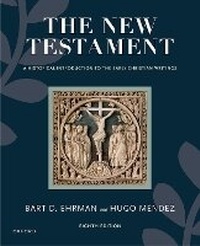
The New Testament
A Historical Introduction to the Early Christian Writings
8th Edition
Published on 17. March 2025
Book
Paperback/Softback
544 pages
978-0-19-775402-3 (ISBN)
Description
Featuring vibrant full color throughout, the eighth edition of Bart D. Ehrman's highly successful introduction approaches the New Testament from a consistently historical and comparative perspective, emphasizing the rich diversity of the earliest Christian literature. New to this edition, Hugo Mendez has brought fresh perspectives to the text. Distinctive to this study is The New Testament's unique focus on the historical, literary, and religious milieux of the Greco-Roman world, including early Judaism. As part of its historical orientation, the book also discusses other Christian writings that were roughly contemporary with the New Testament, such as the Gospel of Thomas, the Apocalypse of Peter, and the letters of Ignatius.
Reviews / Votes
The depth of the scholarship and the exhaustive content in The New Testament is impressive. The exploration of the New Testament documents from a historical and exegetical perspective is invaluable. Ehrman's writing style is engaging, conversationalist, and easy to follow. I can imagine him in a conversation with his students as he wrote the book. * William Rodriguez, Bethune Cookman University * Excellent. The book's main strengths are its impeccable scholarship and clarity of explanation. It's the only textbook I use in any course. * Corrie Norman, University of Wisconsin-Madison * The New Testament draws from a rich consultation with numerous resources, aptly distributed, so that Ehrman gives a nod to all parties, policies, and nuances. His prose style is substantive and accessible and his treatment of theological platforms is respectfully acknowledged. The book's advantage is its appeal to 21st-century students. * Doris Plantus, Oakland University * Ehrman and Mendez's new edition features an array of stunning full-colour images throughout and, as ever, includes a wide variety of maps, timelines and diagrams. Its text-box summaries and "Take a Stand" prompts for further discussion all combine to render this one of the most student-centred text-books on the market, and a must-have for those who teach courses in New Testament or Early Christianity. * Salvador Ryan, Irish Theological Quarterly *More details
Edition
8th Revised edition
Language
English
Place of publication
New York
United States
Edition type
Revised edition
Dimensions
Height: 235 mm
Width: 192 mm
Thickness: 23 mm
Weight
939 gr
ISBN-13
978-0-19-775402-3 (9780197754023)
Copyright in bibliographic data and cover images is held by Nielsen Book Services Limited or by the publishers or by their respective licensors: all rights reserved.
Schweitzer Classification
Persons
Bart D. Ehrman is James A. Gray Distinguished Professor of Religious Studies at the University of North Carolina at Chapel Hill. He has written or edited thirty-three books, including six New York Times best sellers. His publications include A Brief Introduction to the New Testament, Fifth Edition (2020) and After the New Testament, Second Edition (2014), both published by Oxford University Press.
Hugo Mendez is Assistant Professor of Religious Studies at the University of North Carolina at Chapel Hill, where he teaches New Testament and Early Christianity. He is the author of The Cult of Stephen in Jerusalem: Inventing a Patron Martyr (2016), published by Oxford University Press.
Hugo Mendez is Assistant Professor of Religious Studies at the University of North Carolina at Chapel Hill, where he teaches New Testament and Early Christianity. He is the author of The Cult of Stephen in Jerusalem: Inventing a Patron Martyr (2016), published by Oxford University Press.
Content
- Boxes
- Maps, Timelines, and Diagrams Preface
- Notes on Suggestions for Further Reading Resources for Instructors and Students Credits
- Master Timeline
- Introduction: Why Study the New Testament?
- 1. What Is the New Testament? The Early Christians and Their Literature
- The Diversity of Early Christianity
- The New Testament Canon of Scripture
- Implications for Our Study
- Excursus 1: Some Additional Reflections: The Historian and the Believer
- 2. Do We Have the Original New Testament?
- Publishing Books: Now and Then
- How Can We Know if We Have an Ancient Author's Actual Words?
- What Manuscripts of the New Testament Do We Have? The Good News and Bad News
- A Concrete Example
- Accidental Mistakes
- Intentional Errors
- Criteria for Establishing the Text
- Photo Essay 1: Ancient Manuscripts of the New Testament
- 3. The Greco-Roman World of Early Christian Traditions
- The Problem of Beginnings
- One Remarkable Life
- The Environment of the New Testament: Religions in the Greco-Roman World
- 4. The Jewish World of Jesus and His Followers
- Judaism as a Greco-Roman Religion
- Political Crises in Palestine and Their Ramifications
- The Formation of Jewish Groups
- 5. From Oral Traditions to Written Gospels
- Oral Traditions behind the Gospels
- The Earliest Christian Gospels
- The Question of Genre
- Biography as a Greco-Roman Genre
- The Gospels as Ancient Biographies
- Excursus 2: Some Additional Reflections: The Authors of the Gospels
- 6. Jesus, the Suffering Son of God: The Gospel According to Mark
- The Beginning of the Gospel: Jesus the Messiah, the Son of God Who Fulfills Scripture
- Jesus the Authoritative Son of God
- Jesus the Opposed Son of God J
- esus the Misunderstood Son of God
- Jesus the Acknowledged Son of God
- Jesus the Suffering Son of God
- Jesus the Crucified Son of God
- Jesus the Vindicated Son of God
- Conclusion: Mark and His Readers
- 7. The Synoptic Problem: Two Competing Views
- Evidence of Literary Copying
- Markan Priority
- The Relationship of Matthew and Luke
- Looking Ahead
- 8. Jesus, the Jewish Messiah: The Gospel According to Matthew
- The Importance of Beginnings: Jesus the Jewish Messiah in Fulfillment of the Jewish Scriptures
- Jesus and His Forerunner from Matthew's Perspective
- The Portrayal of Jesus in Matthew: The Sermon on the Mount as a Springboard
- Jesus and the Jewish Cultic Practices Prescribed by the Law
- Jesus Rejected by the Jewish Leaders
- Matthew and His Readers
- 9. Jesus, the Savior of the World: The Gospel According to Luke
- The Comparative Method and the Gospel of Luke
- A Comparative Overview of the Gospel
- The Preface to Luke's Gospel
- Luke's Birth Narrative in Comparative Perspective
- From Jew to Gentile: Luke's Portrayal of Jesus the Rejected Prophet
- Luke's Distinctive Emphases throughout His Gospel
- Conclusion: Luke in Comparative Perspective
- 10. Jesus, the Celestial Man: The Gospel According to John
- John versus the Synoptics
- The Teachings of Jesus and John
- Does the Author of John Know the Synoptics?
- John and Narrative Criticism
- Composing John
- Excursus 3: Methods of Ideological Criticism
- 11. From John's Jesus to the Gnostic Christ: The Johannine Epistles and Beyond
- The Questions of Genre
- The Epistles as "Johannine"
- The New Testament Epistles from a Contextual Perspective
- Reflections on the Contextual Method
- The Rise of Christian Gnosticism
- Major Views of Various Gnostic Groups
- The Gnostics and the Johannine Literature
- 12. Jesus from Different Perspectives: Other Gospels in Early Christianity
- Narrative Gospels
- Marcion's Gospel
- Sayings Gospels
- Infancy Gospels
- Passion Gospels
- Conclusion: The Other Gospels
- 13. The Historical Jesus: Sources, Problems, and Methods
- Problems with Sources
- Non-Christian Sources
- Christian Sources
- Using Our Sources: Some of the Basic Rules of Thumb
- Specific Criteria and Their Rationale
- Conclusion: Reconstructing the Life of Jesus
- Excursus 4: The Historian and the Problem of Miracles
- 14. Jesus in Context
- Popular Modes of Resistance to Oppression
- An Ideology of Resistance
- Jesus in His Apocalyptic Context
- Photo Essay 2: The Material World of Jesus and the Gospels
- 15. Jesus, the Apocalyptic Prophet
- The Apocalyptic Deeds of Jesus
- The Apocalyptic Teachings of Jesus
- The Apocalyptic Death of Jesus
- 16. From Jesus to the Gospels
- The Beginning of Christianity
- Jesus' Resurrection from an Apocalyptic Perspective
- Jesus' Death, According to the Scriptures
- The Emergence of Different Understandings of Jesus
- 17. Luke's Second Volume: The Acts of the Apostles
- The Genre of Acts and Its Significance
- The Thematic Approach to Acts
- From Gospel to Acts: The Opening Transition
- Themes in the Speeches in Acts
- Conclusion: The Author and His Themes in Context
- Excursus 5: The Author of Luke-Acts and His Audience
- 18. Paul the Apostle: The Man and His Mission
- The Study of Paul: Methodological Difficulties
- The Life of Paul
- 19. Paul and His Apostolic Mission: 1 Thessalonians as a Test Case
- The Founding of the Church in Thessalonica
- The Beginnings of the Thessalonian Church: A Socio-historical Perspective
- The Church at Thessalonica after Paul's Departure
- Conclusion: Paul the Apostle
- 20. Paul and the Crises of His Churches: 1 and 2 Corinthians, Galatians, Philippians, and Philemon
- 1 Corinthians
- 2 Corinthians
- Galatians
- Philippians
- Philemon
- 21. The Gospel According to Paul: The Letter to the Romans
- The Occasion and Purpose of the Letter
- The Theme of the Epistle
- Pauline Models for Salvation
- The Flow of Paul's Argument
- Conclusion: Paul and the Romans
- Photo Essay 3: The Cities and Roads of Paul
- 22. Does the Tradition Miscarry? Paul in Relation to Jesus, James, Thecla, and Theudas
- Paul in Relation to What Came Before
- Paul in Relation to What Came After
- Conclusion: Pauline Christianities
- 23. In the Wake of the Apostle: The Deutero-Pauline and Pastoral Epistles
- Pseudonymity in the Ancient World
- The Deutero-Pauline Epistles
- The Pastoral Epistles
- The Historical Situation and Authorship of the Pastoral Epistles
- Conclusion: The Post-Pauline Pastoral Epistles
- 24. From Paul's Female Colleagues to the Pastor's Intimidated Women: The Oppression of Women in Early Christianity
- Women in Paul's Churches
- Women Associated with Jesus
- Paul's Understanding of Women in the Church
- Women in the Aftermath of Paul
- Ancient Ideologies of Gender
- Gender Ideology and the Pauline Churches
- 25. Christians and Jews: Hebrews, Barnabas, and Later Anti-Jewish Literature
- Early Christian Self-Definition
- Continuity and Superiority: The Epistle to the Hebrews
- Discontinuity and Supremacy: The Epistle of Barnabas
- Conclusion: The Rise of Christian Anti-Judaism
- Excursus 6: The Digital Bible
- 26. Christians and Pagans: 1 Peter, the Letters of Ignatius, the Martyrdom of Polycarp, and Later Apologetic Literature
- The Persecution of the Early Christians
- Christians in a Hostile World: The Letter of 1 Peter
- Christians Sentenced to Death: The Letters of Ignatius
- Christians before the Tribunal: The Martyrdom of Polycarp
- Christians on the Defensive: The Later Apologetic Literature
- 27. Christians and Christians: James, the Didache, Polycarp, 1 Clement, Jude, and 2 Peter
- The Epistle of James
- The Didache
- Polycarp's Letter to the Philippians
- 1 Clement
- 2 Peter
- Conclusion: Conflicts within the Early Christian Communities
- 28. Christians and the Cosmos: The Revelation of John, The Shepherd of Hermas, and the Apocalypse of Peter
- Introduction: The End of the World and the Revelation of John
- The Content and Structure of the Book of Revelation
- The Book of Revelation from a Historical Perspective
- Apocalyptic Worldviews and the Apocalypse Genre The Revelation of John in Historical Context
- The Shepherd of Hermas
- The Apocalypse of Peter
- Excursus 7: Doing Research in Early Christianity: Sources and Tools
- Glossary of Terms
- Index
- Maps, Timelines, and Diagrams Preface
- Notes on Suggestions for Further Reading Resources for Instructors and Students Credits
- Master Timeline
- Introduction: Why Study the New Testament?
- 1. What Is the New Testament? The Early Christians and Their Literature
- The Diversity of Early Christianity
- The New Testament Canon of Scripture
- Implications for Our Study
- Excursus 1: Some Additional Reflections: The Historian and the Believer
- 2. Do We Have the Original New Testament?
- Publishing Books: Now and Then
- How Can We Know if We Have an Ancient Author's Actual Words?
- What Manuscripts of the New Testament Do We Have? The Good News and Bad News
- A Concrete Example
- Accidental Mistakes
- Intentional Errors
- Criteria for Establishing the Text
- Photo Essay 1: Ancient Manuscripts of the New Testament
- 3. The Greco-Roman World of Early Christian Traditions
- The Problem of Beginnings
- One Remarkable Life
- The Environment of the New Testament: Religions in the Greco-Roman World
- 4. The Jewish World of Jesus and His Followers
- Judaism as a Greco-Roman Religion
- Political Crises in Palestine and Their Ramifications
- The Formation of Jewish Groups
- 5. From Oral Traditions to Written Gospels
- Oral Traditions behind the Gospels
- The Earliest Christian Gospels
- The Question of Genre
- Biography as a Greco-Roman Genre
- The Gospels as Ancient Biographies
- Excursus 2: Some Additional Reflections: The Authors of the Gospels
- 6. Jesus, the Suffering Son of God: The Gospel According to Mark
- The Beginning of the Gospel: Jesus the Messiah, the Son of God Who Fulfills Scripture
- Jesus the Authoritative Son of God
- Jesus the Opposed Son of God J
- esus the Misunderstood Son of God
- Jesus the Acknowledged Son of God
- Jesus the Suffering Son of God
- Jesus the Crucified Son of God
- Jesus the Vindicated Son of God
- Conclusion: Mark and His Readers
- 7. The Synoptic Problem: Two Competing Views
- Evidence of Literary Copying
- Markan Priority
- The Relationship of Matthew and Luke
- Looking Ahead
- 8. Jesus, the Jewish Messiah: The Gospel According to Matthew
- The Importance of Beginnings: Jesus the Jewish Messiah in Fulfillment of the Jewish Scriptures
- Jesus and His Forerunner from Matthew's Perspective
- The Portrayal of Jesus in Matthew: The Sermon on the Mount as a Springboard
- Jesus and the Jewish Cultic Practices Prescribed by the Law
- Jesus Rejected by the Jewish Leaders
- Matthew and His Readers
- 9. Jesus, the Savior of the World: The Gospel According to Luke
- The Comparative Method and the Gospel of Luke
- A Comparative Overview of the Gospel
- The Preface to Luke's Gospel
- Luke's Birth Narrative in Comparative Perspective
- From Jew to Gentile: Luke's Portrayal of Jesus the Rejected Prophet
- Luke's Distinctive Emphases throughout His Gospel
- Conclusion: Luke in Comparative Perspective
- 10. Jesus, the Celestial Man: The Gospel According to John
- John versus the Synoptics
- The Teachings of Jesus and John
- Does the Author of John Know the Synoptics?
- John and Narrative Criticism
- Composing John
- Excursus 3: Methods of Ideological Criticism
- 11. From John's Jesus to the Gnostic Christ: The Johannine Epistles and Beyond
- The Questions of Genre
- The Epistles as "Johannine"
- The New Testament Epistles from a Contextual Perspective
- Reflections on the Contextual Method
- The Rise of Christian Gnosticism
- Major Views of Various Gnostic Groups
- The Gnostics and the Johannine Literature
- 12. Jesus from Different Perspectives: Other Gospels in Early Christianity
- Narrative Gospels
- Marcion's Gospel
- Sayings Gospels
- Infancy Gospels
- Passion Gospels
- Conclusion: The Other Gospels
- 13. The Historical Jesus: Sources, Problems, and Methods
- Problems with Sources
- Non-Christian Sources
- Christian Sources
- Using Our Sources: Some of the Basic Rules of Thumb
- Specific Criteria and Their Rationale
- Conclusion: Reconstructing the Life of Jesus
- Excursus 4: The Historian and the Problem of Miracles
- 14. Jesus in Context
- Popular Modes of Resistance to Oppression
- An Ideology of Resistance
- Jesus in His Apocalyptic Context
- Photo Essay 2: The Material World of Jesus and the Gospels
- 15. Jesus, the Apocalyptic Prophet
- The Apocalyptic Deeds of Jesus
- The Apocalyptic Teachings of Jesus
- The Apocalyptic Death of Jesus
- 16. From Jesus to the Gospels
- The Beginning of Christianity
- Jesus' Resurrection from an Apocalyptic Perspective
- Jesus' Death, According to the Scriptures
- The Emergence of Different Understandings of Jesus
- 17. Luke's Second Volume: The Acts of the Apostles
- The Genre of Acts and Its Significance
- The Thematic Approach to Acts
- From Gospel to Acts: The Opening Transition
- Themes in the Speeches in Acts
- Conclusion: The Author and His Themes in Context
- Excursus 5: The Author of Luke-Acts and His Audience
- 18. Paul the Apostle: The Man and His Mission
- The Study of Paul: Methodological Difficulties
- The Life of Paul
- 19. Paul and His Apostolic Mission: 1 Thessalonians as a Test Case
- The Founding of the Church in Thessalonica
- The Beginnings of the Thessalonian Church: A Socio-historical Perspective
- The Church at Thessalonica after Paul's Departure
- Conclusion: Paul the Apostle
- 20. Paul and the Crises of His Churches: 1 and 2 Corinthians, Galatians, Philippians, and Philemon
- 1 Corinthians
- 2 Corinthians
- Galatians
- Philippians
- Philemon
- 21. The Gospel According to Paul: The Letter to the Romans
- The Occasion and Purpose of the Letter
- The Theme of the Epistle
- Pauline Models for Salvation
- The Flow of Paul's Argument
- Conclusion: Paul and the Romans
- Photo Essay 3: The Cities and Roads of Paul
- 22. Does the Tradition Miscarry? Paul in Relation to Jesus, James, Thecla, and Theudas
- Paul in Relation to What Came Before
- Paul in Relation to What Came After
- Conclusion: Pauline Christianities
- 23. In the Wake of the Apostle: The Deutero-Pauline and Pastoral Epistles
- Pseudonymity in the Ancient World
- The Deutero-Pauline Epistles
- The Pastoral Epistles
- The Historical Situation and Authorship of the Pastoral Epistles
- Conclusion: The Post-Pauline Pastoral Epistles
- 24. From Paul's Female Colleagues to the Pastor's Intimidated Women: The Oppression of Women in Early Christianity
- Women in Paul's Churches
- Women Associated with Jesus
- Paul's Understanding of Women in the Church
- Women in the Aftermath of Paul
- Ancient Ideologies of Gender
- Gender Ideology and the Pauline Churches
- 25. Christians and Jews: Hebrews, Barnabas, and Later Anti-Jewish Literature
- Early Christian Self-Definition
- Continuity and Superiority: The Epistle to the Hebrews
- Discontinuity and Supremacy: The Epistle of Barnabas
- Conclusion: The Rise of Christian Anti-Judaism
- Excursus 6: The Digital Bible
- 26. Christians and Pagans: 1 Peter, the Letters of Ignatius, the Martyrdom of Polycarp, and Later Apologetic Literature
- The Persecution of the Early Christians
- Christians in a Hostile World: The Letter of 1 Peter
- Christians Sentenced to Death: The Letters of Ignatius
- Christians before the Tribunal: The Martyrdom of Polycarp
- Christians on the Defensive: The Later Apologetic Literature
- 27. Christians and Christians: James, the Didache, Polycarp, 1 Clement, Jude, and 2 Peter
- The Epistle of James
- The Didache
- Polycarp's Letter to the Philippians
- 1 Clement
- 2 Peter
- Conclusion: Conflicts within the Early Christian Communities
- 28. Christians and the Cosmos: The Revelation of John, The Shepherd of Hermas, and the Apocalypse of Peter
- Introduction: The End of the World and the Revelation of John
- The Content and Structure of the Book of Revelation
- The Book of Revelation from a Historical Perspective
- Apocalyptic Worldviews and the Apocalypse Genre The Revelation of John in Historical Context
- The Shepherd of Hermas
- The Apocalypse of Peter
- Excursus 7: Doing Research in Early Christianity: Sources and Tools
- Glossary of Terms
- Index