

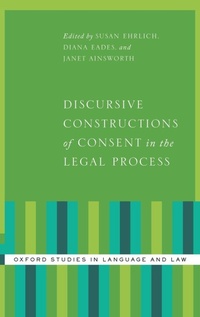
Discursive Constructions of Consent in the Legal Process
Published on 1. February 2016
Book
Hardback
344 pages
978-0-19-994535-1 (ISBN)
Description
As a linguistically-grounded, critical examination of consent, this volume views consent not as an individual mental state or act but as a process that is interactionally-and discursively-situated. It highlights the ways in which legal consent is often fictional (at best) due to the impoverished view of meaning and the linguistic ideologies that typically inform interpretations and representations in the legal system. The authors are experts in linguistics and law,
who use diverse theoretical and analytical approaches to examine the complex ways in which language is used to seek, negotiate, give, or withhold consent in a range of legal contexts.
Authors draw on case studies, or larger research corpora or a wider sociolegal approach, in investigations of: police-citizen interactions in the street, police interviews with suspects, police call handlers, rape and abduction trials, interactions with lay litigants in a multilingual small claims court, a restorative justice sentencing scheme for young offenders, biomedical research, and legal disputes over contracts.
who use diverse theoretical and analytical approaches to examine the complex ways in which language is used to seek, negotiate, give, or withhold consent in a range of legal contexts.
Authors draw on case studies, or larger research corpora or a wider sociolegal approach, in investigations of: police-citizen interactions in the street, police interviews with suspects, police call handlers, rape and abduction trials, interactions with lay litigants in a multilingual small claims court, a restorative justice sentencing scheme for young offenders, biomedical research, and legal disputes over contracts.
More details
Other editions
Additional editions
Susan Ehrlich | Diana Eades | Janet Ainsworth
Discursive Constructions of Consent in the Legal Process
E-Book
02/2016
1st Edition
OUP eBook
€53.49
Available for download
Susan Ehrlich | Diana Eades | Janet Ainsworth
Discursive Constructions of Consent in the Legal Process
E-Book
01/2016
1st Edition
OUP eBook
€53.49
Available for download
Persons
Susan Ehrlich is Professor of Linguistics at York University in Toronto.
Diana Eades is Adjunct Professor at University of New England.
Janet Ainsworth is the John D. Eshelman Professor of Law at Seattle University and Research Professor in the Research Center for Legal Translation at China University of Political Science and Law.
Diana Eades is Adjunct Professor at University of New England.
Janet Ainsworth is the John D. Eshelman Professor of Law at Seattle University and Research Professor in the Research Center for Legal Translation at China University of Political Science and Law.
Content
Chapter 1; Introduction: Linguistic and Discursive Dimensions of Consent; Susan Ehrlich and Diana Eades; Section 1: Free and voluntary consent; Chapter 2; Culture, cursing, and coercion: The impact of police officer swearing on the voluntariness of consent to search in police-citizen interactions; Janet Ainsworth; Chapter 3; Post-penetration rape: Coercion or freely-given consent?; Susan Ehrlich; Chapter 4; Erasing context in the courtroom construal of consent; Diana Eades; Section 2: Informed consent vs. ritualized consent; Chapter 5; Talking the ethical turn: Drawing on tick-box consent in policing; Frances Rock; Chapter 6; Transparent and opaque consent in contract formation; Lawrence Solan; Chapter 7; The empty performative?: Informed consent to genetic research; John Conley, R. Jean Cadigan and Arlene Davis; Section 3: The influence of discursive practices; Chapter 8; Promoting litigant consent to arbitration in multilingual small claims court; Philipp Sebastian Angermeyer; Chapter 9; Consent and compliance in youth justice conferences?; Michele Zappavigna, Paul Dwyer and J. R. Martin; Chapter 10; Non-consent and discursive resistance: Radical reformulation in a post-sting police interview; Philip Gaines; Section 4: The coercive force of cautions; Chapter 11; Totality of circumstances and translating the Miranda warnings; Susan Berk-Seligson; Chapter 12; Negotiating the right to remain silent in inquisitorial trials; Fleur van der Houwen and Guusje Jol; Chapter 13; 'No comment' responses to questions in police investigative interviews; Elizabeth Stokoe, Derek Edwards and Helen Edwards