

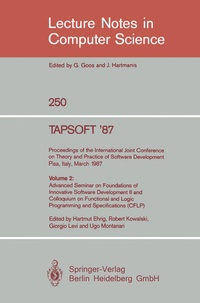
TAPSOFT '87: Proceedings of the International Joint Conference on Theory and Practice of Software Development, Pisa, Italy, March 23 - 27 1987
Volume 2: Advanced Seminar on Foundations of Innovative Software Development II and Colloquium on Functional and Logic Programming and Specifications (CFLP)
Published on 27. February 1987
Book
Paperback/Softback
XIV, 336 pages
978-3-540-17611-4 (ISBN)
Description
Models and equality for logical programming.- Fifth generation computer project: Current research activity and future plans.- A compositive abstraction algorithm for combinatory logic.- Linear logic and lazy computation.- The natural dynamic semantics of mini-Standard ML.- Listlog - A PROLOG extension for list processing.- Intensional negation of logic programs: Examples and implementation techniques.- Improving the execution speed of compiled Prolog with modes, clause selection, and determinism.- Simulation results of a multiprocessor PROLOG architecture based on a distributed and/or graph.- Generating efficient code from strictness annotations.- Hoisting: Lazy evaluation in a cold climate.- Inductive assertion method for logic programs.- Higher order generalization in program derivation.- Implementing algebraically specified abstract data types in an imperative programming language.- A declarative environment for concurrent logic programming.- Or-parallel execution models of Prolog.- Retractions: A functional paradigm for logic programming.- Refined strategies for semantic unification.- Extensional models for polymorphism.- A type discipline for program modules.- Theory and practice of canonical term functors in abstract data type specifications.
More details
Series
Edition
1987 ed.
Language
English
Place of publication
Berlin
Germany
Publishing group
Springer Berlin
Target group
Professional and scholarly
Research
Illustrations
XIV, 336 p.
Dimensions
Height: 235 mm
Width: 155 mm
Thickness: 20 mm
Weight
540 gr
ISBN-13
978-3-540-17611-4 (9783540176114)
DOI
10.1007/BFb0014968
Schweitzer Classification
Content
Models and equality for logical programming.- Fifth generation computer project: Current research activity and future plans.- A compositive abstraction algorithm for combinatory logic.- Linear logic and lazy computation.- The natural dynamic semantics of mini-Standard ML.- Listlog - A PROLOG extension for list processing.- Intensional negation of logic programs: Examples and implementation techniques.- Improving the execution speed of compiled Prolog with modes, clause selection, and determinism.- Simulation results of a multiprocessor PROLOG architecture based on a distributed and/or graph.- Generating efficient code from strictness annotations.- Hoisting: Lazy evaluation in a cold climate.- Inductive assertion method for logic programs.- Higher order generalization in program derivation.- Implementing algebraically specified abstract data types in an imperative programming language.- A declarative environment for concurrent logic programming.- Or-parallel execution models of Prolog.- Retractions: A functional paradigm for logic programming.- Refined strategies for semantic unification.- Extensional models for polymorphism.- A type discipline for program modules.- Theory and practice of canonical term functors in abstract data type specifications.