

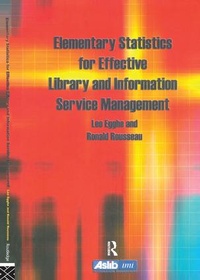
Elementary Statistics for Effective Library and Information Service Management
1st Edition
Published on 15. August 2017
Book
Hardback
128 pages
978-1-138-43941-2 (ISBN)
Description
This title describes how best to use statistical data to produce professional reports on library activities. The authors cover data gathering, sampling, graphical representation of data and summary statistics from data, and also include a section on trend analysis. A full bibliography and a subject index make this a key title for any information professional..
More details
Language
English
Place of publication
London
United Kingdom
Publishing group
Taylor & Francis Ltd
Target group
College/higher education
Dimensions
Height: 234 mm
Width: 156 mm
Weight
453 gr
ISBN-13
978-1-138-43941-2 (9781138439412)
Copyright in bibliographic data and cover images is held by Nielsen Book Services Limited or by the publishers or by their respective licensors: all rights reserved.
Schweitzer Classification
Other editions
Additional editions
Leo Egghe | Ronald Rousseau
Elementary Statistics for Effective Library and Information Service Management
E-Book
09/2003
1st Edition
Routledge
€78.99
Available for download
Leo Egghe | Ronald Rousseau
Elementary Statistics for Effective Library and Information Service Management
E-Book
09/2003
1st Edition
Routledge
€78.99
Available for download
Leo Egghe | Ronald Rousseau
Elementary Statistics for Effective Library and Information Service Management
Book
02/2001
1st Edition
Europa Publications Ltd
€85.30
Shipment within 3-4 weeks
Persons
Leo Egghe, Ronald Rousseau
Content
Introduction Part 1: Information about the library 1.1 Reports 1.2 Data gathering 1.3Data gathering in an electronic environment 1.4 Complete and incomplete data 1.5 How to sample 1.5.1 Random sampling 1.5.2 Systematic sampling 1.5.3 The Fussler sampling method 1.5.4 Structural sampling 1.6 What to sample 1.6.1 Collection 1.6.2 User Services 1.6.3 Automation and catalogue aspects 1.6.4 The personal 1.6.5 External relations 1.6.6 Budgets 1.6.7 Data on companies involved in the library's activities 1.7 Measuring scales 1.7.1 Normal scale 1.7.2 Rank order scale 1.7.3 Interval scale 1.7.4 Difference and ratio scales 1.7.5 Absolute scale Part 2: Descriptive statistics 2.1 Graphical aspects of data 2.1.1 Mathematical functions 2.1.2 Graphical representation of data 2.1.3 Problems with graphical representation 2.1.4 Scatterplots and regression lines 2.2 Measuring central tendencies and irregularity of data 2.2.1 The mean of average 2.2.2 The variance and the standard deviation 2.2.3 Median, quartile, percentile 2.2.4 Applications: box-whisker plots, 80/20 rule, Lorenz curves 2.2.5 Calculation of the equation of the regression line Part 3: Inferential statistics 3.1 Goal of part 3 3.2 First test for the mean: one sample and one set of measurements 3.3 Consequence of the first test of the mean: confidence intervals for the population mean ? 3.4 Second test for the mean: one sample but with two sets of measurements 3.5Third test for the mean: two samples 3.6 Sample sizes 3.6.1 Rough Argument 3.6.2 Logical correction and refinement 3.7Confidence intervals and sample sizes for multinomial fractions 3.7.1 Introduction 3.7.2 The correct method for determining multinomial confidence intervals 3.7.3 Sample sizes for multinomial confidence intervals 3.8 Epilogue: test for the quality of regression line of a scatterplot - the correlation coefficient Conclusion Appendix 1. Table of random number Appendix 2. Logic of calculations Appendix 3. Basic arithmetic on pocket calculators Appendix 4. List of notation Bibliography Subject Index