

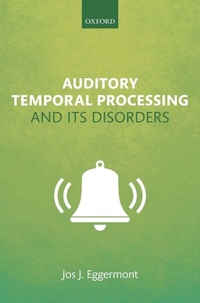
Auditory Temporal Processing and its Disorders
Published on 30. April 2015
Book
Hardback
368 pages
978-0-19-871909-0 (ISBN)
Description
'Auditory temporal processing' determines our understanding of speech, our appreciation of music, our ability to localize a sound source, and even to listen to a person in a noisy crowd.
Sound is dynamic and as such has temporal and spectral content. In disorders such as auditory neuropathy and MS, problems can occur with these temporal representations of sound, leading to a mismatch between auditory sensitivity and speech discrimination. In dyslexia, specific language impairment, and auditory processing disorders, similar problems occur early in life and set up additional cognitive speech processing problems. It has also been found that in disorders such as autism, schizophrenia and epilepsy, temporal processing deficits can occur.
This book reviews comprehensively the mechanisms for temporal processing in the auditory system, looking at how these underlie specific clinical disorders, with implications for their treatment. Written by a prolific researcher in auditory neuroscience, this book is valuable for auditory neuroscientists, audiologist, neurologists, and speech language pathologists.
Sound is dynamic and as such has temporal and spectral content. In disorders such as auditory neuropathy and MS, problems can occur with these temporal representations of sound, leading to a mismatch between auditory sensitivity and speech discrimination. In dyslexia, specific language impairment, and auditory processing disorders, similar problems occur early in life and set up additional cognitive speech processing problems. It has also been found that in disorders such as autism, schizophrenia and epilepsy, temporal processing deficits can occur.
This book reviews comprehensively the mechanisms for temporal processing in the auditory system, looking at how these underlie specific clinical disorders, with implications for their treatment. Written by a prolific researcher in auditory neuroscience, this book is valuable for auditory neuroscientists, audiologist, neurologists, and speech language pathologists.
Reviews / Votes
I strongly recommend this book to everyone working on the auditory system and related disorders * Sabine Joseph, University College London, in 'Perception', Vol. 44 (12), 2015 *More details
Language
English
Place of publication
Oxford
United Kingdom
Target group
College/higher education
Dimensions
Height: 250 mm
Width: 175 mm
Thickness: 28 mm
Weight
1124 gr
ISBN-13
978-0-19-871909-0 (9780198719090)
Copyright in bibliographic data and cover images is held by Nielsen Book Services Limited or by the publishers or by their respective licensors: all rights reserved.
Schweitzer Classification
Other editions
Additional editions
Jos J. Eggermont
Auditory Temporal Processing and its Disorders
E-Book
04/2015
1st Edition
OUP eBook
€122.99
Available for download
Jos J. Eggermont
Auditory Temporal Processing and its Disorders
E-Book
04/2015
1st Edition
OUP eBook
€122.99
Available for download
Person
Jos Eggermont was born in The Netherlands, and was educated at Leiden University (MSc in 1967, PhD in 1972, both in Physics). In 1978 he became Professor in experimental physics at Nijmegen University. In 1986 he became Professor at the University of Calgary, Canada in the Department of Psychology. In 1997 he was named Campbell McLaurin Chair for Hearing Deficiencies and joined the Department of Physiology and Pharmacology. In 1989 he was elected in the Royal Netherlands Academy of Arts and Sciences, in 1998 he was elected Fellow of the Acoustical Society of America, and in 2014 he was elected Fellow of the Royal Society of Canada.
Content
1. Introduction ; 2. Stimulus onsets and echoes ; 3. Adaptation and forward masking ; 4. Gap-detection and voice-onset-time ; 5. Temporal modulation transfer functions ; 6. Modeling temporal processing ; 7. Correlation, coincidence and synchrony ; 8. Periodicity pitch ; 9. Binaural hearing and sound localization ; 10. Stream segregation and cocktail parties ; 11. Maturation and aging ; 12. Hearing loss and temporal processing ; 13. Auditory neuropathy and multiple sclerosis ; 14. Dyslexia, specific language impairment, and auditory processing disorder ; 15. General neurological disorders with temporal processing deficits ; 16. Multimodal interactions and auditory temporal processing