

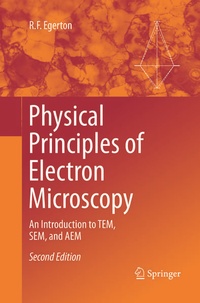
Physical Principles of Electron Microscopy
An Introduction to TEM, SEM, and AEM
2nd Edition
Published on 30. May 2018
Book
Paperback/Softback
XI, 196 pages
978-3-319-81986-0 (ISBN)
Description
This popular textbook provides an introduction to the theory and practice of electron microscopy. The second edition has been updated to reflect the recent developments, including correction of lens aberrations in a TEM column and new material on environmental TEM and SEM. The text is linked to a new website that contains additional educational material such as sample exam questions and answers to selected problems. This edition also contains expanded reference lists that allow the reader to efficiently explore key topics in greater depth.
Scanning and fixed-beam electron microscopes are an indispensable tool for both research and routine evaluation in the physical, biological and medical sciences, including specialized fields in materials science, nanotechnology and semiconductor processing. Physical Principles of Electron Microscopy, Second Edition , is ideal for students, researchers, and technologists who make use of electron microscopes buthave only a limited knowledge of physics and mathematics. Undergraduate students will understand how basic principles of physics are utilized in this important area of applied science, while university teachers and researchers will find a concise but authoritative teaching, supplemental, or reference text covering the basic principles and practice of microscopy.
Scanning and fixed-beam electron microscopes are an indispensable tool for both research and routine evaluation in the physical, biological and medical sciences, including specialized fields in materials science, nanotechnology and semiconductor processing. Physical Principles of Electron Microscopy, Second Edition , is ideal for students, researchers, and technologists who make use of electron microscopes buthave only a limited knowledge of physics and mathematics. Undergraduate students will understand how basic principles of physics are utilized in this important area of applied science, while university teachers and researchers will find a concise but authoritative teaching, supplemental, or reference text covering the basic principles and practice of microscopy.
More details
Edition
Softcover reprint of the original 2nd ed. 2016
Language
English
Place of publication
Cham
Switzerland
Publishing group
Springer International Publishing
Edition type
Revised edition
Illustrations
109 s/w Abbildungen, 15 farbige Abbildungen
XI, 196 p. 124 illus., 15 illus. in color.
Dimensions
Height: 235 mm
Width: 155 mm
Thickness: 12 mm
Weight
324 gr
ISBN-13
978-3-319-81986-0 (9783319819860)
DOI
10.1007/978-3-319-39877-8
Schweitzer Classification
Other editions
Additional editions
Book
07/2016
2nd Edition
Springer
€96.29
Shipment within 10-15 days
Person
Ray Egerton is Professor Emeritus of Physics at the University of Alberta and at Portland State University. He serves as the Physical Sciences Editor for
Micron
, The International Research and Review Journal for Microscopy.
Prof. Egerton has published 90 full papers in refereed journals and is the author of Electron Energy-Loss Spectroscopy in the Electron Microscope, (3rd Edition, 2011, Springer). His awards include the Presidential Science Award from the Microbeam Analysis Society, the Distinguished Scientist Award from the Microscopy Society of America, and the Frances Doane Award for service to the Microscopical Society of Canada. He is a fellow of the Royal Society of Canada.
Prof. Egerton has published 90 full papers in refereed journals and is the author of Electron Energy-Loss Spectroscopy in the Electron Microscope, (3rd Edition, 2011, Springer). His awards include the Presidential Science Award from the Microbeam Analysis Society, the Distinguished Scientist Award from the Microscopy Society of America, and the Frances Doane Award for service to the Microscopical Society of Canada. He is a fellow of the Royal Society of Canada.
Content
An Introduction to Microscopy.- Electron Optics.- The Transmission Electron Microscope.- TEM Specimens and Images.- The Scanning Electron Microscope.- Analytical Electron Microscopy.- Special Topics.- Appendix: Mathematical Derivations.