

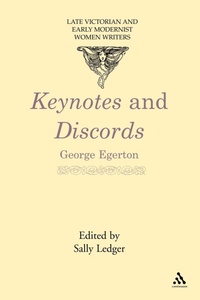
Keynotes and Discords
Late Victorian and Early Modernist Women Writers
Published on 21. October 2003
Book
Paperback/Softback
196 pages
978-0-8264-8185-6 (ISBN)
Description
George Egerton was the pen name of Mary Chavelita Dunne (1859-1945). She was the most substantial and striking of the women writers of the fin de siècle who developed the modern short story, with its focus on the 'psychological moment', its exploration of the interior landscapes of human experience, and its only sporadic commitment to a realist aesthetic. This volume contains her two best collections of short stories, Keynotes (1893) and Discords (1895).
An incipient modernism can clearly be identified in her stories: there is a recurrent focus on the inner consciousness of their female subjects, revealed through reverie or dream, or through intense moments of psychological and emotional connection. The stories are full of wanderers, and have the sense of dislocation characteristic of literary modernism; their compression and resistance to narrative closure confirm their alignment with the emergent aesthetic. Coupled with this aesthetic experimentation are explorations of female sexual desire, new gender identities and the pains and pleasures of maternity. Thirty years before Virginia Woolf's annunciation of modernism in the 1920s, when she presented this 'new' aesthetic movement as an abrupt break with a worn-out nineteenth-century realism. George Egerton had penetrated the emotional and psychological tragedies of apparently unexceptional women's lives and powerfully translated these tragedies into fiction. She forged a new way of expressing women's experience: her status as an important and compelling writer is indisputable.
An incipient modernism can clearly be identified in her stories: there is a recurrent focus on the inner consciousness of their female subjects, revealed through reverie or dream, or through intense moments of psychological and emotional connection. The stories are full of wanderers, and have the sense of dislocation characteristic of literary modernism; their compression and resistance to narrative closure confirm their alignment with the emergent aesthetic. Coupled with this aesthetic experimentation are explorations of female sexual desire, new gender identities and the pains and pleasures of maternity. Thirty years before Virginia Woolf's annunciation of modernism in the 1920s, when she presented this 'new' aesthetic movement as an abrupt break with a worn-out nineteenth-century realism. George Egerton had penetrated the emotional and psychological tragedies of apparently unexceptional women's lives and powerfully translated these tragedies into fiction. She forged a new way of expressing women's experience: her status as an important and compelling writer is indisputable.
More details
Language
English
Place of publication
London
United Kingdom
Publishing group
Bloomsbury Publishing PLC
Product notice
Paperback (trade)
Illustrations
black & white illustrations
Dimensions
Height: 234 mm
Width: 156 mm
Thickness: 11 mm
Weight
307 gr
ISBN-13
978-0-8264-8185-6 (9780826481856)
Copyright in bibliographic data and cover images is held by Nielsen Book Services Limited or by the publishers or by their respective licensors: all rights reserved.
Schweitzer Classification
Persons
Sally Ledger is a Reader in Nineteenth-Century Literature in the School of English and Humanities at Birkbeck College, University of London.