

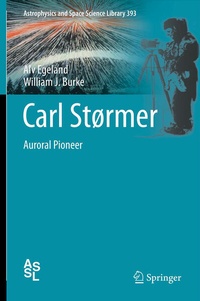
Carl Størmer
Description
This biography summarizes the seminal contributions to auroral and space science of Carl Størmer (1874 - 1957). He was the first to develop precise photographic methods to calculate heights and morphologies of diverse auroral forms during four solar cycles. Størmer independently devised numerical techniques to determine the trajectories of high-energy charged particles allowed and forbidden in the Earth's magnetic field. His theoretical analyses explained cosmic ray access to the upper atmosphere, 20 years before they were identified by other scientists. Størmer's crowning achievement, "The Polar Aurora," published when he was 81 years old, stands to this day as a regularly cited guide in graduate-level courses on space physics.
The authors present the life of this prodigious scientist in relation to the cultural life of early 20th century in Norway and to the development of the space sciences in the post-Sputnik era.
Reviews / Votes
From the book reviews:
"The authors give a detailed account of his early life, his parents, and Størmer's growing interest in mathematics, astronomy, and botany. . for those who have seen, or harbour hopes of seeing, the lights in the northern sky, this is a book worth reading as it will infect the reader with some of Størmer's magic and will make the experience so much more meaningful." (Ken Kennedy, The Observatory, Vol. 134 (1242), October, 2014)More details
Other editions
Additional editions
Persons
Dr. William J. Burke got his Ph.D. in 1971 from MIT. During his scientific career he lead several teams for satellite experiments. He authored or co-authored about 300 scientific publications.
Content
Preface.- 1 Introduction.- 2 Carl Størmer's Origins.- 3 Størmer's Auroral Studies.- 4 Mother-of-Pearl-, Noctilucent Clouds, Comets and Metors.- 5 Botanical Interests.- 6 Mathematical Analyses.- 7 Cooperation and conflict with Kristian Birkeland.- 8 Størmer the Man.- 9 The Størmer Family.- 10 Størmer's Accomplishments: In Retrospect.- 11 Carl Størmer's publications, biographies, and other sources. Appendix 1 Størmer's Trajectory Analyses.- Appendix 2 Auroral Height and Position Orientations.- Bibliography.- Index of names.