

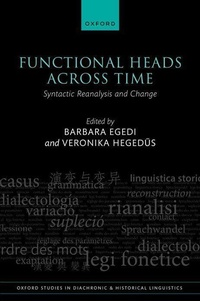
Functional Heads Across Time
Syntactic Reanalysis and Change
Published on 4. July 2022
Book
Hardback
302 pages
978-0-19-887153-8 (ISBN)
Description
This volume explores the role that functional elements play in syntactic change and investigates the semantic and functional features that are the driving force behind those changes. Structural developments are explained in terms of the reanalysis of parts of the functional sequences in the clausal, nominal, and adpositional domains, through changes in parameter settings and feature specifications. The chapters discuss 'microdiachronic' syntactic changes that often have implications for large-scale syntactic effects, such as word order variation, the emergence (and lexicalization) of syntactic projections, grammaticalization, and changes in information-structural properties. The volume contains both case studies of individual languages, such as German, Hungarian, and Romanian, and detailed investigations of cross-linguistic phenomena, based primarily on digital corpora of historical and dialectal data.
More details
Series
Language
English
Place of publication
Oxford
United Kingdom
Target group
Professional and scholarly
Product notice
sewn/stitched
Cloth over boards
Dimensions
Height: 237 mm
Width: 160 mm
Thickness: 23 mm
Weight
626 gr
ISBN-13
978-0-19-887153-8 (9780198871538)
Copyright in bibliographic data and cover images is held by Nielsen Book Services Limited or by the publishers or by their respective licensors: all rights reserved.
Schweitzer Classification
Other editions
Additional editions
E-Book
06/2022
1st Edition
OUP eBook
€62.99
Available for download
Persons
Barbara Egedi is Senior Research Fellow at the Hungarian Research Centre for Linguistics. She has published several papers on the noun phrase structures of Old and Middle Hungarian as well as Ancient Egyptian and Coptic. Her major interests are changes in definiteness marking and possessive constructions, grammaticalization, and the comparative syntax of Uralic languages.
Veronika Hegedues is Senior Research Fellow at the Hungarian Research Centre for Linguistics. She has worked on the structure and grammaticalization of adpositions and verbal particles in Hungarian, and on the syntactic properties of non-verbal primary and secondary predicates. Her main interests include the syntax of adpositions, grammaticalization, and word order change, as well as the structure of copular clauses.
Veronika Hegedues is Senior Research Fellow at the Hungarian Research Centre for Linguistics. She has worked on the structure and grammaticalization of adpositions and verbal particles in Hungarian, and on the syntactic properties of non-verbal primary and secondary predicates. Her main interests include the syntax of adpositions, grammaticalization, and word order change, as well as the structure of copular clauses.
Content
1: Barbara Egedi and Veronika Hegedues: The role of functional heads in syntactic change
2: Lieven Danckaert: Changing patterns of clausal complementation in Latin: A parametric approach to 'constructional' changes
3: Adina Dragomirescu and Virginia Hill: From split to remerged Fin in Romanian supine complements
4: Ana Maria Martins, Sandra Pereira, and Clara Pinto: The diachronic path of senao: From conditional subordination to exceptive coordination
5: Emanuela Sanfelici, Jacopo Garzonio, and Cecilia Poletto: On Italian relative complementizers and relative pronouns: Rethinking grammaticalization
6: Julia Bacskai-Atkari: Information structure, functional left peripheries, and the history of a Hungarian interrogative marker
7: Eric Haeberli and Tabea Ihsane: The recategorization of modals in English: Evidence from adverb placement
8: Ida Larsson and Ellen Brandner: Tense recursion, perfect doubling, and the grammaticalization of auxiliaries
9: Johannes Gisli Jonsson and Brynhildur Stefansdottir: P-incorporation in the history of Icelandic
10: Heimir F. Vi?arsson: From Old to Modern Icelandic: Dative applicatives and NP/DP configurationality
2: Lieven Danckaert: Changing patterns of clausal complementation in Latin: A parametric approach to 'constructional' changes
3: Adina Dragomirescu and Virginia Hill: From split to remerged Fin in Romanian supine complements
4: Ana Maria Martins, Sandra Pereira, and Clara Pinto: The diachronic path of senao: From conditional subordination to exceptive coordination
5: Emanuela Sanfelici, Jacopo Garzonio, and Cecilia Poletto: On Italian relative complementizers and relative pronouns: Rethinking grammaticalization
6: Julia Bacskai-Atkari: Information structure, functional left peripheries, and the history of a Hungarian interrogative marker
7: Eric Haeberli and Tabea Ihsane: The recategorization of modals in English: Evidence from adverb placement
8: Ida Larsson and Ellen Brandner: Tense recursion, perfect doubling, and the grammaticalization of auxiliaries
9: Johannes Gisli Jonsson and Brynhildur Stefansdottir: P-incorporation in the history of Icelandic
10: Heimir F. Vi?arsson: From Old to Modern Icelandic: Dative applicatives and NP/DP configurationality