

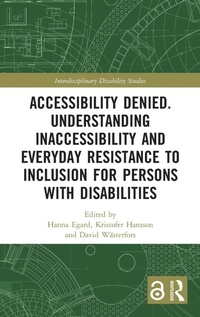
Accessibility Denied. Understanding Inaccessibility and Everyday Resistance to Inclusion for Persons with Disabilities
1st Edition
Published on 10. November 2021
Book
Hardback
218 pages
978-0-367-63728-6 (ISBN)
Description
This book explores the societal resistance to accessibility for persons with disabilities, and tries to set an example of how to study exclusion in a time when numerous policies promise inclusion.
With 12 chapters organised in three parts, the book takes a comprehensive approach to accessibility, covering transport and communication, knowledge and education, law and organisation. Topics within a wide cross-disciplinary field are covered, including disability studies, social work, sociology, ethnology, social anthropology, and history. The main example is Sweden, with its implementation of the United Nations Convention on the Rights of Persons with Disabilities within the context of the Nordic welfare state. By identifying and discussing persistent social and cultural conditions as well as recurring situations and interactions that nurture resistance to advancing accessibility, despite various strong laws promoting it, the book's conclusions are widely transferable. It argues for the value of alternating between methods, theoretical perspectives, and datasets to explore how new arenas, resources and technologies cause new accessibility concerns - and possibilities - for persons living with impairments. We need to be able to follow actors closely to uncover how they feel, act, and argue, but also to connect to wider discursive and institutional patterns and systems.
This book will be of interest to scholars and students of disability studies, social work, sociology, ethnology, social anthropology, political science, and organisation studies.
With 12 chapters organised in three parts, the book takes a comprehensive approach to accessibility, covering transport and communication, knowledge and education, law and organisation. Topics within a wide cross-disciplinary field are covered, including disability studies, social work, sociology, ethnology, social anthropology, and history. The main example is Sweden, with its implementation of the United Nations Convention on the Rights of Persons with Disabilities within the context of the Nordic welfare state. By identifying and discussing persistent social and cultural conditions as well as recurring situations and interactions that nurture resistance to advancing accessibility, despite various strong laws promoting it, the book's conclusions are widely transferable. It argues for the value of alternating between methods, theoretical perspectives, and datasets to explore how new arenas, resources and technologies cause new accessibility concerns - and possibilities - for persons living with impairments. We need to be able to follow actors closely to uncover how they feel, act, and argue, but also to connect to wider discursive and institutional patterns and systems.
This book will be of interest to scholars and students of disability studies, social work, sociology, ethnology, social anthropology, political science, and organisation studies.
More details
Series
Language
English
Place of publication
London
United Kingdom
Publishing group
Taylor & Francis Ltd
Target group
College/higher education
Illustrations
7 s/w Abbildungen, 7 s/w Photographien bzw. Rasterbilder
7 Halftones, black and white; 7 Illustrations, black and white
Dimensions
Height: 240 mm
Width: 161 mm
Thickness: 17 mm
Weight
517 gr
ISBN-13
978-0-367-63728-6 (9780367637286)
Copyright in bibliographic data and cover images is held by Nielsen Book Services Limited or by the publishers or by their respective licensors: all rights reserved.
Schweitzer Classification
Other editions
Additional editions
Hanna Egard | Kristofer Hansson | David Waesterfors
Accessibility Denied. Understanding Inaccessibility and Everyday Resistance to Inclusion for Persons with Disabilities
Book
05/2023
1st Edition
Routledge
€65.20
Shipment within 15-20 days
Hanna Egard | Kristofer Hansson | David Waesterfors
Accessibility Denied. Understanding Inaccessibility and Everyday Resistance to Inclusion for Persons with Disabilities
E-Book
11/2021
1st Edition
Routledge
€0.00
Available for download
Hanna Egard | Kristofer Hansson | David Waesterfors
Accessibility Denied. Understanding Inaccessibility and Everyday Resistance to Inclusion for Persons with Disabilities
E-Book
11/2021
1st Edition
Routledge
€0.00
Available for download
Persons
Hanna Egard is Senior Lecturer in the Department of Social Work, Malmoe University, Sweden.
Kristofer Hansson is Senior Lecturer and Associate Professor in the Department of Social Work, Malmoe University, Sweden.
David Waesterfors is Professor of Sociology in the Department of Sociology, Lund University, Sweden.
Kristofer Hansson is Senior Lecturer and Associate Professor in the Department of Social Work, Malmoe University, Sweden.
David Waesterfors is Professor of Sociology in the Department of Sociology, Lund University, Sweden.
Content
Introduction: Into the fields of stubborn obstacles and lingering exclusion. Part 1 - City and transport. 1. Accessible enough? Legitimising half-measures of accessibility in Swedish urban environments. 2. The bus trip: Constraints, hierarchies and injustice. 3. Monitoring the standard - here, now and in person: Detecting accessibility faults as an engaged citizen. 4. Traveling insecurely: The association of security and accessibility in public transport. Part 2 - Knowledge and education. 5. Struggles for inclusion: The unrecognised toil of hearing-impaired students. 6. Gatekeepers and gatekeeping: On participation and marginalisation in everyday life. 7. Still waiting for the hand to be raised: On being crip killjoys at an ableist university. 8. Access to sexuality: Disabled people's experiences of multiple barriers. 9. New barriers and new possibilities: Confronting language inaccessibility in and around a pandemic. Part 3 - Institution, law and history. 10. It is supposed to be a home: Barriers to everyday life decisions in group homes. 11. Making the law invisible: How bureaucratic resistance makes support inaccessible. 12. Using building requirements as a means to create inclusion: Accessibility and usability at a crossroads. Afterword.