

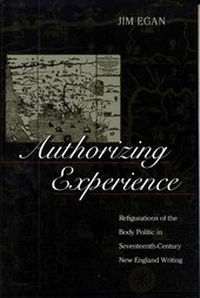
Authorizing Experience
Refigurations of the Body Politic in Seventeenth-Century New England Writing
Published on 25. April 1999
Book
Hardback
184 pages
978-0-691-05949-5 (ISBN)
Description
The emphasis on practical experience over ideology is viewed by many historians as a profoundly American characteristic, one that provides a model for exploring the colonial challenge to European belief systems and the creation of a unique culture. Here, Jim Egan offers an unprecedented look at how early modern American writers helped make this notion of experience so powerful that we now take it as a given rather than as the product of hard-fought rhetorical battles waged over ways of imagining one's relationship to a larger social community. In order to show how our modern notion of experience emerges from a historical change that experience itself could not have brought about, he turns to works by seventeenth-century writers in New England and reveals the ways in which they authorized experience, ultimately producing a rhetoric distinctive to the colonies and supportive of colonialism. Writers such as John Smith, William Wood, John Winthrop, Anne Bradstreet, Benjamin Tompson, and William Hubbard were sensitive to the challenge experiential authority posed to established social hierarchies.
Egan argues that they used experience to authorize a supplementary status system that would at once enhance England's economic, political, and spiritual status and provide a new basis for regulating English and native populations. These writers were assuaging fears over how exposure to alien environments threatened actual English bodies and also the imaginary body that authorized English monarchy and allowed English subjects to think of themselves as a nation. By reimagining the English nation, these supporters of English colonialism helped create a modern way of imagining national identity and individual subject formation.
Egan argues that they used experience to authorize a supplementary status system that would at once enhance England's economic, political, and spiritual status and provide a new basis for regulating English and native populations. These writers were assuaging fears over how exposure to alien environments threatened actual English bodies and also the imaginary body that authorized English monarchy and allowed English subjects to think of themselves as a nation. By reimagining the English nation, these supporters of English colonialism helped create a modern way of imagining national identity and individual subject formation.
Reviews / Votes
Learned and well documented... Many have embarked on the long, complex quest to define what is peculiarly American. Egan contributes by describing the Colonial writers' preference for experience over theory. ChoiceMore details
Language
English
Place of publication
New Jersey
United States
Target group
Professional and scholarly
College/higher education
Product notice
Trade binding
Dimensions
Height: 229 mm
Width: 152 mm
Weight
482 gr
ISBN-13
978-0-691-05949-5 (9780691059495)
Copyright in bibliographic data and cover images is held by Nielsen Book Services Limited or by the publishers or by their respective licensors: all rights reserved.
Schweitzer Classification
Other editions
Additional editions
James Egan
Authorizing Experience
Refigurations of the Body Politic in Seventeenth-Century New England Writing
E-Book
04/1999
1st Edition
Princeton University Press
€56.49
Available for download
Person
Jim Egan is Associate Professor of English at Brown University.
Content
ACKNOWLEGMENTS ix INTRODUCTION Inverting American Experience 3 CHAPTER ONE How the English Body Becomes That of the English Nation 14 CHAPTER TWO The Man of Experience 32 CHAPTER THREE A Body That Works 47 CHAPTER FOUR Discipline and Disinfect 66 CHAPTER FIVE The Insignificance of Experience 82 CHAPTER SIX A National Experience 95 NOTES 121 BIBLIOGRAPHY 161 INDEX 179